Nervous system regulation: what actually works (and what the neurowellness trend gets wrong)


“Nervous system regulation” has moved from the therapy room to the front of every wellness feed. The Global Wellness Summit named neurowellness its number one trend for 2026, the #nervoussystemhealing tag on TikTok carries well over 200,000 videos, and every second reel promises to reset your vagus nerve in thirty seconds.
I teach yoga, I trained in Yoga Nidra, and I came to the practice during a rough stretch of my own life, so I have a stake in this being taken seriously rather than sold cheaply. This guide covers what regulation actually means, how to tell when yours is off, the handful of practices with real evidence behind them, and a ten-minute routine you can do tonight.
Quick answer
What nervous system regulation actually means
Your autonomic nervous system runs everything you do not think about: heart rate, digestion, breathing, blood pressure. It has two main branches. The sympathetic branch is the accelerator, mobilising you for action. The parasympathetic branch is the brake, and its main channel is the vagus nerve, which runs from the brainstem to the heart, lungs and gut.
A regulated nervous system is not a calm one. It is one that can get activated when something needs your attention and come back down when the moment has passed. What most of us are living with is not too much stress but a stuck return path: the accelerator works fine, the brake has gone soft, and we sit at a low hum of alert all day and into the night.
Therapists often describe this with the “window of tolerance”. Inside the window you can think, feel and respond. Above it you are in hyperarousal (anxious, wired, reactive). Below it you are in hypoarousal (flat, foggy, shut down). Regulation is the practice of widening that window and finding your way back into it faster.
One honest note. A lot of the online language (“vagal tone”, “ventral vagal state”) comes from polyvagal theory, which is popular in wellness circles and contested among neuroscientists. You do not need to settle that argument. The practical evidence for slow breathing, long exhales and restorative practice stands on its own, and that is what the rest of this guide is built on.
Why everyone is suddenly talking about neurowellness
The Global Wellness Summit put neurowellness at the top of its 2026 trends list because the baseline has shifted: by its numbers, around 40 percent of people report high anxiety on any given day. The trend splits into two halves. One is somatic, meaning practices you do with your own body: breathwork, yoga, humming, chanting, touch. The other is neurotech, devices that stimulate the vagus nerve or read your brainwaves for you.
My view, as someone who teaches the first half for a living: the somatic side is three thousand years old under a new name. Pranayama, chanting and a long savasana are nervous system regulation. It is good that science has caught up and given us better language for why they work. The tech half is interesting, mostly early-stage, and a three-hundred-dollar earpiece cannot do anything a longer exhale does for free.
There is also a counter-trend worth naming. The same 2026 reports flag a backlash against over-optimisation: people are tired of scoring their sleep and their heart rate variability. I see it in class. The students who improve fastest are the ones who put the watch in a drawer and learn what a settled body actually feels like from the inside.
Signs your nervous system is dysregulated
You do not need a device to check. The tell is what happens after the stressful thing is over. If you are stuck on, you will recognise most of these:
- You cannot wind down at night even when you are exhausted, and you wake at 3am with a running mind.
- Your jaw, shoulders and belly are braced most of the day, and your breath sits high in the chest.
- Small things (a notification, a tone of voice) produce a reaction out of proportion to the event.
- Digestion is unpredictable, you are hungry at odd times, and coffee hits harder than it used to.
- You feel irritable or tearful with no obvious trigger and describe yourself as “wired but tired”.
If you are stuck off, it looks different and is easier to miss:
- You feel flat, numb or far away, as if you are watching your life through glass.
- Getting started on anything takes enormous effort, and you procrastinate on things you care about.
- Your body feels heavy and slow, and rest does not seem to restore you.
- You lose track of time, zone out in conversations, or cannot remember the drive home.
Many of these overlap with medical conditions (thyroid problems, anaemia, sleep apnoea, depression), so if they are persistent, see a doctor before you self-diagnose a “dysregulated nervous system” from a video. This guide is about practice, not diagnosis.
7 nervous system regulation exercises with real evidence
I have ranked these by how much evidence sits behind them and how fast they work. Everything here is safe to do alone unless noted, needs no equipment, and takes between one and twenty minutes.
1. The physiological sigh (cyclic sighing)
Inhale through the nose until the lungs feel full, then take a second, shorter sniff on top to open the air sacs fully. Exhale slowly through the mouth, taking twice as long as the inhale. Repeat two or three times in the moment, or for five minutes as a daily practice.
This is the one with the best recent data. In a 2023 Stanford trial, five minutes a day of cyclic sighing for a month improved mood more than mindfulness meditation and lowered resting breathing rate more than box breathing, and the benefit grew with practice. It is the first thing I teach anyone who says they cannot meditate.
2. Slow breathing with a longer exhale
Breathe in through the nose for a count of four, out for a count of six to eight. Aim for roughly six breaths a minute. Do it for five to ten minutes, ideally lying down or sitting with your back supported.
A 2018 systematic review found that breathing below ten breaths a minute reliably increases heart rate variability and shifts the balance towards the parasympathetic branch, with reduced anxiety and better mood alongside. In yoga this is just basic pranayama, and it is the calming end of the different types of breathwork. If you want the full list of benefits of breathwork, most of them trace back to this one mechanism.
3. Humming and Bhramari
Inhale through the nose, then hum on the exhale with the lips closed, low and steady, until the breath runs out. Six to ten rounds. In yoga this is Bhramari, the bee breath, and you can close your ears with your thumbs to make the vibration louder.
Humming forces a long exhale, adds vibration through the throat and chest where the vagus nerve runs, and gives a restless mind something to hold onto. It is also the practice I use with students whose anxiety gets worse when they try to breathe slowly, because the sound keeps them out of their head.
4. Cold water on the face
Splash cold water on your face, or hold a cold, wet cloth over your eyes and cheeks for twenty to thirty seconds while holding a gentle breath. This triggers the mammalian dive reflex, which slows the heart quickly. It is a good emergency brake before a difficult conversation or when a wave of panic is building.
Note the difference from full-body cold. An ice bath is a deliberate stressor that trains recovery afterwards; it is not a way to calm down in the moment, and it can push an already-wired person further up. Face only for regulation, whole body only when you are already stable.
5. Orienting: let your eyes go wide and slow
Sit or stand, soften your gaze so you can see the edges of the room, and slowly turn your head to look around. Name five things you can see, four you can hear, three you can feel. Thirty seconds to two minutes.
This comes from somatic experiencing and it works because a threatened nervous system narrows vision and stops scanning. Deliberately doing the opposite tells the brainstem the coast is clear. It is the cheapest tool on this list and the one I reach for first when a student arrives visibly frazzled.
6. Shaking and somatic release
Stand with soft knees and let the body bounce and shake for one to three minutes, arms loose, jaw loose, letting sound out if it wants to come. Then stand still and notice what changed. Animals do this after a chase; we trained ourselves out of it.
The formal evidence here is thinner than for breathing, but the risk is close to zero and the effect is often immediate. It is the entry point into somatic yoga and, for people with a trauma history, it is worth exploring with someone trained in trauma-informed breathwork rather than alone with a video.
7. Horizontal, supported yoga: legs up the wall, supported savasana, yoga nidra
Lie on your back with your legs up the wall or your calves on a chair, or in a supported savasana with a bolster under the knees, hands on the belly. Ten to twenty minutes. Add a recorded yoga nidra and it becomes the most reliable regulation practice I know.
Lying down with the legs raised takes the work off the heart and the postural muscles, so the body can stop bracing. Yoga nidra then guides attention through the body in a way that keeps the mind occupied without effort. In my own training I watched people who “could not relax” drop into it in a few sessions; the research on yoga nidra for sleep points the same way. Our wall yoga sequence has the set-up if you have never tried legs up the wall.
Los Angeles yoga therapist Goli Gabbay, who worked with clients in psychiatric treatment centers, described the aim of this kind of practice when she spoke to YOGI TIMES: to guide people “into that place of savasana that is bliss, peace, well-being and wholeness.”
Yoga for nervous system regulation: what to practise and what to skip
Not all yoga regulates. Some of it is designed to activate, and there is nothing wrong with that as long as you know which one you are doing. The short version:
- Choose: slow hatha, yin, restorative and gentle yoga, forward folds, long supported holds, exhale-led movement, and a savasana that is not cut to two minutes.
- Skip when you are wired: hot power flow at nine at night, Kapalabhati and other fast breathing, long breath retentions, and any class where the instruction is to push through.
- If you are in shutdown: move first. A slow flow or a walk, then stillness. Going straight to lying down when you are flat often makes the flatness worse.
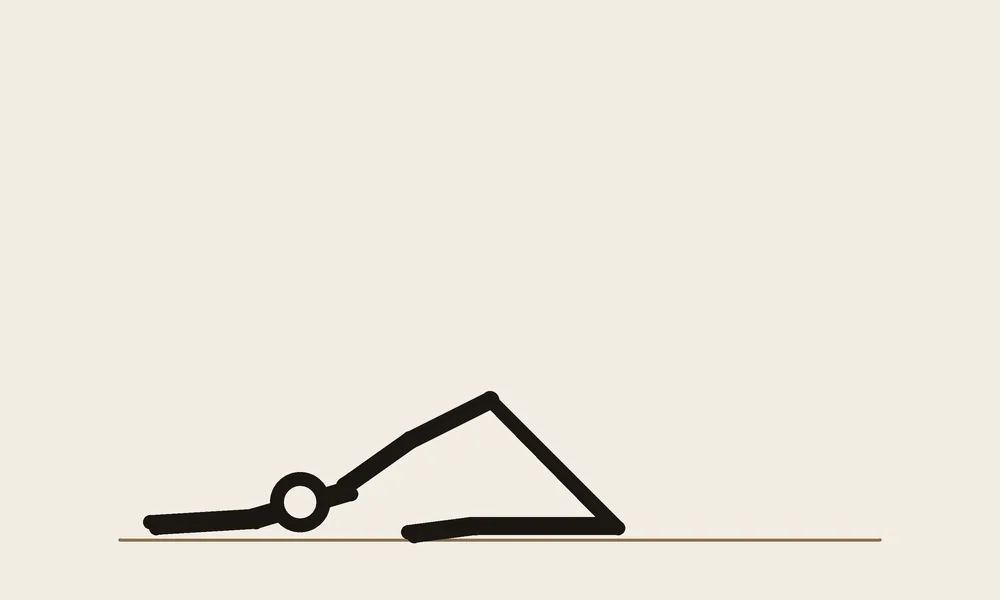
The through-line is the exhale. Whatever the pose, if you are lengthening the exhale and the front of the body is soft, you are training the brake. If you are holding the breath and gripping, you are training the accelerator. Both have a place; only one of them is what most people need on a Tuesday night.
A 10-minute daily nervous system reset
This is the routine I give students who ask for “something I will actually do”. It stacks the fastest tools from the list above, in the order the body prefers: settle the eyes, slow the breath, add sound, then go still.
- Minute 1, orient. Sit down, look slowly around the room, name what you see, then take three physiological sighs.
- Minutes 2 to 5, slow breathing. Lie down in Viparita Karani, or legs-up-the-wall pose, or with your calves on a chair. Breathe in for four, out for six to eight, through the nose. Hands on the belly.
- Minute 6, hum. Six rounds of Bhramari, eyes closed, ears covered if you like.
- Minutes 7 to 10, stillness. Stay where you are, or move to child’s pose or supported savasana. Nothing to do. If the mind races, count exhales back from twenty.
Do it at the end of the working day or before bed, the same time each day. Consistency beats length: ten minutes daily changes a baseline in a way a ninety-minute class once a fortnight does not. Give it two to four weeks before you judge it.
What the research says, honestly
The strong evidence is for slow breathing. Multiple reviews agree that breathing at around six breaths a minute raises heart rate variability, lowers blood pressure and reduces anxiety, in healthy people and in clinical groups. The Stanford cyclic sighing trial adds that a five-minute daily dose is enough to move mood, and that exhale-focused breathing beats other patterns.
For yoga and mental health, a large 2026 cross-sectional study found that regular yoga practitioners reported lower depression, anxiety and distress than both regular exercisers and inactive people. That is encouraging, with the usual caveat that people who feel better may simply keep practising. The trial evidence for yoga in anxiety and stress is positive but smaller.
For the vagus nerve specifically, be sceptical of precise claims. “Vagal tone” is inferred from heart rate variability, not measured directly, and consumer stimulation devices are early and mostly tested on small groups. Wearable HRV tracking helps some people and makes others more anxious, to the point that “orthosomnia”, anxiety about sleep scores, has its own name in the sleep literature.
What does not work, or is not worth your money
- The cortisol cocktail. Orange juice, sea salt, coconut water and magnesium do not lower cortisol. It is an electrolyte drink with a good marketing name.
- Thirty-second resets as a cure. A sigh helps in the moment. The change in your baseline comes from doing it every day for a month, which is a less shareable message.
- “Nervous system coaches” with no stated training. Ask what they trained in and for how long. Anyone working with trauma should be able to name a recognised modality and a supervisor.
- Buying the device before building the habit. If you have not yet tried five minutes of slow breathing a day for four weeks, you do not know whether you need the headset.
If tapping is your thing, EFT tapping sits in the same family as the practices above (rhythm, touch, long exhale) and is fine as a bridge, as long as it does not become the only tool.
Going deeper: learning to teach this
If this is the part of yoga that lights you up, it is also the part with the most demand right now. Studios, workplaces and therapists are all looking for people who can teach breath and regulation properly. The two routes I would look at first are a dedicated breathwork certification and a yoga nidra teacher training, because both are about the down-regulating end of the practice rather than the athletic one.
We compare the main breathwork programmes by price, hours, format and accreditation, and say which are worth it for teaching regulation specifically, in our roundup of the best breathwork certifications online.
FAQs
Expect a shift in how you handle a stressful moment within a couple of weeks of daily practice, and a change in your baseline (sleep, irritability, how fast you recover) in about one to three months. The Stanford breathing trial saw measurable mood and breathing-rate changes after 28 days of five minutes a day, and the benefit kept growing with practice. If you have a history of trauma the timeline is longer and worth doing with a trained practitioner.
Two or three physiological sighs: a full inhale through the nose, a second short sniff on top, then one long slow exhale through the mouth. It works within a minute because the long exhale slows the heart directly. Cold water on the face and humming are the next fastest. None of these fixes a chronically wound-up system on their own; that takes a daily practice.
Yes, if you choose the right kind. Slow, exhale-led practice with long supported holds (restorative, yin, gentle hatha, yoga nidra, a proper savasana) is one of the most effective and best-studied ways to train the parasympathetic response. Fast, hot or breath-retention-heavy classes are stimulating and can leave an already-wired person more wired, so match the class to the state you are in.
It is common and it has a name, relaxation-induced anxiety. When a system has been on high alert for a long time, stillness can register as unsafe, and people in a shutdown state can feel heavier and flatter when they lie down. The fix is to move first (a slow walk, a gentle flow, shaking) and only then get still, keep the eyes open at first, and start with two or three minutes rather than twenty.
Relaxation is a state; regulation is a skill. A regulated nervous system can get activated when it needs to and return to baseline afterwards, on purpose. A glass of wine and a series on the sofa can produce relaxation without training that return path at all. The practices in this guide are useful because they build the return path, so you need them less over time.
Nose in, almost always. Nasal breathing slows the breath, warms and filters the air and makes it easier to breathe into the belly rather than the upper chest. For calming practices the exhale can go through the nose or, for the physiological sigh and humming, through the mouth or with the lips closed and a sound. Habitual mouth breathing at rest and during sleep is worth mentioning to a doctor or dentist.
References
- Balban, M. Y. et al. (2023). Brief structured respiration practices enhance mood and reduce physiological arousal. Cell Reports Medicine.
- Zaccaro, A. et al. (2018). How breath-control can change your life: a systematic review on psycho-physiological correlates of slow breathing. Frontiers in Human Neuroscience.
- National Center for Complementary and Integrative Health. Relaxation techniques: what you need to know.
- Global Wellness Summit (2026). Neurowellness, one of the biggest wellness trends of 2026.
- The role of yoga in enhancing spiritual and psychological health: evidence from a large cross-sectional study (2026). PubMed.
Free course finder
Which online course fits you?
One question, and we send you all nine programs compared honestly, including who each one is not for.
One short email series, no spam. Unsubscribe anytime.
Free comparison
Nine online courses, compared honestly
Price, format, certificate, and the column most sites skip: who each course is not for. Read it before you pay.
One short email series, no spam. Unsubscribe anytime.

YOGI TIMES · Your privacy
A few cookies, only with your yes
We use cookies to understand what you read and to measure our own marketing. Nothing is set until you choose. Privacy policy