Unalome meaning explained: a guide to the symbol’s spiritual power, origins, and use in tattoos


The unalome is a Buddhist symbol from Thailand: one thin line that starts as a spiral, twists through a few loops, straightens out and ends in a dot or a lotus. Read from bottom to top, it is the path from a confused, looping life to a clear and awakened one, which is why so many yogis wear it as a tattoo.
Next to Om and Sanskrit script, it is one of the most common spiritual tattoos you will see in a yoga class. Below: where the unalome comes from, what each part means, the female, male, dot and lotus versions, how to say the word, and where not to put it on your body.
Unalome meaning: what the symbol represents
Quick answer
Buddhist unalome: the curl between the Buddha’s eyebrows
The Buddhist unalome, written อุณาโลม (unalom) in Thai, is a stylised drawing of the ūrṇā, the small spiral curl on the forehead of Buddha images. Buddhist texts count that curl among the 32 marks of a great being, and in Thailand the sign is so established that King Rama I took it as his personal seal at his coronation in 1785.
The unalome also runs through sak yant, the sacred yantra tattoos of Thailand, Cambodia, Laos and parts of Myanmar. In that setting it stands for the path to enlightenment, and that is the meaning most tattoo wearers borrow today.
According to the Buddhist view, the Unalome reflects each person’s life path. The path can be straight, circular or winding, paved with anxiety, fear, joy or love.
The unalome’s message is the Buddhist one: life is full of suffering, and even in hard times you keep moving forward, keep learning, and learn to look at yourself honestly.
The symbol of Unalome represents our path to enlightenment. The spiral represents the struggle with life, the journey through several incarnations, and the process of growth towards spiritual enlightenment.
Feeling called to deepen your spiritual path through teaching?
Explore accredited yoga teacher certification paths that align with your values and lifestyle.
Hindu reading: the third eye of Shiva
The Hindu reading of the unalome ties the spiral to the third eye of Shiva. You will find this link mostly in modern yoga and tattoo writing rather than in classical Hindu texts, which do not describe a symbol called the unalome. The overlap is not random, though: the ūrṇā itself comes from Indian iconography, and Shiva is often shown with a third eye.
Shiva is the destroyer in the Hindu trinity of Brahma the creator, Vishnu the preserver and Shiva the destroyer, and his destruction is the kind that clears the way for something new. In this reading, the spiral at the base of the unalome is that eye, and the message is simple: life is handed to us without a manual.
We are the only ones who need to understand where we are going.
The ascending path, which resembles a line with knots, indicates each spiritual turning point in our lives.
The knots are obstacles that must be overcome to get to the lotus flower at the top. The lotus flower symbolizes perfection in Hinduism and represents Moksha, or enlightenment (in the Buddhist religion, known as Nirvana).
Moksha means that when we reach the top and open our spiritual Lotus, we are liberated from the cycle of birth, death and reincarnation.
The parts of the unalome: spiral, knots, line and dot
The spiral at the base of the unalome is where the story starts: your birth, a spiritual awakening, or the first day of a struggle.
The looping knots in the middle, which make up most of the drawing, are the struggles that thin out as we move through life. As they fade, the line rises and straightens, a sign that your own life path and the path to enlightenment are the same road.
The journey begins at the center of the spiral, and the spiral reflects how hard it is to escape our flaws, worries and doubts.
However, our mind sees clearly as the life path unfolds. Gradually it breaks away from the cycles of suffering.
Perhaps when we connect to the various networks of emotions, we do not realize how confused we are thinking. We all make the same mistakes because we are all human.
Getting out of this cycle is not easy. The spiral, however, represents just that.
The Unalome symbol is a visual metaphor for this journey. It is the apex and culmination of our struggle for self-awareness. The straight line in the Unalome represents finding clarity, direction, and the eventual path to enlightenment. It signifies transcending chaos and finding one’s true path towards wisdom and success.
Unalome tattoo meaning: why it works as a tattoo
An unalome tattoo says “I am on my way, and I have not arrived yet.” It is one thin line, so it sits small on a wrist or the back of the neck, and its meaning is personal enough that no two people read their own the same way.
Unalome is timeless
An unalome tattoo does not go out of date as your life changes, because it describes the journey itself rather than one moment in it.
Just as each part of the Unalome symbol makes the whole what it is, each stage of the journey to self-awareness is necessary. The beginning is a catalyst for events leading to the end; the end could never come without the beginning.
Because each part is interconnected, its significance and importance can never be surpassed.
Where to put an unalome tattoo (and where not to)
The best places for an unalome tattoo are the wrist, the back of the neck, between the shoulder blades, behind the ear, the forearm and the chest. Most people pick a spot that means something to them, and the long, narrow shape suits all of these.
Keep it off your feet. In Thailand, and in much of Buddhist Southeast Asia, the head is the highest and most sacred part of the body and the feet are the lowest, so a sacred symbol on the foot reads as disrespect. We would keep it above the waist for the same reason.
The classic unalome is a stand-alone design, but tattoo artists now work it into larger pieces: an unalome can grow out of a lotus, sit under a small Buddha or a meditating figure, or run alongside an Om.
Unalome variations: dots, lotus, female and male
Unalome variations come down to two details: what sits at the top of the line (dots or a lotus) and which way the spiral turns. Be aware that most of these meanings come from modern tattoo culture rather than Buddhist scripture, so treat them as a shared vocabulary, not as rules.
Unalome with dots
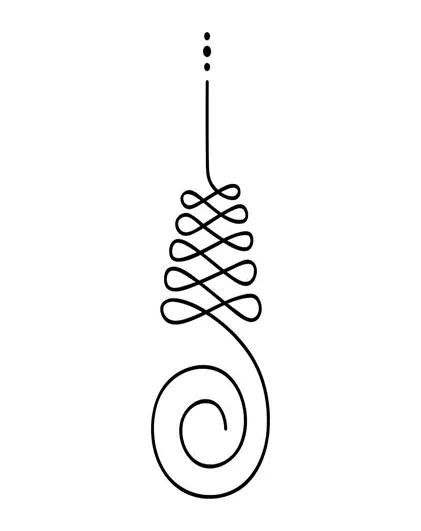
An unalome with dots ends in a short row of dots above the straight line, usually three, as in the drawing below. The dots are read as reaching your goals, freedom and, at the very top, enlightenment.
Lotus unalome meaning
A lotus unalome swaps the dots for a lotus flower at the top of the line. The lotus is one of the oldest symbols in Buddhism and Hinduism because of how it grows: rooted in mud at the bottom of a pond, it pushes up through dark water and opens clean on the surface.
That is exactly the unalome’s story told a second time, so the two fit naturally. In a lotus unalome, the flower is the moment of awakening: whatever the mud was, it did not stain what grew out of it.
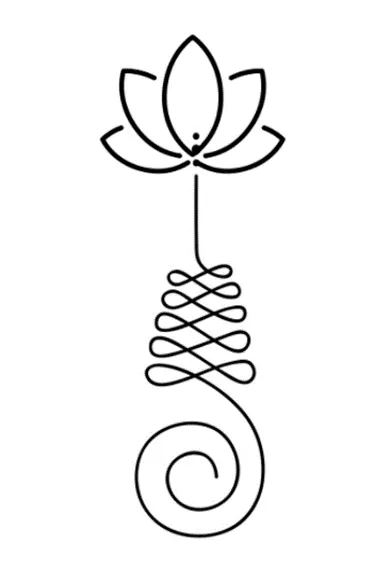
The lines below the lotus are the mud and muck we push through before we can bloom. Choose the lotus version if the struggle part of your story matters to you as much as the ending; choose the dots if you want the cleaner, more minimal line.
Female unalome meaning (and the male version)
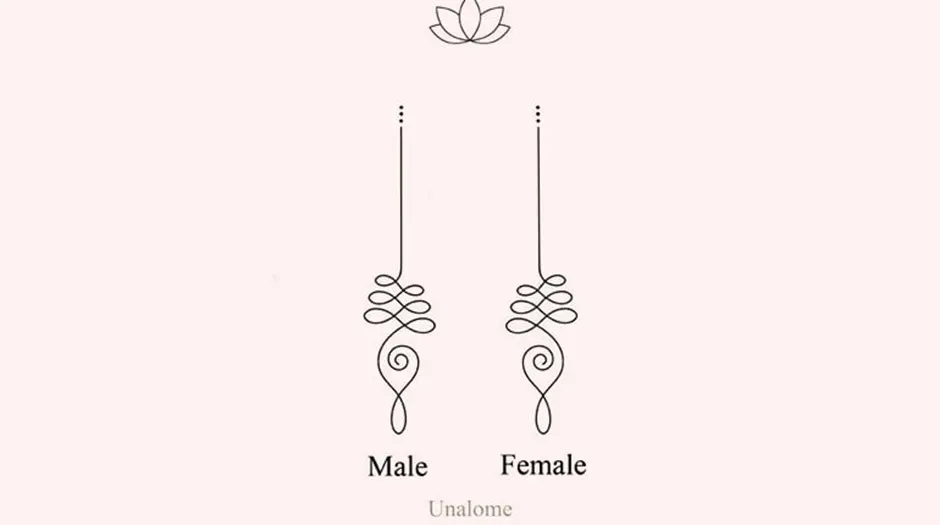
A female unalome has its spiral base turning to the left and inward, and it stands for feminine energy: intuition, receptivity, the inner journey. A male unalome turns the other way, to the right and outward, for masculine energy. That is the reading you will meet in most tattoo studios and on Pinterest charts like the one above.
Know that this male and female split does not come from Buddhist texts. Traditional Thai belief reads the direction differently: a spiral turning left is linked to protection and invulnerability, one turning right to loving-kindness and being loved. Whichever meaning you want, tell your tattoo artist the direction before they start, because the stencil is easy to flip.
Symbols to pair with an unalome tattoo
Unalome tattoos are often paired with a second symbol that adds to the story. The eight below are the most common; for the wider family of yoga imagery, see our guide to the meaning of spiritual yoga symbols.
Om
Om is the symbol most often added to an unalome tattoo. The Om symbol is a sacred syllable and mantra in Hinduism, Buddhism, Jainism and Sikhism, and for many people it is the first image that comes to mind for a spiritual tattoo.
Om is a fundamental concept in the Hindu religion and is considered the first sound of the universe. It symbolizes the union of mind, body and spirit. Pair it with an unalome to anchor your journey to self-awareness in a sense of unity.
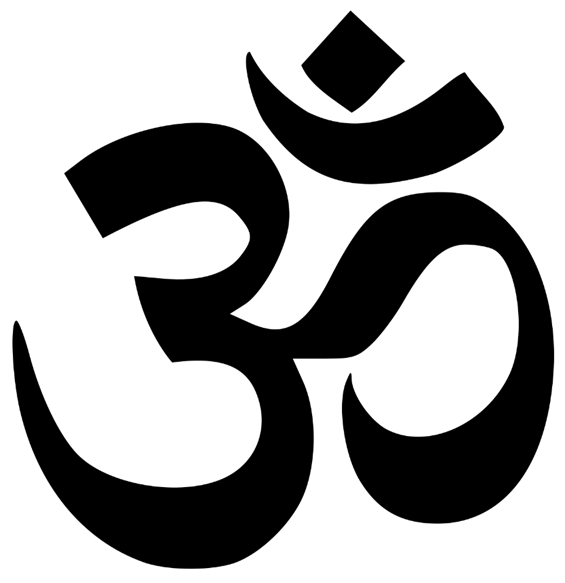
The curves of the Om symbol are commonly read as states of consciousness, an idea rooted in the Mandukya Upanishad, which describes waking, dreaming, deep sleep and a fourth state beyond them:
– The bottom left curve represents the conscious, waking state of being.
– The upper left curve represents the unconscious state.
– The bottom right curve represents the dream state or the transition between wakefulness and unconsciousness.
– The semicircle at the top represents maya, or illusion, the veil that keeps us from seeing clearly.
– The dot at the top represents the fourth state, turiya: pure awareness, where one can simply be.
Mandala
A mandala is a symmetrical arrangement of shapes and symbols, usually set in a circle, and it pairs well with an unalome growing out of or above it.
The circle is symbolic of the universe as a whole. The circle symbolizes eternity, harmony, balance and completeness because it never ends. This eternity encompasses all other forms and designs, giving the impression of harmony, calm and completeness.
Tree of life
The tree of life is usually drawn as a great tree with roots deep in the earth and branches reaching into the sky. Its roots stand for how everything is connected, a link between the physical world we live in and the spiritual one we reach for.
The meaning of the Tree of Life tattoo also reminds us of our universal connection with Mother Earth and our dependence on her to develop and thrive.
Seven chakras
The seven chakras, drawn as spinning disks of light, stand for seven energy centres in the body, and a column of chakras runs naturally along the same vertical line as an unalome. In yoga tradition, when all seven are in balance you are at peace in body and mind; our guide to what the chakras are covers each one.
Lotuses, triangles, colours, circles and Sanskrit letters make up the iconography of the chakras, so meditating on each chakra’s symbol is one way people work with them.
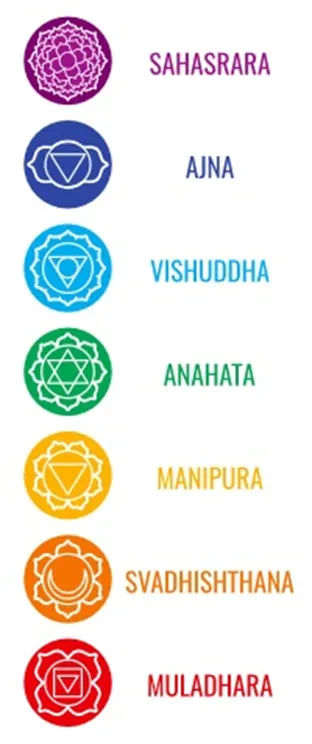
Learning what each symbol stands for is also the first step in spotting which chakra feels blocked.
Buddha
A Buddha tattoo stands for wisdom and spiritual practice. The seated, meditating Buddha shows contemplation and compassion for all living beings, and calm in the face of chaos, which is why it sits so well above or beside an unalome.
Sanskrit
Sanskrit is the ancient language of India’s sacred texts. Few people speak it as a first language today (24,821 Indians named it their mother tongue in the 2011 census), but its words and chants are believed to carry a vibration of their own, which is why many yogis tattoo a short Sanskrit word or mantra.
You could add ancient Sanskrit scriptures to your Unalome tattoo or choose a modern phrase that suits you.
Hamsa
The hamsa is a palm-shaped amulet from North Africa and the Middle East, also known as the hand of Fatima or the hand of Miriam. It is worn for protection against the evil eye and for good luck, health and fertility, a hopeful counterpart to the unalome’s road through struggle.
Namaste
Namaste means “I bow to you”, from the Sanskrit namas (bow) and te (to you). Said with the palms pressed together at the chest and a slight bow, it offers respect to the other person, and as a tattoo it is a short, quiet partner to an unalome.
Ganesha
Ganesha is the elephant-headed Hindu god of beginnings, the remover of obstacles and the patron of wisdom and learning, honoured at the start of new ventures. Paired with an unalome, he fits the start of the line: the spiral where the journey, and its obstacles, begin. His name is pronounced guh-nay-sha.
How to pronounce unalome (and how to spell it)
Unalome is pronounced in three parts: OON + UH + LOAM, with the final e silent. That is close to the Thai original, อุณาโลม, romanised as unalom, which is why the word has no fourth syllable. You will also hear “oo-nah-LOH-may” in English, and people will understand you either way.
The spelling trips people up as much as the sound. Unilome, unalime, analome and una lome are all common misspellings of the same symbol; the correct spelling is unalome, and unalom is the direct Thai transliteration. The short video below says the word out loud.

Unalome questions, answered
The unalome is a Thai Buddhist symbol for the path to enlightenment. Read from the bottom up, the spiral is the confused start of life, the loops are its struggles, the straight line is clarity and the dot or lotus at the top is awakening. It is a stylised form of the ūrṇā, the curl between the Buddha’s eyebrows.
A female unalome has its spiral base turning left and inward and stands for feminine energy: intuition and the inner journey. The male version turns right and outward. This split comes from modern tattoo culture; traditional Thai belief links a left-turning spiral to protection and a right-turning one to loving-kindness.
A lotus unalome ends in a lotus flower instead of dots. Because the lotus roots in mud and opens clean on the surface, it doubles the unalome’s own message: whatever you grew through did not stain what you became. The flower marks the moment of awakening.
The unalome is Buddhist in origin. It is the Thai form of the ūrṇā, one of the 32 marks of a great being, and it appears in Thai sak yant tattoos. The link to Shiva’s third eye is a modern Hindu-flavoured reading found mostly in yoga and tattoo writing, not in classical texts.
Avoid the feet. In Thailand the head is the most sacred part of the body and the feet the lowest, so a sacred symbol on the foot reads as disrespect. The wrist, back of the neck, spine between the shoulder blades, forearm, behind the ear and chest are the usual choices.
Say it in three parts, OON-uh-LOAM, with the final e silent, close to the Thai original unalom. “Oo-nah-LOH-may” is also common in English. The correct spelling is unalome; unilome, unalime and analome are frequent misspellings.
What the unalome teaches: our take
The unalome teaches that every life path is different, and that everyone will read this symbol of enlightenment a little differently. What straightens your course and eases your pain is personal.
The Unalome symbol serves as a reminder of these universal aspects of life. While highly personal, the visual representation has an international unity.
We are not superior to one another.
We are all headed in the same direction.
We simply promote it in different ways.
The unalome accepts that pain is inevitable, but the line does not stay in the spiral, and neither do we. Your pain will not last forever: it will have time to be felt, and then it will let go.
Although our suffering is excruciating, there is always hope that it will end.
Even after unwinding, there is still another level of uncertainty to consider. The end point of the unalome is there for a reason.
The insecurity of the world is inevitable. But, on the other hand, choosing to deny it does nothing to improve one’s self-awareness.
Respecting the process of life means respecting the uncertainty within us. After all, Buddhism is a philosophy of life. It challenges us to think about how to keep improving. It encourages us to grow and satisfy our curiosity without ego.
The unalome is a beautiful emblem to carry. Use it as a visualization tool during your meditation or yoga sessions. Allow it to remind you of the path you are on.
Use the unalome as a sign of hope if you feel stuck or overwhelmed; it points through the muck toward growth. Symbols like this work the way meditation and yoga do, as reminders you come back to.
Our honest take: the unalome is worth wearing if its story is yours, and it is the wrong tattoo if you want it only because it looks good in fine line. It is a sacred mark in Thailand, so treat it with the same care you would give Om or a Buddha, keep it off the feet, and choose the spiral direction on purpose.
Origins, meanings and sources on this page were checked in September 2026.
Sources
- Urna (Wikipedia): the unalome as a stylised ūrṇā
- อุณาโลม (Thai Wikipedia): 32 marks, Rama I’s seal, the Thai reading of the spiral direction
- Sak yant (Wikipedia)
- Trimurti (Wikipedia) and Shiva (Wikipedia)
- Padma, the lotus (Wikipedia)
- Om (Wikipedia) and Mandukya Upanishad (Wikipedia)
- Feet low, head high: a guide to Thai etiquette (Thailand Foundation)
- 10k more Sanskrit speakers in India in 2011 census (Business Standard)
- Hamsa (Wikipedia), Ganesha (Wikipedia) and Namaste (Wikipedia)

Online yoga teacher training
$100 off your 200‑hour online training
Learn to teach yoga, from home
Take Movement Wisdom’s 200-hour online yoga teacher training and save $100 with your YOGI TIMES code.
Use code YT100
Get $100 offThe code is applied when you use this button, or enter YT100 at checkout.
Free wellness e-book
Find your zen
Your free guide to wellness
Download your free 7-Day Wellness Journey Guide and receive weekly inspiration for the lifestyle of a modern yogi.
🔒 We respect your privacy. Unsubscribe anytime.

YOGI TIMES · Your privacy
A few cookies, only with your yes
We use cookies to understand what you read and to measure our own marketing. Nothing is set until you choose. Privacy policy