DoYogaWithMe reviews: the 200-hour online yoga teacher training, from a graduate


DoYogaWithMe is best known as one of the largest libraries of online yoga classes, with a big free tier and a low-cost Premium membership. Fewer people know that the same team runs a full Yoga Alliance-registered 200-hour online yoga teacher training on its course platform, taught by the teachers you already see in the class videos.
I enrolled in this online YTT in 2024 as an already-certified teacher. Eight years after my in-person course, I wanted to refresh my knowledge, get expert feedback on my teaching, and see how a serious online training compares with the studio version. This review covers what the training looks like from the inside, what it costs in 2026, the pros and cons, and who I think it suits.

DoYogaWithMe teacher training at a glance
- Format: 200-hour online YTT in three levels. Levels 1 and 2 are self-paced (160 hours across 32 courses), Level 3 is live (40 to 45 hours), either two 3-day weekends on Zoom in July or August, or a 6-day in-person retreat on Vancouver Island in June.
- Two ways to start: join the yearly October cohort (160 hours from October to May, Level 3 in June) or enrol in the self-paced version and begin any day of the year.
- Live contact: two or three livestream practices a month, monthly cohort meetings, two 45-minute one-to-one coaching calls, and email access to the faculty.
- Certification: the school is a Registered Yoga School with Yoga Alliance; graduates can register as RYT-200.
- Styles taught: Hatha and Vinyasa Flow.
- Price (checked 16 November 2026 on the DoYogaWithMe enrolment page): $2,750 paid once, or 6 monthly payments of $508. Single courses can be bought a la carte, most at $55, and the Level 1 Orientation course is free.
- Included: a year of unlimited access to the Do Yoga With Me class library, the 190-page asana guide, 300+ pages of handouts, and lifetime access to the course material.
- Refund: unconditional 30-day money-back guarantee.
What it costs in 2026, and what you get for it
When I enrolled, the training cost $2,400. The school raised it to $2,750 in 2025 and that is still the price I found on the enrolment page on 16 November 2026. The table below is what the page showed that day; the school also runs an early-bird discount code in the weeks before each October cohort, so check the page before you pay.
| Item | Detail, checked 16 November 2026 |
|---|---|
| Price | $2,750 one-time payment (the school calls this “save 10%”), or 6 monthly payments of $508 ($3,048 in total) |
| Level 3 options | Two 3-day live weekends on Zoom (July or August) at no extra cost, or the 6-day in-person retreat on Vancouver Island in June for an extra $200 plus your travel and accommodation |
| Included | 32 self-paced courses, 2 to 3 livestream practices a month for 8 months, two 45-minute one-to-one coaching sessions, 300+ pages of handouts and worksheets, the 190-page asana guide, a 140-page Yoga Sutras PDF, a yoga business video playlist, a resume and cover letter template, a sample intake form and waiver, and 1 year of unlimited access to the Do Yoga With Me class library (the school values the bundle at US$1,860) |
| Access | Lifetime, your enrolment never expires |
| Time to finish | About 8 months at 5 hours a week for Levels 1 and 2, then Level 3 in June, July or August. Self-paced students must still attend at least 9 live meetings before they can certify |
| Try before you buy | Level 1 Orientation is free with an account; any single course can be bought on its own (most cost $55) and counts toward the full training |
| Refund | Full refund within 30 days, no questions asked |
| Certificate | Yoga Alliance RYS 200; graduates register as RYT-200, certified to teach Hatha and Vinyasa Flow |
For context, that puts DoYogaWithMe in the upper half of our online YTT schools comparison: the same as Uplifted’s pay-in-full price ($2,750), and a long way above the sale prices of YogaDownload ($395) or YogaRenew.
What you are paying for is the live layer (livestreams, cohort meetings, one-to-one coaching, a 40 to 45-hour live Level 3) and a faculty that has run teacher trainings for decades. If you only want the certificate and a video library, a cheaper school will do it. Prices can vary slightly with location-based tax on the Thinkific checkout.
Hands-on learning experience
Course content and structure
According to the DYWM faculty, their online yoga teacher training course was carefully crafted to include all the necessary information in an accessible way. The training is broken down into 32 individual courses, each covering one topic, and that structure makes it one of the most accessible paths to teaching yoga for students who want flexibility without giving up depth.
Tuition is mainly delivered in video form, with the most pertinent information noted in the handout copy. Each course ends with a quiz to check that the information has been retained and understood.
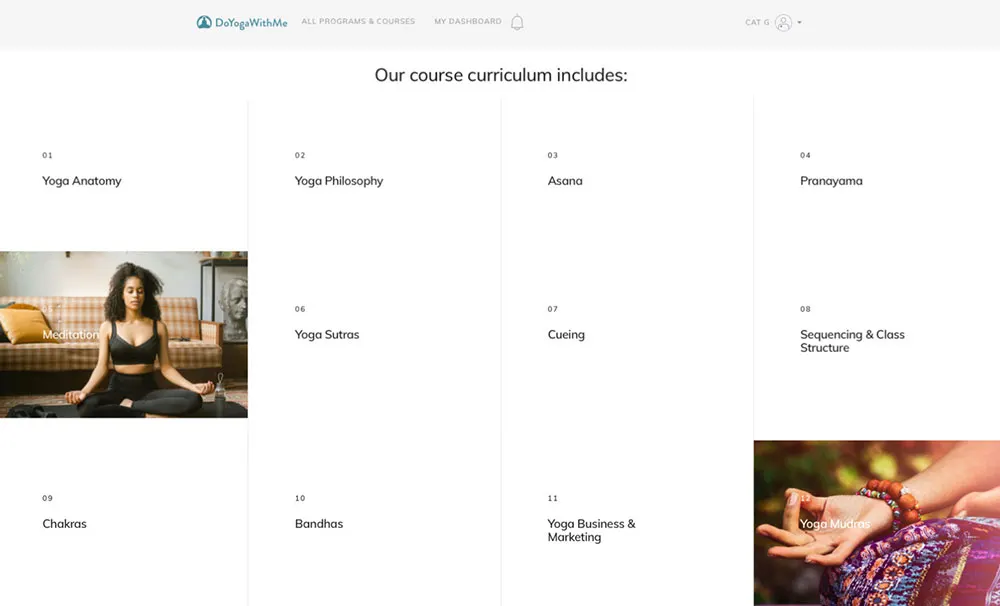
The curriculum covers twelve subject areas:
- Yoga anatomy
- Yoga history and philosophy, including the Yoga Sutras
- Asana practice and breakdown
- Pranayama techniques
- Guided meditation techniques
- Cueing, sequencing and class structure
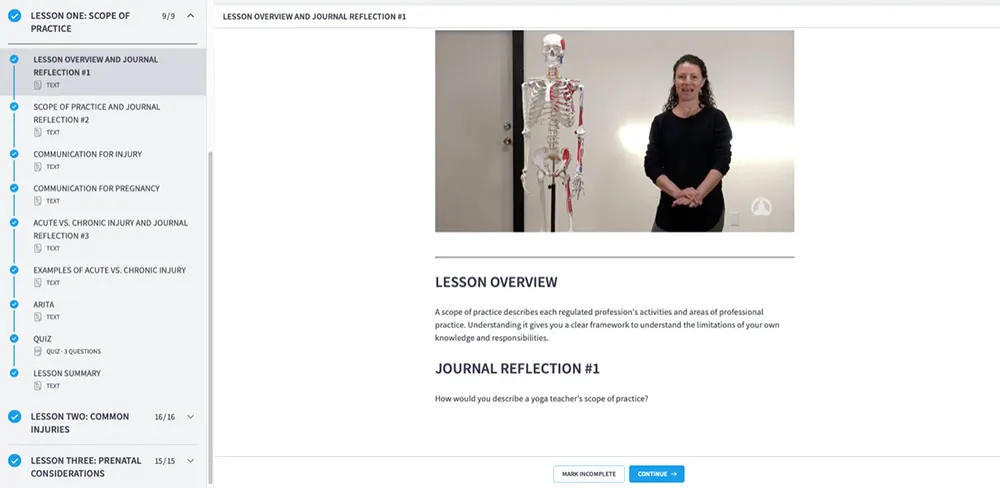
- Injury and pregnancy yoga
- Subtle body: chakras, bandhas, mudras, Ayurveda and the vayus
- Yoga business and marketing
Detailed breakdown of asanas
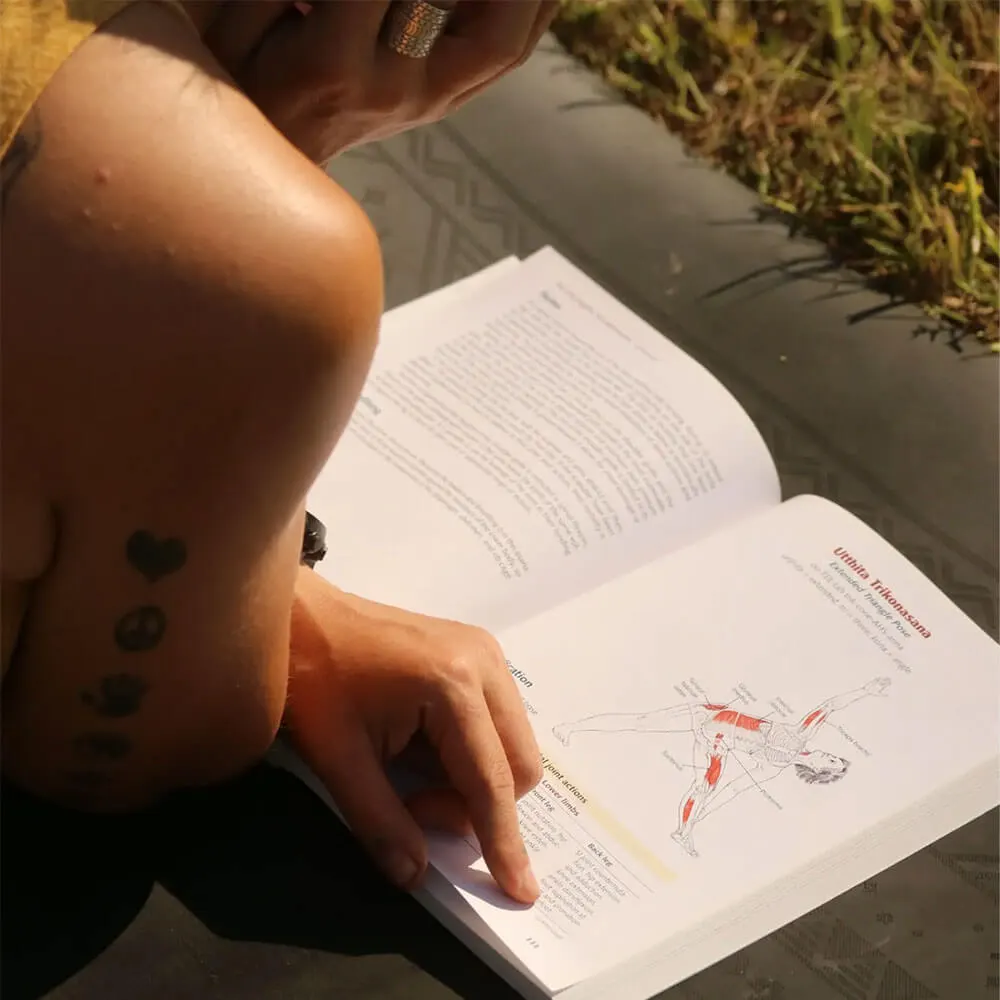
DoYogaWithMe training materials include a 190-page detailed asana guide. Additionally, the course covers various “families” of yoga poses and their purpose.
Part of the learning process is the personal practice. Trainees are required to complete 3 to 5 recorded practices that correspond with each topic to learn more about asana breakdown. The training bundles a year of the Premium class library so you can do this without buying anything else.
Certification and who teaches it
Yoga Alliance registration
DoYogaWithMe’s teacher training is a Registered Yoga School (RYS 200) with Yoga Alliance. Trainees receive a certificate on completion and can register with Yoga Alliance as an RYT-200. Yoga Alliance does not publish a public rating for this school the way it does for some others on our list, so I cannot quote one; what I can say is that the individual courses carry 4.8 to 5.0 student ratings on the school’s own platform.
The faculty
The faculty consists of four renowned yoga teachers and trainers, who between them have over 70 years of teaching experience:
- Rachel Scott (E-RYT 500, licensed massage therapist, MFA, MS) is the YTT program director. She built and ran the teachers college for the Canadian studio chain YYoga before joining DoYogaWithMe, has written several yoga books, and describes herself as an anatomy nerd, so she covers many of the anatomy courses.
- Fiji McAlpine (E-RYT 500, M.Ed) is DoYogaWithMe’s director of development, an international retreat leader and a certified teacher trainer. Fiji covers a variety of topics, including the subtle body and teaching methodology.
- Tracey Noseworthy (E-RYT 500, BA, ACE) trained with Shiva Rea and Janet Stone, holds a physical education degree, and brings 25+ years in the fitness and wellness industry. Students praise her simple, direct approach to yoga philosophy.
- David Procyshyn (E-RYT 250, registered massage therapist, BSc) is the founder of DoYogaWithMe, a long-time meditator and a yoga teacher with over 20 years of experience.
Support
To encourage communication and a sense of community, the course includes cohort meetings with the faculty and live yoga classes. The school now also lists two 45-minute one-to-one coaching sessions as part of Levels 1 and 2.
Faculty can be accessed directly via email, should questions arise about specific modules or the training overall. Each topic also includes a forum for the trainees to share their experiences and ask questions. I was very impressed with the great level of communication and multiple avenues to connect with the faculty and fellow training participants.
Technical overview
Intuitive design
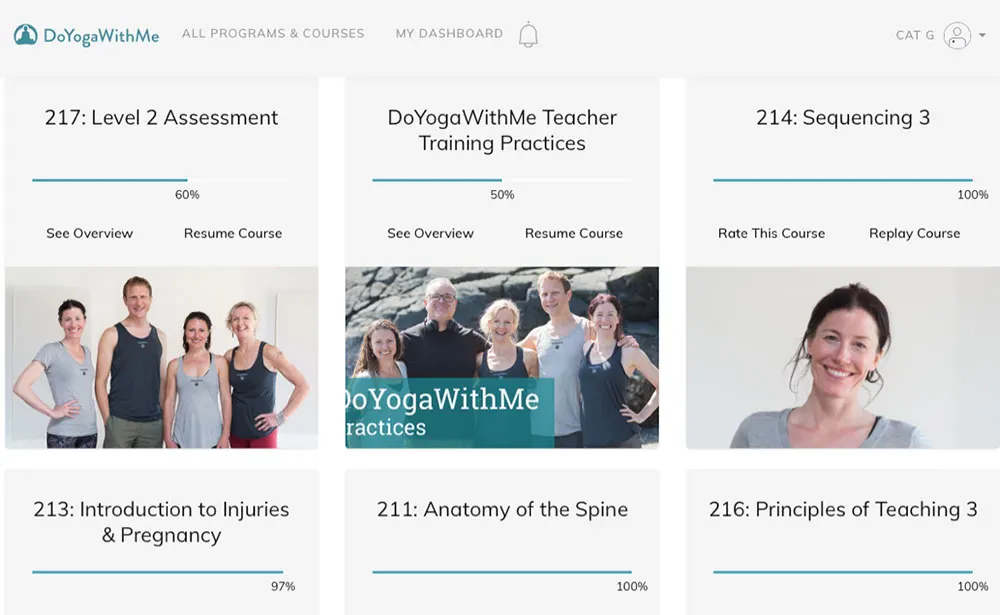
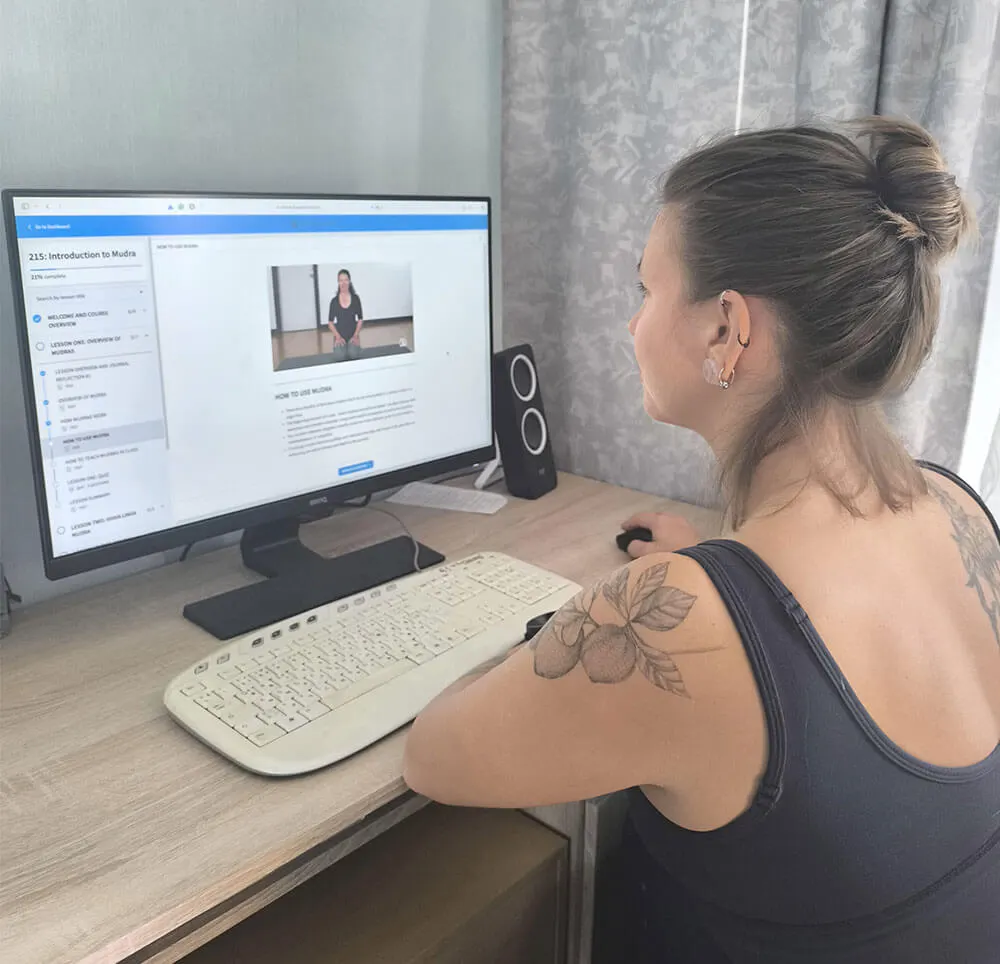
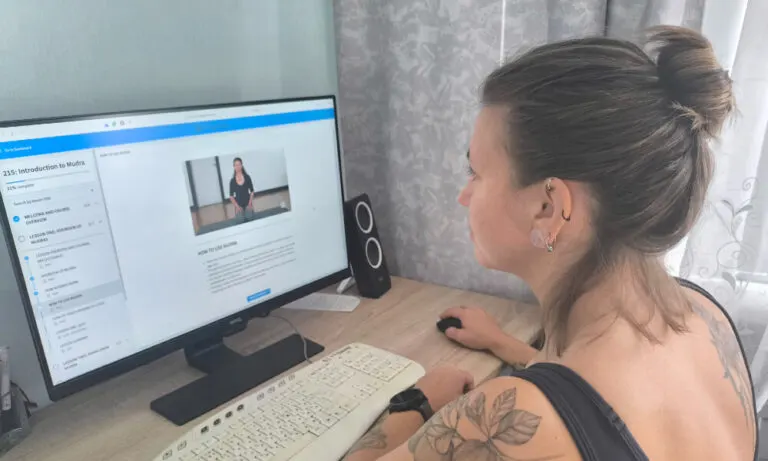
The training has very few technical requirements or expenses outside of the course itself. It runs on Thinkific and is accessible in-browser or in the Thinkific app on a phone, tablet or computer. Personally, I found the interface more convenient to use on my laptop.
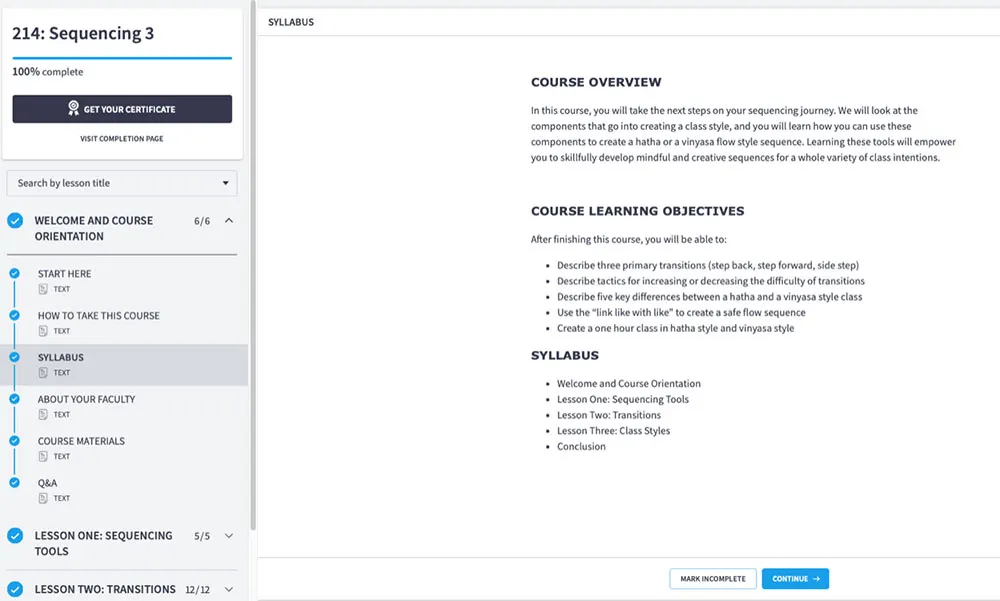
The interface is simple and easy to navigate, and it tracks your progress. The videos have accessible features like subtitles and speed adjustment. As someone with ADHD, I found both incredibly useful.
Live classes, Level 3 training and cohort meetings are all conducted via Zoom, which requires free access to the app. Level 1 and Level 2 assessments are submitted in video form, which requires a camera (such as a phone camera). The assessment details include thorough instruction on how to record and upload the video assessments.
Interactive learning
Interactive digital course materials do not require a printer (but can be printed if desired). This lets students absorb and reflect on topics on their own timeline. Each topic also includes an interactive quiz, and part of the Level 1 and Level 2 assessments is a broader quiz covering multiple topics.
Dynamic course materials
Engagement and interactions
Self-study is supported by live yoga classes and cohort meetings, where students have a chance to ask questions, as well as connect with each other and the trainers.
Furthermore, it was very easy to get in contact with the faculty. In fact, the trainers’ email details are included at the start of each topic, encouraging the student teachers to get in touch to provide feedback or ask questions.
Community and peer support
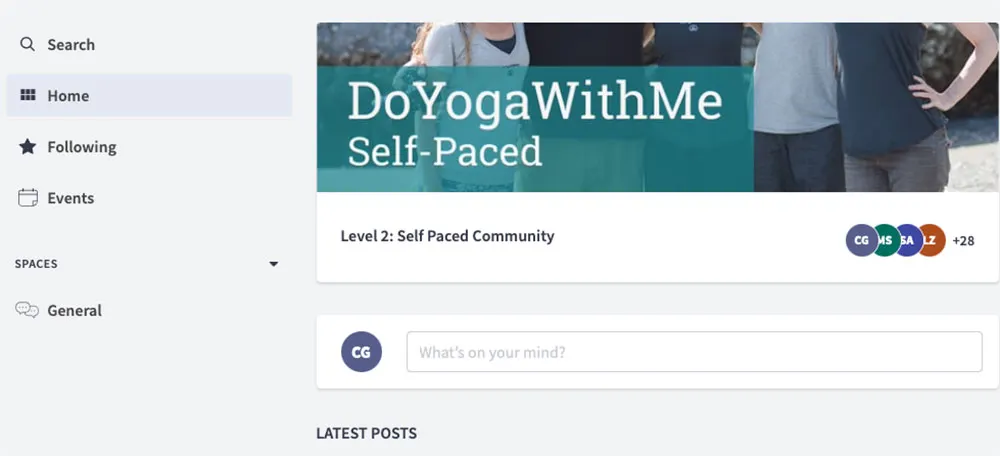
Even though this online YTT is largely self-paced, it is recommended that you join a cohort. A training cohort is similar to a study group.
Cohort members meet via Zoom approximately once a month to discuss their progress and dive more deeply into one of the topics included in the course. When I trained, these meetings were optional for Level 1 and Level 2 required at least three; today the school asks self-paced students to attend at least nine live meetings across the training before they can certify, which I think is the right call.
Some of the cohort meetings include peer learning, very similar to in-person training. Zoom allows participants to split off into pairs or groups to work on specific teaching assignments and provide feedback to each other.
Feedback
Additionally, the activities and communication channels had to be adapted to the online format to enable students to get personalized feedback and connect with their peers.
In Rachel’s own words, “We wanted to create a balance between the flexibility of self-paced learning with the personalized feedback necessary for growth and learning and were very intentional about creating peer-peer as well as faculty-peer interaction to enhance community engagement and provide the personalized feedback necessary for growth.“
Hours that matter
Course hours and participation
The entire course, including lectures, personal practice, cohort meetings and live classes, adds up to 200 hours, which is the industry standard for yoga teacher training. The school now breaks it down as 160 hours on demand plus 62 live hours: 16 hours of livestream practices, the two coaching calls, and the 40 to 45-hour Level 3. Homework such as journaling and the assessments are counted inside those figures.
200-hour courses are designed to build a solid foundation for future yoga teachers, allowing them to teach in a safe and productive way. I’m happy to say that this online YTT ticks all of the boxes. Graduates who want more can go on to the school’s in-person retreats and its continuing-education courses.
Impact on teaching practice
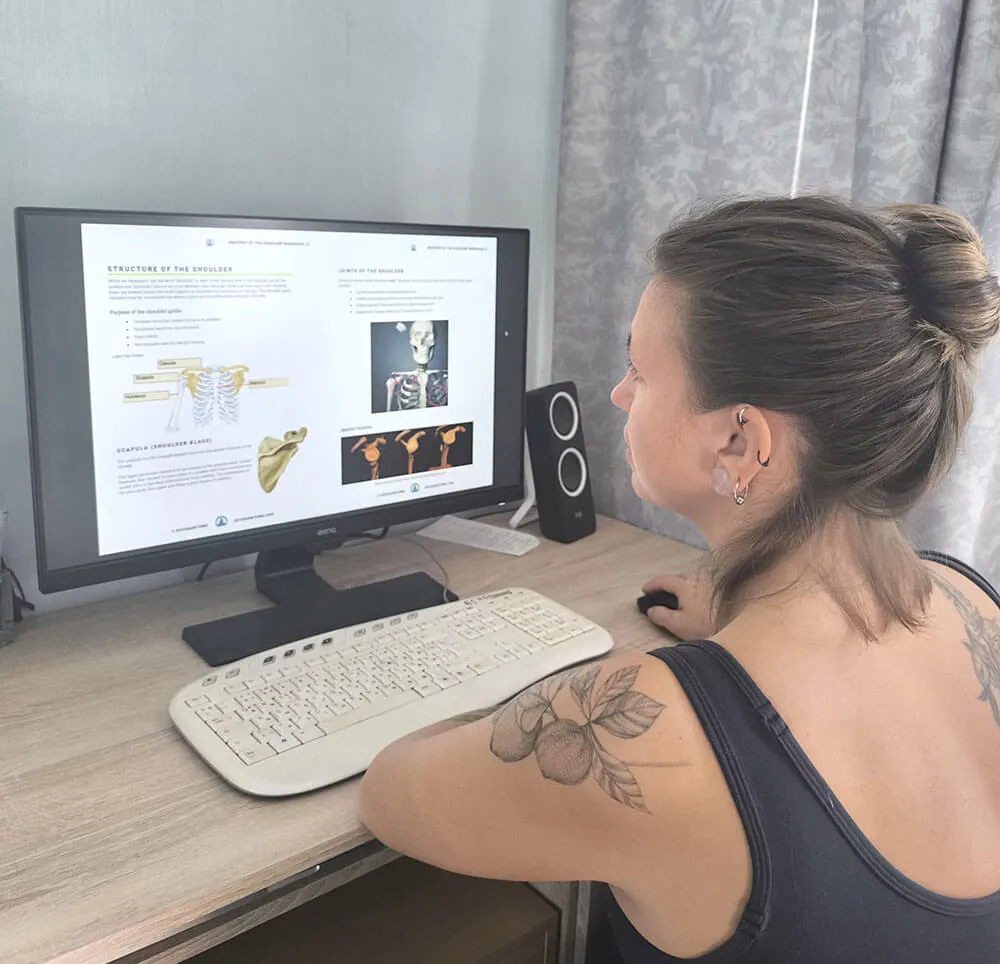
The highlight for me was the anatomy training. It was exceptional and included brilliant courses on the nervous and respiratory systems that weren’t part of my first YTT.
There is also a strong emphasis on energetic systems and the subtle body, which empowered me to start incorporating more ethereal components of yoga in my teaching.
Lastly, this training course felt like a gift from the heavens because it truly reignited my passion for teaching. It can be so easy to fall into familiar patterns, and this training helped me shake things up and step out of my comfort zone.
Pros and cons
Pros
- Faculty is easy to contact directly via email, and two one-to-one coaching calls are now built into Levels 1 and 2.
- Excellent coverage of yoga anatomy, the best I have seen in an online 200-hour.
- Multiple trainers, each presenting the topics they specialize in.
- Realistic pace: about 5 hours a week, so you can finish even with a full-time job.
- Unconditional 30-day money-back guarantee and lifetime access to the material.
- A year of the Do Yoga With Me class library and 300+ pages of handouts are included.
- Accessible features like subtitles and speed adjustment on every video.
- Assignments are reviewed with personalized feedback, and the quizzes make you reflect rather than memorize.
- Very few technical requirements or expenses outside the course fee.
- Start any day with the self-paced track, or join the October cohort for a fixed rhythm.
Cons
- At $2,750 it is among the pricier online 200-hour trainings, and the price has risen from the $2,400 I paid.
- Level 3 only runs in June (in person) or July and August (Zoom), so your finish date depends on the calendar, not just your pace.
- The in-person Level 3 retreat costs an extra $200 plus travel to Vancouver Island.
- Students in some time zones may find the compulsory live meetings inconvenient.
- Minor errors in texts and quizzes. To the faculty’s credit, these are fixed immediately when pointed out.
- Despite the effort put into personalized feedback, some students may find it hard to self-align without a teacher in the room.
Is DoYogaWithMe legit?
Yes. The training is a Yoga Alliance Registered Yoga School, the four teachers are named, credentialed and have been on the platform for years, the school publishes its prices, refund policy and academic policies openly, and you can take the first course for free before spending anything.
I completed the program myself, and everything the enrolment page promised was delivered. The main thing to know is that it is a real workload, not a certificate you can buy and forget.
The DoYogaWithMe platform versus the teacher training
A lot of people searching for DoYogaWithMe want the class site, not the training, so a quick distinction. DoYogaWithMe.com is the streaming library: free classes plus a Premium membership, which we cover in our best online yoga classes and subscriptions comparison. courses.doyogawithme.com is the separate education platform where the 200-hour YTT, the continuing-education courses and the master practitioner program live.
You do not need a Premium membership to enrol in the training; a year of it is bundled in. And if you are only looking for classes to practise with, the training is overkill; the Premium membership is the product you want.
Platform and design choices
To provide insight into the course design, I was able to ask Rachel about intentional choices in regards to the content, structure, and changes that happened along the way.
Platform
“Part of what makes creating a quality pre-recorded program so challenging is that it needs to be mapped out thoroughly in advance; there is no room to refilm everything or make small tweaks as you can in an in-person program. As a result, we did an enormous amount of planning for this program and have had to shift very little,” Rachel shared.
Frankly, it shows. Each topic is approached thoroughly and mindfully, delivered in a way that’s comprehensive but not overwhelming.
One major change was adapting the final 40 hours of training (Level 3). Originally, it was supposed to be completed in person, but with the travel restrictions of the COVID pandemic it had to be conducted over Zoom. Today students get both options: the June retreat on Vancouver Island, or the live Zoom weekends.
In the long run, this change made this training more accessible for someone like me, who lives on another continent. I have met other trainees from Europe, the US, or even another province of Canada, who all benefited from this change.
Some small changes were integrated as a result of student feedback. Rachel writes, “We have had really positive feedback about the program and the platform, which has been great! We have made some small adjustments where we see an opportunity to level up.“
Online versus in-person benefits
According to Rachel, the online DYWM teacher training is structured in a way that results in identical learning outcomes compared to the in-person YTT programs. Part of the process was organizing information in digestible chunks to make it accessible for self-study, as well as integrating ways for trainees to self-evaluate their progress.
Technology and user experience
Of course, user experience and technological requirements were a major focus when designing an online program. “However,” Rachel notes, “technology doesn’t make for great education; great education makes for great education.”
My platform experience was a positive one. The visual design is simple and effective, and the video format works great. I especially appreciated accessibility features like subtitles and speed settings.
According to Rachel, most students find the platform intuitive, and the most complex technological task is probably recording and uploading video for faculty review. However, the assessment instructions are very thorough and tech-friendly.
Additional resources
In addition to the coursework materials, this training includes a Premium subscription to DoYogaWithMe, which enables every student to complete the required personal practice, as well as take advantage of this resource outside of mandatory classes. This YTT comes with a list of required and recommended reading, which includes fundamental yogic texts such as Patanjali’s Yoga Sutras and the Bhagavad Gita; a 140-page Yoga Sutras study PDF is part of the bundle.
Who it is for, and who should look elsewhere
Choose DoYogaWithMe if you want to teach from a strong anatomical foundation, you like learning from several teachers rather than one personality, and you want real live contact (monthly meetings, livestream practices, coaching calls) without committing to fixed weekly class times.
It is also a natural fit if you already practise on the DoYogaWithMe platform and trust these teachers. The 30-day refund and the free orientation course mean you can find out whether the format suits you before the money is really at stake.
Look elsewhere if price is the deciding factor, you want a philosophy-first or spiritually oriented training, or you need to finish on your own timetable: Level 3 only happens in June, July or August, and self-paced students still owe nine live meetings. Complete beginners can do it, the cohorts include people at every level, but expect the anatomy courses to be dense.
Conclusion
I cannot overstate how greatly impressed I have been by this online YTT. The technical aspects (content, ease of access, structure) are unmatched, further fueled by the amazingly knowledgeable and passionate educators.
I had my concerns in regards to studying online, but it was just as comprehensive and effective as the first YTT I completed in 2016. In fact, in some regards this training was better, downright transformative. The most surprising outcome was how much I learned about myself. I was able to keep up with the course through self-discipline and find humility.
If you’re on the lookout for an incredible online yoga teacher training, I could not recommend the DoYogaWithMe program enough. It’s comprehensive, expert-led, and surprisingly flexible. If you want to explore more alternatives, see our comparison of the best online YTTs before you decide.
Curious to find out more? Rachel and David hosted an online YTT info session, and you can watch the recording here; a newer session with Fiji and Rachel from August 2026 is on the school’s enrolment page.
References
- Yoga Alliance, for the accreditation standards this training is certified under.
- DoYogaWithMe, Your Faculty, for the teachers’ credentials quoted above (read September 2026).
- DoYogaWithMe, 200-hour self-paced bundle, for the 2026 prices, hours, inclusions and refund policy.
- Weighing your options? See our online YTT roundup for how DoYogaWithMe compares.
FAQs
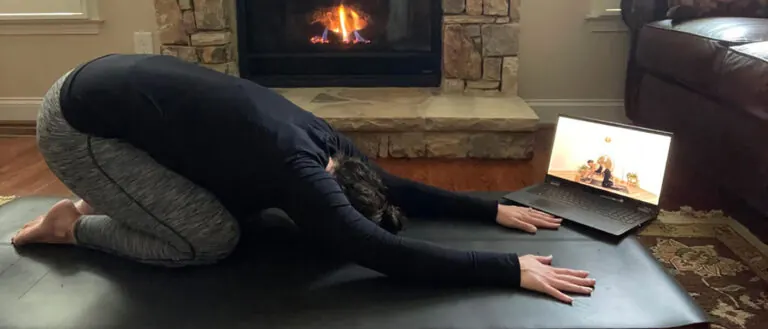
Yes. Everything in Levels 1 and 2 is online, the live meetings and practices run on Zoom, and Level 3 can be done as two live Zoom weekends, so you never have to travel. I did the whole training from Europe. The one thing to check is how the live session times, set by a school on Canada’s west coast, map onto your time zone.
Yes. Self-paced means you can start any day and move through the 32 courses at your own speed, but to certify the school requires at least nine synchronous meetings over the training plus the live Level 3 capstone (Zoom weekends or the in-person retreat).
No. Your enrolment never expires and you keep lifetime access to the material. In practice most students finish Levels 1 and 2 in about eight months at five hours a week, and Level 3 runs once a year in June (in person) or July and August (Zoom), so plan around that.
Yes, in three ways. The Level 1 Orientation course is free once you create an account, any single course can be bought a la carte (most cost $55) and counts toward the full program, and the full training carries a 30-day unconditional money-back guarantee.
Same courses, same teachers, same price. The cohort starts together in October, works through Levels 1 and 2 from October to May and does Level 3 in June, which gives you a fixed rhythm and a group that moves at your pace. Self-paced lets you begin any day and join whichever live meetings fit your calendar.
Yes. Yoga business and marketing is one of the twelve curriculum subjects, and the bundle includes a video playlist on yoga business, a yoga resume and cover letter template, and a sample intake form and waiver. It is an introduction, not a marketing course, but it is more than most 200-hour trainings offer.
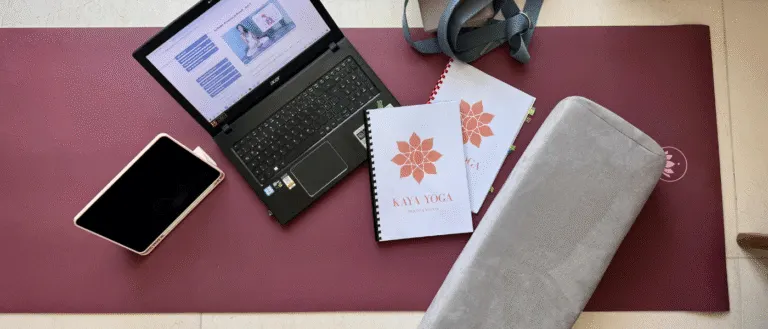
A yoga mat and basic props (blocks, a strap, a blanket) for the practices, a device that runs a browser or the Thinkific app, free Zoom access for the live sessions, and a phone or camera to record your video assessments. A printer is optional; the materials are designed to be used on screen.
The school says the training is for anyone who loves yoga, whether or not you plan to teach, and my cohort included people at every level. Beginners can absolutely do it, but the anatomy courses are detailed and the personal-practice requirements assume you can already hold a regular practice, so give yourself the full eight months rather than rushing.
Online yoga teacher training
$100 off your 200‑hour online training
Learn to teach yoga, from home
Take Movement Wisdom’s 200-hour online yoga teacher training and save $100 with your YOGI TIMES code.
Use code YT100
Get $100 offThe code is applied when you use this button, or enter YT100 at checkout.
Free wellness e-book
Find your zen
Your free guide to wellness
Download your free 7-Day Wellness Journey Guide and receive weekly inspiration for the lifestyle of a modern yogi.
🔒 We respect your privacy. Unsubscribe anytime.

YOGI TIMES · Your privacy
A few cookies, only with your yes
We use cookies to understand what you read and to measure our own marketing. Nothing is set until you choose. Privacy policy
Found my course online thanks to you guys. great resource.
Namaste
Exactly what I needed, thank you for the resource, i found my training
Love it thanks, big help, cheers
Thank you, I am taking this Online TT at the moment, it’s amazing.!
Hi there! I could have sworn I’ve been to this blog before but after reading through some of the post I realized it’s new to me. Anyways, I’m definitely glad I found it and I’ll be book-marking and checking back frequently!