How to make money as a yoga teacher


How to make a living as a yoga instructor
“Do what you love, and you’ll never work a day in your life.” – Mark Twain
That thought echoed in my head as I rolled up my mat after teaching my very first class. I was lit up, energized, aligned, and full of hope.
But soon after came the question that so many yoga teachers quietly carry:
Can I actually make a living doing this?
Flashback many years ago, I was working full-time in a restaurant in Los Angeles, stress clinging to me like a second skin. A friend invited me to a free yoga class, and something drastic clicked.
That hour and a half of mindful movement and silence felt like coming home. One training led to another, and before long, I was teaching. Passionate, committed and broke.
The journey to figure out how to make money as a yoga teacher took years with trial, error, burnout, and pivots. This journey eventually led me to launch YOGI TIMES, dive into publishing and start supporting yoga teachers in building sustainable businesses.
But I’ve never forgotten the challenge of turning this calling into a career.
So if you’re standing at that same crossroads, passionate but unsure how to make it work financially, this guide is for you. Let’s break down the strategies, mindset shifts, and marketing tools that can help you thrive, without compromising the heart of your practice.
1. Building a sustainable business foundation
Before we talk about revenue streams, pricing, or Instagram strategies, let’s get clear on something that too many teachers skip:
Are you treating your yoga career like a calling and a business?
Because even the most heart-led path needs structure, and without a clear business foundation, most yoga teachers stay stuck in survival mode, undercharging, over-giving, and always one cancelled class away from financial stress.
Here’s what grounding your business truly looks like:
- Define your niche. Are you the go-to teacher for stressed-out parents? Office workers? Women recovering from burnout? Don’t try to teach everyone. The clearer your niche, the easier it becomes to attract your ideal students and price your services accordingly.
- Clarify your offer stack. Beyond drop-in classes, what services do you provide? Think: private sessions, online programs, workshops, retreats, mentoring, or corporate yoga. Your offer stack should reflect both your expertise and your lifestyle goals.
- Know your numbers. Yes, you’re a yoga teacher, but you’re also a business owner. What’s your monthly income target? How many private clients or workshops would it take to meet it? Once you know the math, your choices become much more empowered. A new teacher might aim for $2K/month via a mix of group and private classes. Experienced teachers may build to $5K–$10K/month with online programs, retreats, and trainings.
- Mind your mindset. Teaching yoga for a living doesn’t mean you’ve sold out. In fact, when you’re resourced and supported, you show up better for your students. Money doesn’t dilute your dharma; it can help you sustain it.
Grounding your business does not mean becoming “corporate.” It’s about building something steady enough to hold the weight of your purpose, so you can stop chasing and start leading.
Question to reflect on: Where am I currently operating more like a “freelancer” than a business owner? What would shift if I treated my yoga offerings as sacred and strategic?
Example : One teacher I worked with had been teaching group classes for years, 12 classes a week, barely breaking even.
Once she clarified her niche (postnatal yoga for first-time moms) and created a 6-week small group program with personalized support, she doubled her monthly income with half the teaching hours.
The shift wasn’t about doing more, it was about doing it with intention.
2. Teaching yoga
Naturally, the first avenue you explore after completing a teacher training program is teaching classes.
Whether you plan on teaching yoga online or in a local yoga studio, this is likely to be your first job after becoming a certified yoga instructor. But there’s more to being a yoga teacher than guiding asanas and breathwork. And there’s more to your career than leading classes alone.
To build a sustainable income, you’ll need to tap into your creativity and look beyond the studio walls, but first, let´s explore what that looks like to teach in the studio or gym.
Teaching at a yoga studio or gym

As a first step to building your career in the yoga industry, I would suggest applying to teach at a yoga studio or gym. There may also be opportunities to teach at a different type of fitness centre, such as a rock climbing gym or tennis club.
Typically, you are hired as a contractor. This means that rather than being employed, you sell your services on a class-by-class basis, and your rate will likely depend on location and attendance. In a city studio, you may earn $25–$60 per class depending on experience, class size, and location.
In some cases, studios may be looking for someone to cover reception or help out in other ways, which is a great way to make extra money and make the commute worthwhile.
This type of arrangement has several benefits:
- No expenses for rent, equipment, or marketing
- No responsibility for class bookings and scheduling
- Networking opportunities
- Free class attendance for teachers (check with the studio)
- One of the easiest ways to make money as a new teacher
Diversify beyond studio classes
If you’ve been teaching in studios for a while, you already know that it’s rarely enough to cover the bills.
While living in a city with a strong yoga scene might offer more teaching opportunities, those same studios often set low pay standards and, with capped class sizes, inconsistent attendance, and fixed rates. It creates a ceiling effect, making it a financially fragile model.
On the other hand, if you offer yoga classes in a small community, you won’t have as much competition. As a result, you will be able to set the prices based on outgoings and demand.
The good news? Your teaching skills are highly transferable, and with the right structure, they can open doors to more fulfilling and sustainable income streams.

Private Yoga classes
Another benefit of teaching at various fitness locations is the opportunity to meet people and build relationships. This opens an avenue to teach privately, which is worth more because of the individual approach.
Teaching private clients is one of the greatest ways to make money as a yoga professional. People pay top dollar for one-to-one attention because the classes are tailored to suit individual needs and preferences.
Establish your hourly rate based on your skill set and how far you are willing to drive. You don’t have to charge exorbitant prices, as long as you make sure to cover your bases. One-on-one sessions allow you to personalize, deepen your impact, and raise your rates.
- Higher hourly rate compared to group classes
- Option to offer private tuition online or in person
- Work on tailoring your teaching style to individuals
- Freedom to make your own schedule
- Solid connections with your students
Corporate Yoga
Similar to the education sector, many companies now hire yoga teachers to deliver lessons as a way to best support their employees’ wellbeing.
Connect with local businesses to become one of their on-staff or cover teachers.
Teaching corporate yoga classes can expand your network, give you experience and provide a steady income. I got my first gig in a corporate setting because an existing student came to me on behalf of her company. You never know when an opportunity like that may come along!
Offering a few free classes can also help you get your foot in the door. For instance, you may reach out to companies and offer a taster session at corporate events. Some yoga teachers enhance their income by guest teaching at workshops or conferences.
From tech offices to law firms, businesses are investing in employee wellness. These clients often book weekly sessions or packages.
Schools and colleges
Many colleges and schools offer yoga as part of their wellness programs. This way, current students enjoy the mental and physical benefits, which reflects positively on the school.
The best way to approach this is to reach out. Even if your local schools and colleges do not have a wellbeing program yet, there is nothing to say that you couldn’t be the pivotal figure in creating one.
Be prepared to adapt your style to younger audiences. Remember, this is a case when your clients and your students are separate; therefore, the relationship dynamics with you as a teacher will be different compared to a yoga studio.
High-end hotels
Yoga instructors have the option to teach at luxury hotels or resorts, capitalizing on the hospitality industry’s growth. Get in touch with the headquarters of a local office to enquire about any job opportunities.
If you build a rapport with this clientele, this may also become an opportunity to find private clients for one-on-one or couples practice. Referring clients to allied health professionals can create referral partnerships that enhance business.
Outdoor Classes
The beauty of teaching yoga is that you can do it literally anywhere! Get creative and organize lessons and workshops at the beach, in parks, rooftop lounges, and public squares; there is no limit!
Of course, this takes work, just like any other item on this list. You’ll have to find a way to spread the word, whether it is through social media, bulletin boards, or flyers. Whatever it is, you’ve got this!
Workshops + speciality classes.
Instead of relying on inconsistent drop-ins, create theme-based experiences like “Yoga for Back Pain,” “Intro to Somatics,” or “New Moon Intention Flow.”
These focused sessions allow you to charge a higher rate, serve a specific need, and attract new students who may not attend regular classes but are curious about a particular topic. Bonus: they’re also great for building your email list and filling future offerings.
Retreats (micro or international)
Whether it’s a cozy weekend immersion at a local venue or a 5-day escape to Tuscany, retreats allow you to deepen your connection with students while generating significant income in fewer teaching hours.
You can combine movement, coaching, meditation, and ceremony, creating a transformational experience that’s both nourishing for them and sustainable for you. Micro-retreats are a great place to start if you’re testing the waters.
Yoga Education – mentoring new teachers
Do not limit yourself to simply teaching yoga. If you complete a minimum of 500 hours of training as a teacher, you unlock new ways to make money in the yoga industry.
With further training, you are no longer just a teacher; you can design training programs and facilitate teacher trainings for the future generation of yoga instructors.
On a smaller scale, you can become a continuing education provider, delivering speciality workshops and courses for those who have already graduated from a 200-hour YTT.
Many newer teachers are hungry for support around sequencing, confidence, or business skills.
Also, with many teacher certifications moving online, it may be easier to approach an existing yoga school that you like and offer your services for the teacher trainings they host.
Since there is more money in workshops and certification courses, many studios may be looking for an opportunity to present a YTT option to their students. It is definitely worth asking!
3. Online Opportunities
The digital age is your playground. When you take your teaching online, you’re no longer limited by where you live or by being in the studio at a specific time.
All around you, yoga teachers are moving their classes online and creating a lifestyle that gives them the freedom to travel, choose their own schedule, and live comfortably from their income.
One radiant example of digital yoga success is Kelly McHugh, founder of Digital Yoga Academy. What started as her own teaching journey evolved into a thriving six-figure business, now serving thousands of yoga teachers across the globe.
She’s not just teaching yoga anymore, she’s teaching yogis how to build empowered, sustainable businesses.
On January 13th, she’s hosting a free online event packed with soul-aligned marketing wisdom.
If you’re a yoga teacher ready to expand your reach, don’t miss this. Kelly is the go-to expert when it comes to marketing for the yoga world, and she’s sharing generously.

Online yoga courses
Ask yourself, what unique knowledge can you offer through your online courses? How can you monetize your online presence?
Platforms like Udemy or Teachable can host your courses for a percentage of their cost. You can also sell educational content on your own website, but then it will be up to you to promote the workshop or course to your potential audience.
Creating online yoga courses or workshops can increase your income and reputation. Free or discounted courses can attract new students who may eventually buy your premium content.

- Online yoga classes are more accessible to students around the world
- You can decide on the length and style of lessons
- It’s easier to combine online yoga with a full-time job
- You can still teach in gyms and studios alongside your online teaching
- Great opportunity to cultivate a yoga community
- Collaborate with other teachers to create an online yoga studio
Earn through affiliate and brand partnerships
Affiliate marketing can be a subtle, smart way to support your students while generating passive income as long as you keep it authentic.
My advice? Use a reliable platform like ShareASale or ClickBank, to find reputable partners. This lets you earn commissions without compromising your integrity as a yoga teacher.
Start by asking: Which brands or products do I already love and trust? Focus on items that align with your values and truly serve your audience.
Here are some thoughtful affiliate ideas to explore:
- Eco-conscious yoga clothing or accessories.
- Props and tools: mats, blocks, straps, bolsters.
- Fitness or wellness apps (e.g., breathwork, meditation, habit tracking).
- Functional wellness tools like the Lumivitae hydrogen water bottle (personal use and experience is always recommended before promoting a product).
- Holistic home tech (e.g., the Healy Frequency Device, which requires purchase to promote through its MLM model).
- Online teaching software (like OfferingTree or Teachable).
You can also pair digital products you love with affiliate tools. For example, create a meditation script + recommend your favourite recording mic. Many teachers do it through Amazon Associates by linking to gear they already use: microphones, tripods, lighting kits, or books.
The key is to recommend only what you truly use and believe in. Make sure you’ve used the product, and share how it helped you. Your students trust your voice; honour that by sharing only what enhances their practice or lifestyle.
Create digital products
One of the most underrated income streams for yoga teachers? Digital products! These are assets you create once that can serve your audience (and your income) again and again.
Think e-books, audio meditations, instructional videos, class plans, wellness journals, or even printable guides. These resources can support both students and fellow teachers, depending on your niche.
You don’t need to reinvent the wheel, just solve a real problem for your audience.
Examples include:
- A downloadable guide for “Yoga for Anxiety Relief”
- A collection of meditation scripts for teachers
- A 7-day home practice calendar for busy parents
- A video series on “How to Build Your First Class Sequence”
Even small digital offers priced between $5–$20 can create a steady income and build trust with your audience.
You can host your digital products on platforms like Etsy, Gumroad, or Amazon Kindle Direct Publishing, but you’re not limited to third-party marketplaces.
Selling directly through your own website or newsletter keeps your audience close and your profits higher.
Think of it this way: once your product is created and published, it keeps working for you, bringing in income while freeing up your time to focus on teaching, resting, or creating your next offering.
Start writing
How often have you browsed online publications like YOGI TIMES, Yoga International, Yoga Journal, etc., to find answers about the practice, history, or philosophy?
If you have the knack for writing, you can approach yoga blogs or publish articles on your own website and earn money through advertising.
It can be a long-term shot in terms of revenue, but it certainly establishes you as an authority on the subjects you develop.
In short, writing for online yoga publications can supplement your income and increase your visibility in the community.
On-Demand Videos or Memberships
Creating a video library or membership platform can provide recurring income. Students can access recordings anytime, which means you can earn while you’re not teaching live. It’s not fully passive, you still maintain and promote it, but it’s automated.
Affordable tools like OfferingTree make it easier for yoga teachers to host memberships and accept payments.
Online teaching gives you the freedom to grow beyond the mat, expand your reach, and create income on your terms, all while staying rooted in authenticity and purpose.
Start with what feels aligned. You don’t need to do everything at once. Choose one path at first: digital products, affiliate income, on-demand videos, or writing, and build from there with consistency and care. Your knowledge is valuable.
Your voice is needed. And the tools are already at your fingertips.
Question to reflect on: Which of my current teaching offers feels most energizing and which feels depleting? Where could I shift my time to create more income and more impact?
4. Pricing & budgeting
Yoga teacher expenses
One of the most overlooked aspects of making money as a yoga teacher? The hidden costs of doing the work you love.
Whether you’re fresh out of teacher training or have years of experience, it’s essential to recognize that your teaching income needs to cover more than just your time on the mat. Behind every class is a series of ongoing expenses, both visible and behind the scenes.
Like with any business, you need to manage your finances.
Create a budget that takes into account your income, expenses and goals. Use online accounting tools like Mint or Personal Capital to track your financials.
And keep in mind that if you struggle to care for the financial side, it may be wise to hire an accountant or financial advisor.
Here are some of the most common costs yoga teachers take on:
- Insurance – Liability or professional coverage is essential for most in-person and online teaching environments.
- Venue rental – If you’re hosting your own classes or workshops, you’ll likely need to pay for space, either per hour or per month.
- Utilities – Some venues may charge for heating, electricity, or even water use during your sessions.
- Equipment – Mats, blocks, straps, bolsters, blankets, especially if you provide them for students.
- Transport – Gas, public transport, or car expenses when travelling to studios or clients.
- Website + hosting – A professional online presence, plus domain and maintenance fees.
- Marketing materials – Printed flyers, graphic design, ad boosts, photography, or promotional videos.
- Software – Booking platforms (like Momoyoga), Zoom plans, or digital course hosting tools.
- Consumables – Candles, incense, cleaning sprays, and ambience tools that enhance the student experience.
- Taxes + health insurance – Depending on your location, self-employment tax, healthcare contributions, and accounting help can add up quickly.
While teaching online can reduce many of these costs, especially venue and travel, it also increases competition.
You’re no longer one of ten teachers in your neighbourhood; you’re one of thousands with internet access and a Zoom link.
That’s why, like many new teachers, I began by working in gyms or established studios. It removed the burden of managing bookings, covering overhead, and marketing myself, but it was also often at the cost of lower income and less control over my schedule.
You must understand these expenses, but it does not mean to discourage you; it’s meant to empower you.
When you plan for these costs and build them into your pricing, you’re no longer guessing; you’re running a grounded, conscious business.
You don’t need a fancy spreadsheet, just clarity. Know your monthly baseline: rent, food, tech tools, self-care.
Then build your offers around covering that with spaciousness. Add 10–15% for taxes, savings, or growth. That’s not greedy, it’s being responsible for your well-being and your growth as a teacher.
Successful yoga teachers incorporate all of their invested time and expenses into the cost of their services, which helps them grow their yoga business.
How much can you earn as a Yoga teacher?

Research is key. Use the US Bureau of Labor yoga statistics 2025 to look up average salaries for yoga professionals in your area. If you’re from a different part of the world, enquire with most studios and local fellow teachers.
Your earning potential is based on your experience, qualifications and reputation. If you are constantly upskilling, your value will increase. Similarly, if you create multiple income streams, your overall earnings will benefit.
One mistake I see often is teachers copying what others charge. Consider your skill level, experience, niche, and most importantly, the transformation you’re offering. Price in alignment with the value you provide, not just the time you spend.
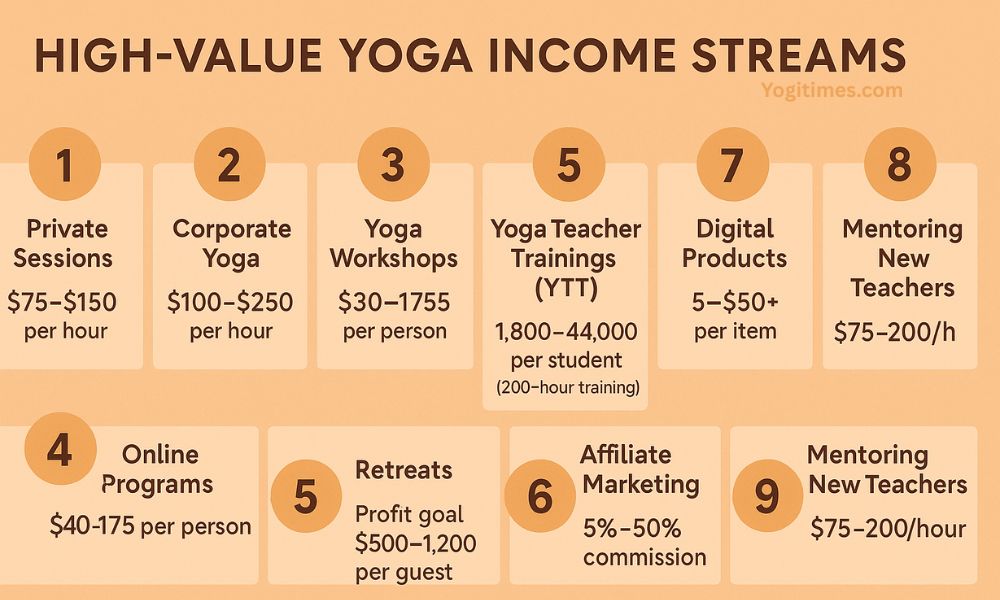
1. Private Sessions
$75–$150 per hour
One-on-one sessions tailored to a student’s needs (injury recovery, stress, athletic training, etc.) tend to be one of the most consistent and scalable offerings.
2. Corporate Yoga
$100–$250 per hour
Teach in offices or virtual workplaces. Often paid by the company, not individual students, more stable and high-yield. Try reaching out to HR reps via LinkedIn.
3. Yoga Workshops
$30–$175 per person
One-off themed events (2–3 hours) like “Yoga for Stress,” “Inversions 101,” or “Chakra Balancing.” Ideal for deepening student experience and testing new teaching formats. Example: charge $30–$75 per person for 90-minute workshops, or $175+ for 3–4 week series. Use a website like Eventbrite.
4. Online programs & courses
$47–$297+ per program
Pre-recorded or live group programs covering topics like alignment, philosophy, meditation, or yoga for beginners. Can be self-paced or facilitated over several weeks.
5. Yoga teacher trainings (YTT)
$1,800–$4,000 per student (200-hour training)
Hosting your own teacher training (in person or online) is a major income stream but also a significant time and energy investment. It can also be done collaboratively or in partnership with a studio.
6. Retreats
Profit goal: $500–$1,200 per guest
Hosting retreats (local or international) allows you to combine practice, community, and deeper transformation. Consider factoring in travel, venue costs, marketing, and your time. Profit depends on the pricing structure and student numbers.
7. Digital products
$5–$50+ per item
E-books, journals, class plans, guided meditations, or printables. Low-cost to produce and can generate passive income.
8. Affiliate marketing
5%–50% commission
Earn by recommending products you genuinely use, props, clothing, software, or wellness tools. Use platforms like ShareASale and many others like ClickBank or negotiate percentage/deals directly with the vendor when you see you start sending regular traffic to their brand.
9. Mentoring new teachers
$75–$200/hour
When you create training programs for new yoga instructors, you get to transmit your knowledge and continue to generate an additional income stream. Rates often range from for mentoring calls or packages.
Remember, charge what allows you to show up fully and sustainably.
Yoga earnings >>> What is an average Yoga teacher salary?
Abundance mindset

Do the inner work around your self-worth
I like to talk about money from a place of clarity and worth, because undercharging doesn’t make you more spiritual. It makes your business unsustainable.
Let´s be clear, many of us as yoga teachers resist setting strong financial foundations. But when your finances are grounded, your teaching flows more freely. You’re not panicked, and you can be more present.
Just like it is with any other job, knowing your worth as a yoga teacher is key. Every lesson requires your time, expertise, and energy.
You’ve already invested in the yoga teacher training and maybe even further speciality certifications. Think about those investments and set yourself and your yoga business accordingly.
Your ability to receive is deeply tied to your beliefs. Many of us carry guilt around charging for something we love or for what feels sacred. Remember: money is not the opposite of yoga. It’s a neutral tool that reflects energy exchange. You can be both spiritual and successful.
A teacher I know in Amsterdam resisted raising her private session rates for years, even though she had a waitlist.
When she finally went from €70 to €110, she didn’t lose a single client. In fact, they showed up more committed. Why? Because she did.
Stand your ground
One of the obstacles we face as yoga teachers is our lack of conviction. To fully dedicate yourself to delivering the best practice you can as a yoga instructor, you have to trust your worth.
Do not devalue your knowledge or skill. You worked hard to get where you are, and you deserve to be rewarded financially for what you bring to your students.
Set clear boundaries not just for yourself but for fellow teachers in the industry. Be unapologetic about your worth; this is attractive to students and clients.
Ethical considerations
As yoga instructors, our relationship with money can often be as complex as the asanas we teach. The underlying ethos of yoga further complicates this as a devoted and selfless practice.
Spend some time looking into your inner landscape and let it reveal new ways to align your financial goals with your yoga values. It’s not just about making money; it’s about doing so in a way that feels authentic and aligned with your principles, but also pushes you outside of your comfort zone.
For instance, you may offer free yoga classes as a way to give back to your community and supplement the teaching you do as a job.
Question to reflect on: Where am I undercharging or undervaluing my work, and what belief might be keeping me there? What would my most empowered self charge, and why?
Yoga business advice >>> How to host a Yoga retreat
Marketing strategies for Yoga teachers

There is something really evident that I did tend to overlook for years, which is that being an amazing yoga teacher is not enough if no one knows you exist.
Marketing is not self-promotion. It’s about service with clarity. You’re not “selling yourself.” You’re helping the right people find you. And in a sea of content, that takes more than just good vibes and hope.
The goal? To market your offerings in a way that feels honest, effective, and true to your voice.
Build a personal brand that resonates
Before you dive into platforms and content plans, take a step back:
What do you want to be known for?
What kind of students are you here to serve?
Your brand is not your logo, it’s your energy, your message, and your presence across everything you share. Whether you focus on yoga for anxiety, trauma-informed teaching, or soulful vinyasa, clarity is key. When your audience knows what to expect from you, they’re more likely to trust and follow you.
Tip: Pick 2–3 core themes that reflect your values and expertise, and create content around those consistently.
Build your audience
It won’t happen overnight, but if you commit to online marketing, you have to attract an audience. Building relationships is essential for growing a client base in yoga.
Focus your social media strategy
Use Social Media with Intention, Not Exhaustion. You don’t need to be everywhere to make an impact.
In fact, trying to show up on every platform can quickly lead to burnout.
Instead, choose 1–2 platforms where your ideal students already spend time, whether that’s Instagram, YouTube, TikTok, Facebook, or even Substack, and focus your energy there.
Here’s how to use social media as a tool for connection and growth, not just promotion:
- Share valuable content – Offer short practices, common yoga myths, behind-the-scenes insights, or reflections from your teaching.
- Tell your story – Let people into your process. Share the “why” behind your work. Authentic storytelling creates trust and resonance.
- Repurpose your content – One class theme can become a blog post, reel, email, and graphic. Stretch your ideas across formats instead of constantly creating from scratch.
- Engage, don’t just broadcast – Reply to comments, ask questions, and build real relationships. Community matters more than reach.
And remember: show up consistently not constantly. Your presence doesn’t need to be perfect, just real and aligned.
When used mindfully, social media can become a powerful extension of your teaching not a distraction from it.
However, educate, don’t just promote yourself. Share tips, myths, mini-practices, and insights. People want to learn from you, not just hear about your next offering. Serve first, invite second.
Create your email list
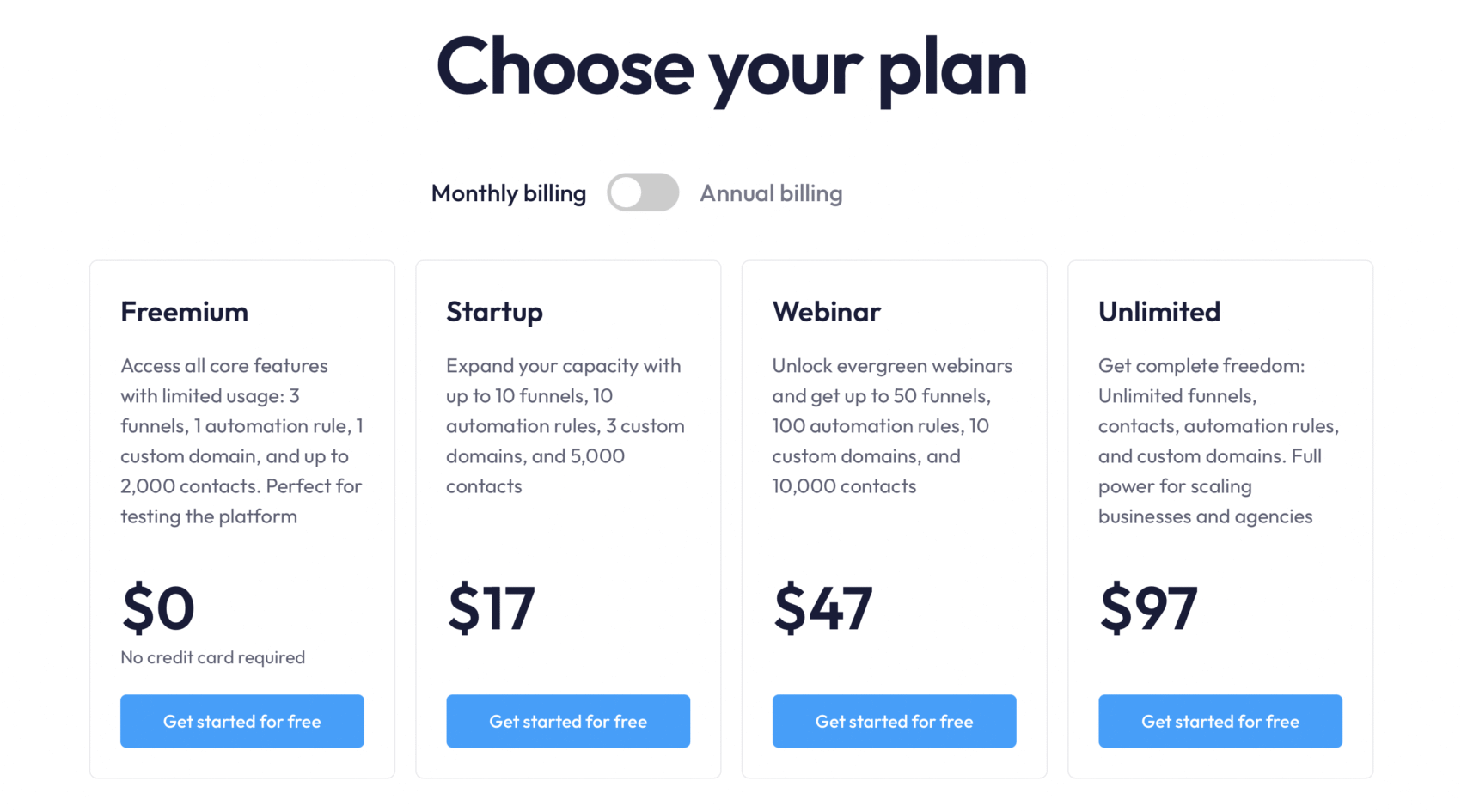
Outside of social media, it’s always good to build a mailing list, at YOGI TIMES we use Systeme.io and we love it, we use the Unlimited plan for 97 US$, see pricing plans in the screenshot below, you can start free with your first 2000 emails.
Unlike social media, you own your list, and it’s where deeper connections and conversions happen.
Use a freebie (like a guided meditation, cheat sheet, or short video class) to encourage sign-ups. This way, you can review products and services you want to promote as an affiliate, as well as engage with your community.
Use your emails to:
- Share your story
- Educate and inspire
- Promote your classes, courses, or collaborations
- Highlight affiliate products or digital offerings
Borrow other people´s audience
Not sure where to start? Try the BOPA method, “Borrowing People’s Audience.” Collaborate with influencers, brands, or publishers with large or niche audiences, such as blogs or email lists.
One of the fastest ways to grow your audience is to connect with others who already have one.
- Guest post for yoga blogs or wellness websites.
- Appear on podcasts or Instagram Lives.
- Collaborate on classes, challenges, or giveaways.
- Partner with aligned brands or teachers to co-create content.
- Organized a collab with a local café for a “Yoga & Brunch”.
When done with intention, this expands your reach and boosts your credibility. For example, at YOGI TIMES, we do many guest appearances, joint content, or cross-promotions that can help tap into partners´ following, connect with potential new readers, and build our audience faster while enhancing our credibility.
Get educated, save time
Many teachers try to write, design, film, edit, post, and promote everything themselves, often with no background in marketing. If you can, invest in support such as hiring a virtual assistant to schedule posts or emails, collaborating with a designer for your brand kit, or working with a marketing coach to create a launch strategy.
Even 2–3 hours a month of professional help can save you dozens of hours and a lot of stress. You are the heart of your business, not the entire machine.
And if the idea of marketing overwhelms you, don’t go it alone. Learn from those who specialize in supporting yoga professionals. It’s essential to educate yourself about the marketing side of your business. If this seems like too high a mountain to climb, why not hand this task over to someone who knows what they are doing?
I recommend Digital Yoga Academy, which is a great school for that. Kelly McHugh, the founder and coach, based in Uluwatu, Bali, is truly an expert at digital marketing and can help you save years of learning to promote yourself online.
Question to reflect on: What part of your marketing currently feels out of alignment, and what would change if you approached it as service rather than self-promotion?
Yoga Earnings >>> What is an average Yoga teacher salary?
Redefining success as a Yoga teacher
Success is not just about making money; but you need to earn enough to keep doing what you love. Teaching yoga is a calling, yes, but it’s also a profession. And if your pricing, energy output, or schedule comes at the cost of your health and joy, something’s out of balance.
True success as a yoga teacher means your work nourishes you, first and foremost.
Yes, understand the business side. Yes, charge what your offerings are worth. But also ask yourself:
- Am I building a life I actually want to live?
- Is this schedule sustainable?
- Am I prioritizing my well-being as much as I hold space for others?
Question to reflect on: “What would change in your business if you honored your rest as much as your revenue?”
Final thoughts – your yoga, your business, your way
Making money as a yoga teacher should not be about selling out but about showing up. It’s about honouring your practice, your purpose, and your worth.
A sustainable yoga career comes from balance between income and impact, effort and rest, giving and receiving. When your business supports your body, your spirit, and your bank account, your teaching becomes not just transformational but truly fulfilling.
Whether you’re teaching in studios, running retreats, or building digital products, your work holds deep value. And the more stable and supported you are, the more powerful your impact becomes.
So here’s your next step:
Choose one income stream you haven’t explored yet, maybe it’s a digital offering, a private package, or a brand partnership.
Choose one supportive system, a marketing tool, a virtual assistant, or an online platform – that could ease your load and free up your creative energy.
And remember: your business should nourish you as much as your teaching nourishes others. You don’t have to hustle to be successful, just aligned, intentional, and supported.
And now go for it! Namaste.
Additional questions to ask yourself
What is the industry standard pay in your area?
Is there anything you bring to the table that would justify asking above standard pay?
What are your outgoings as a yoga instructor?
How much time are you investing in your yoga career outside of teaching classes?
Are you comfortable with standing by your prices even if some clients say no?
Is your goal to make a full-time wage, or would you be teaching yoga to supplement your existing income?
Do you have a plan for slow periods?
Do you have a financial “cushion” for cases of illness or unemployment?
How are you investing back into your business?
PS: We’d love to hear from you! Please share your thoughts and tell us if there’s any additional information you’d like to see in this article. Your feedback is invaluable to us.




Free Wellness E-Book
Find Your Zen!
Your Free Guide
To Wellness
Download Your Free Guide & Receive Weekly Inspirations From The Lifestyle Of a Modern Yogi!

I didn’t realize how much i could make from hosting yoga retreats. Took a group to Bali last year and made more than a month of studio classes. Highly recommend if u can swing it
Thankyou for all your efforts that you have put in this article on how to make money, very interesting info .
This article is so insightful—thank you! I’ve been teaching yoga part-time for about a year, but I’m struggling to grow my income.
I love the idea of offering online classes, but I’m not sure where to start with building an audience.
Do you think it’s better to focus on social media platforms like Instagram or create a YouTube channel?
Also, have you seen success with teaching corporate yoga classes? I’d love to hear tips from other teachers on what’s worked for them!
This is such high-quality information, thank you for sharing!
I’ve been looking for ways to diversify my income as a yoga teacher, and your tips on offering private sessions and online classes really stood out. Do you have any advice for finding clients for private lessons?
Also, what platform works best for launching online yoga courses?
Would love to hear more about what’s worked for others!
This article is so helpful—thank you! I’ve been teaching yoga part-time for a year and want to transition into making it my full-time career.
The idea of hosting workshops really caught my attention, but I’m unsure how to price them or market to the right audience.
Do you have any tips for setting up successful workshops? Also, have you seen success with teaching yoga online? I’d love to hear more
Thank you for sharing, indeed a great article on making money as a yoga instructor!