AeroGraph Puffer Jacket reviews: Lightweight Aerogel warmth tested in real cold


Living through Baltic winters is a challenge for anyone spending significant time outdoors. One day you’re cutting firewood at freezing temperatures, the next you’re walking through damp city streets, and then you board a train and suddenly you’re overheating.
Sure, not everyone deals with the same reality, but I am an athlete who lives in the countryside and commutes multiple times a week to teach yoga in the nearest town. I needed a jacket that could handle serious temperature swings. I didn’t want bulk. I didn’t want to constantly layer and de-layer. I wanted a reliable clothing item that could work in different situations.
That’s what led me to review the AeroGraph puffer jacket by Graphene-X, marketed as a next-generation aerogel jacket designed to respond to temperature changes in real time.
After wearing it during outdoor exercise, commute, and everyday errands, here’s what stood out. If you want to see the specs behind this AeroGraph aerogel jacket, you can explore the official product page.

AeroGraph Puffer Jacket: What caught my eye
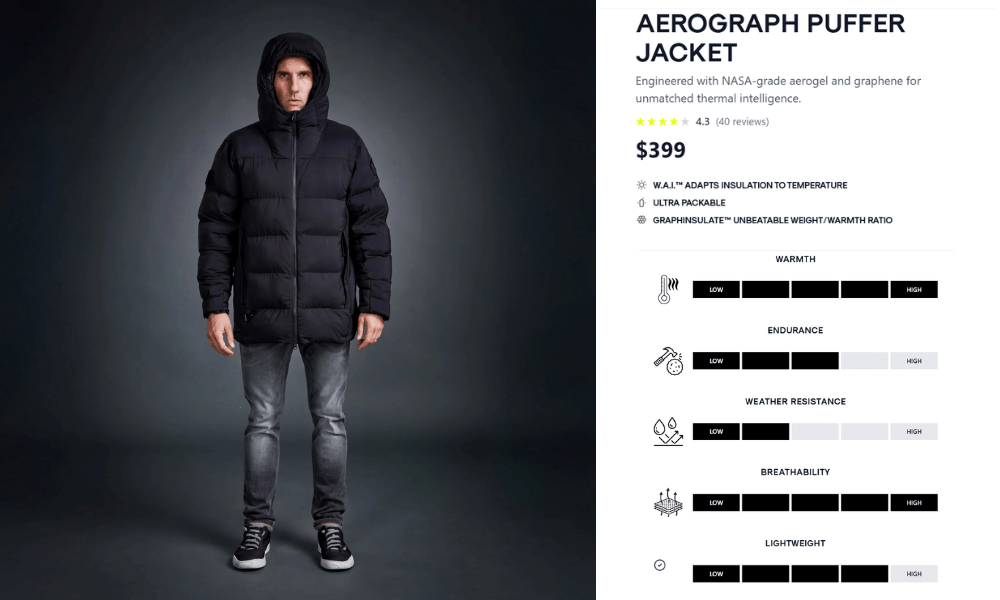
- The brand’s signature Weather Adaptive Insulation (W.A.I.)™ which claims to perform in temperatures from -20°C to +20°C (-4°F to 68°F).
- The promise of warmth without the bulk typical for a puffer jacket. This aerogel jacket weighs 830 grams (29 oz) and fits into a small drawstring bag.
- The sleek, unisex design that includes multiple pockets (two zipper pockets at the front, and three internal pockets). It’s nice to encounter a brand that doesn’t try to capitalize on making women’s outdoor clothing pink.
- The overwhelming majority of positive reviews on the company’s website.
- The versatility that would theoretically allow me to exercise (run, cycle, hike) outdoors and also wear this puffer jacket casually when traveling or running errands.
Technology breakdown: W.A.I.™ & Graphinsulate™
I think it is fair to say that most people don’t know how their puffer jacket insulation works. Most commonly, puffer jackets and coats are filled with natural or synthetic down, creating a buffer that retains body heat.
As a result, an average puffer jacket for lower temps tends to be quite bulky and loses all usefulness once the weather gets warmer.
Graphene-X used a combination of aerogel and graphene to create Weather Apadative Insulation (or W.A.I™) that responds to the temperatures in real time. Essentially, this jacket is like a living organism; it’s filled with material that expands or contracts to provide appropriate insulation level.
To understand how it adapts to temperature shifts, I looked deeper into the technology behind this aerogel insulation jacket.
What is Aerogel?
Aerogel is made by removing liquid from a gel and replacing it with air. The name practically speaks for itself, although I would be lying if I said I’ve heard of aerogel before researching this jacket.
What you get is a solid, ultra-light material that’s mostly air. Aerogel insulation is widely used in aerospace engineering because it’s incredibly light and thermally efficient.
Of course, air is also a powerful insulator. In this jacket, aerogel is formed into tiny tubes that expand in the cold to trap more heat and contract to release excess heat in a warmer environment.
What is Graphene?
Graphene is a hexagonal lattice of carbon atoms, known for having a high strength to weight ratio and being highly conductive.
In clothing insulation, graphene’s role is not just to trap heat but to help distribute it more evenly across the body. The brand’s proprietary insulation fill has graphene integrated into synthetic fibers to improve thermal management and maintain insulation even when wet.
To sum up, the AeroGraph puffer jacket uses some really impressive technology to keep you warm – but not too warm!
Fit, feel, and first use

I tested the unisex model in XS (recommended for chest 37.5 inches and under; mine is 32 inches). The fit is relaxed but not sloppy. It’s not tailored, but the silhouette still looks clean.
Right from the bat, I was pleasantly surprised with the amount of detail that blocks the cold and wind from getting in or under the jacket.
- Elasticated cuffs to block drafts
- High collar that doesn’t make you feel like you’re choking
- Adjustable hem that cinches if you want extra insulation
- The hood with an elasticated brim that seals around the face and stops the wind from blowing the hood off
The outer shell appears sturdy but flexible. The material is neither smooth nor stiff, presumably to give it the ability to withstand changes in the insulation when it expands and shrinks back down. While I cannot speak on long-term durability yet, after two weeks of wear there were no abrasions, loose threads, or “imprints” from backpack straps.
The lining is pleasant to touch and doesn’t cling to the skin. I should also mention I haven’t experienced any static shocks common for this type of material, which is a bonus.
Since this model is unisex, and I wear women’s XS in most clothing, this jacket was a loose fit. In action, weather adaptive insulation does expand and firm up, so I was happy to have the extra space. I would advise going a size up if you’re between sizes to account for the expansion in colder conditions.
Extra features
This puffer jacket has five pockets (five!): two front zipper pockets, and three internal pockets (one with a zipper). Historically, women’s clothing either lacks pockets altogether or features tiny non-pockets that don’t have any functionality. Needless to say, I was psyched! When in doubt, a unisex jacket is the way.
There is a metal loop at the front, which I used to clip my gloves to when I was out for a run. I’m not sure if that’s the intended use, but it worked for me!
The front zipper is double-ended, which was useful when driving. On my frame, the bottom of the puffer sits around my hips, so unzipping the bottom slightly gave me more mobility.
The jacket also came with a drawstring pouch you could use for storage and packing. To be fully honest, I was surprised that the entire jacket fit into the relatively small bag!
Another nice touch was a repair kit. I’m very conscious of my consumption habits, and I always prefer to repair rather than replace my clothing. Unfortunately, most puffer jackets and coats are very difficult to repair – but I hope that this thoughtful addition, together with the overall quality, will extend my jacket’s lifespan even more.
AeroGraph Aerogel Jacket vs Traditional Down Jacket
If you’re wondering how the AeroGraph aerogel jacket compares to a traditional down puffer, here’s a quick breakdown of the key differences in insulation, weight, and versatility.
| Feature | Graphene-X AeroGraph Jacket | Typical Down Puffer Jacket |
|---|---|---|
| Insulation Type | Aerogel + graphene (W.A.I.™) | Goose or duck down |
| Temperature Adaptability | Dynamic insulation that responds to temperature | Fixed insulation level |
| Weight | 830 g (29 oz) | Typically 900–1,200 g |
| Performance When Wet | Maintains insulation thanks to graphene-integrated fibers | Down loses insulating ability when wet |
| Packability | Packs into a small drawstring bag | Moderately packable depending on fill power |
| Pocket Layout | 5 pockets (2 external, 3 internal) | Usually 2–3 pockets |
| Sustainability Features | Bio-based shell partially derived from starch | Varies by brand |
| Best For | Travel, commuting, winter running, versatile daily wear | Static cold conditions and traditional winter layering |
| Price Range | $399 | $150–$400 depending on brand |
Weather performance: how I tested the jacket

The brand claims performance from -20°C to +20°C, which was intriguing to say the least. To put it to the test, I wore it outdoors for running, hiking, driving, my homestead duties and walking commutes in temperatures -7°C to 2°C (19°F to 35°F).
When exercising, I deliberately wore very little underneath. For instance, for my run at -4°C I only wore a tank top and a sports bra. Typically, for a winter run I would layer a merino base layer with a lighter jacket. However, I wanted to see how much warmth is captured by the jacket itself.
I’m happy to report that I warmed up within the first half a mile, to the point I had to take off my gloves. The loop on the front was handy to clip my gloves to it without creating a lot of bulk in the pockets.
For hikes and city walks, I wore a thicker long-sleeve (like a sweater or turtleneck) underneath. It takes a few minutes for the dynamic insulation system to adapt, but I was really impressed with the fact a single layer was enough. I didn’t even know it was possible to be warm enough without feeling really bulky in the winters we have here.
It’s possible that for colder temperatures, I may need to wear something thicker – but I might not have to! When I was out in freezing temperatures, I could feel the aerogel jacket puff up and firm up around me, so it is entirely possible that even in low temps like -20°C the insulation adapts enough to warrant fewer layers underneath.
Naturally, if I went indoors I would undress, unless I was going to the store or pharmacy. I’m not sure what the temperatures were, but there was no point when I felt like I was overheating.
Fortunately for me (and unfortunately for the jacket testing) the weather has been dry, even in the cold temperatures. So at the time of writing this, I am yet to find out how this lightweight aerogel puffer jacket holds up against rain or snow.
The jacket is rated 2/5 for weather resistance on the brand’s own site, but at the same time, it claims that Graphinsulate should keep me warm even if the jacket is wet. Plus, the outer shell is coated in water repellent that is both PFC- and PFA-free.
Key features that matter
- 160g graphene-integrated fill
- Bio-based shell (partially starch-derived)
- Packs into a compact drawstring bag
- Five pockets (2 external, 1 external zip, 2 internal)
- Two-way zipper
- Elastic hem cinch and ready-for-everything hood
- Small metal utility loop
- Lifetime guarantee
- 30-day size exchange
If you want to compare insulation types, warmth levels, and everyday winter styles, browse the full aerogel jackets collection by Graphene-X. It’s a useful place to see how the AeroGraph Puffer Jacket fits into their wider cold-weather lineup.
If you need something even more technical for extreme cold, long outdoor days, or situations where passive insulation might not feel like enough, you can also compare it with their graphene heated jacket.
Pros
- Excellent warmth to weight ratio: this jacket is both lightweight and not bulky
- Noticeably breathable for a synthetic puffer: I never felt like I was overheating
- Packs down efficiently into a drawstring bag included in the kit
- Five pockets with a thoughtful layout for easy access
- Two-way YKK zipper that can provide extra mobility in the lower body.
- Adjustable hem and hood cinch, along with the ability to tighten sleeve cuffs with velcro
- Dynamic insulation that responds to the environment and adds to versatility
- A clean unisex design suitable for outdoor exercise and casual wear
- A repair kit and instructions to increase the longevity of the piece
- The company won an ISPO award in 2022 which recognizes significant products in sports
- Overall positive ratings from customers
- Transparency from the brand in rating their own product’s features and displaying all reviews, even the negative ones
Cons
- Premium price point of $399 is at the top of the range for similar products
- Weather resistance and durability rated lower on the brand’s own website
- Some reviews indicate that the sizing did not work for them
Final verdict

The AeroGraph aerogel jacket by Graphene is a serious attempt to rethink the traditional puffer. It’s lightweight and technical without looking aggressively “sporty”, which was a huge factor for me. It meant I could wear it when exercising outdoors in freezing temperatures, yet it also paired well with casual clothing like jeans and slacks.
The dynamic temperature control was outstanding in the weather range I’ve experienced so far. I wasn’t able to test it against rain or snow, but in dry cold and windy conditions this puffer jacket performed confidently.
Ideal user
This jacket makes sense for someone who:
- Spends a lot of time outdoors (hiking, camping, living in the countryside)
- Lives in a cold but changeable climate
- Wants one adaptable winter layer instead of multiple coats
- Values innovative materials and sustainability elements
If you need one jacket to handle cold runs, city commutes, and winter travel without constant layering adjustments, this is a strong contender.
Travel with it. Trust it. Try the AeroGraph jacket today!
FAQs
Aerogel insulation traps air extremely efficiently. While traditional down jackets can be warmer in static cold conditions, aerogel jackets offer versatility and excellent weight-to-warmth ratio.
Graphene-X aerogel jacket does not claim to be fully waterproof. The AeroGraph puffer uses a water-repellent shell but according to the brand’s website, the weather resistance rating is 2/5.
At $399, this jacket sits firmly in the premium category. I think it is a worthwhile investment if you value lightweight warmth, technical innovation, and versatility across changing temperatures. That said, I have not owned it long enough to speak confidently about long-term durability. If you want to review the specs and technology yourself, you can explore the aerogel insulation jacket.
The sizing was fairly accurate for me, but I would pay close attention to the size chart, especially since this is a unisex fit. I tested an XS, which matched my measurements, but the jacket wore looser than most women’s XS styles. In colder temperatures, the weather adaptive insulation can expand and firm up slightly, so if you are between sizes or plan to wear thicker layers underneath, sizing up may make sense. Overall, I found the fit relaxed, comfortable, and practical for movement without feeling overly bulky.




Free Wellness E-Book
Find Your Zen!
Your Free Guide
To Wellness
Download Your Free Guide & Receive Weekly Inspirations From The Lifestyle Of a Modern Yogi!