Yoga helped my back pain until it didn’t: lessons from my MRI

TL;DR
Yoga can be one of the best tools for managing back pain, but it is not always the right solution for every back problem. After practicing yoga for more than 25 years, I assumed it was protecting my spine. Then an MRI revealed degenerative discs, facet joint arthritis, and a mild spondylolisthesis in my lower back.
The experience taught me an important lesson: yoga can help back pain, but it can also make it worse when we ignore pain signals, chase flexibility at the expense of stability, or apply the same poses to every body. In this article, I’ll share what my MRI revealed, what I learned from years of practice, and how I approach yoga and back pain differently today.
I thought yoga was protecting my back
When I first discovered yoga in Santa Monica more than 25 years ago, I never imagined I would one day be writing about chronic back pain.
Like many people, I came to yoga looking for something deeper than exercise. My journey eventually led me from Bryan Kest’s Power Yoga classes in West LA to a 10-day Vipassana meditation retreat in Northern California. Over the years, yoga became more than a workout. It became part of how I lived, moved, breathed, and understood my body.
Because of that, I assumed yoga was protecting my back.
And for a long time, it probably was.
Throughout my entire life and early fifties, I remained active. I played tennis and practiced yoga regularly, surfed a bit when I could, traveled extensively. Yet every so often, my lower back would remind me that something wasn’t quite right.
At first, I dismissed it.
I blamed long flights.
I blamed age.
I blamed sports.
I blamed sitting too much.
What never crossed my mind was that some of the movement habits I had developed over decades—including certain aspects of my yoga practice—might be contributing to the problem.
Then the pain started becoming harder to ignore.
There were periods when getting out of bed felt difficult. Certain tennis matches would leave me limping. Some mornings my back felt stiff and fragile. For the first time in my life, I began wondering whether I would eventually have to give up some of the activities I loved.
That question led me to get an MRI.
What my MRI revealed
The MRI didn’t reveal a catastrophic injury.
In some ways, that was the surprise.
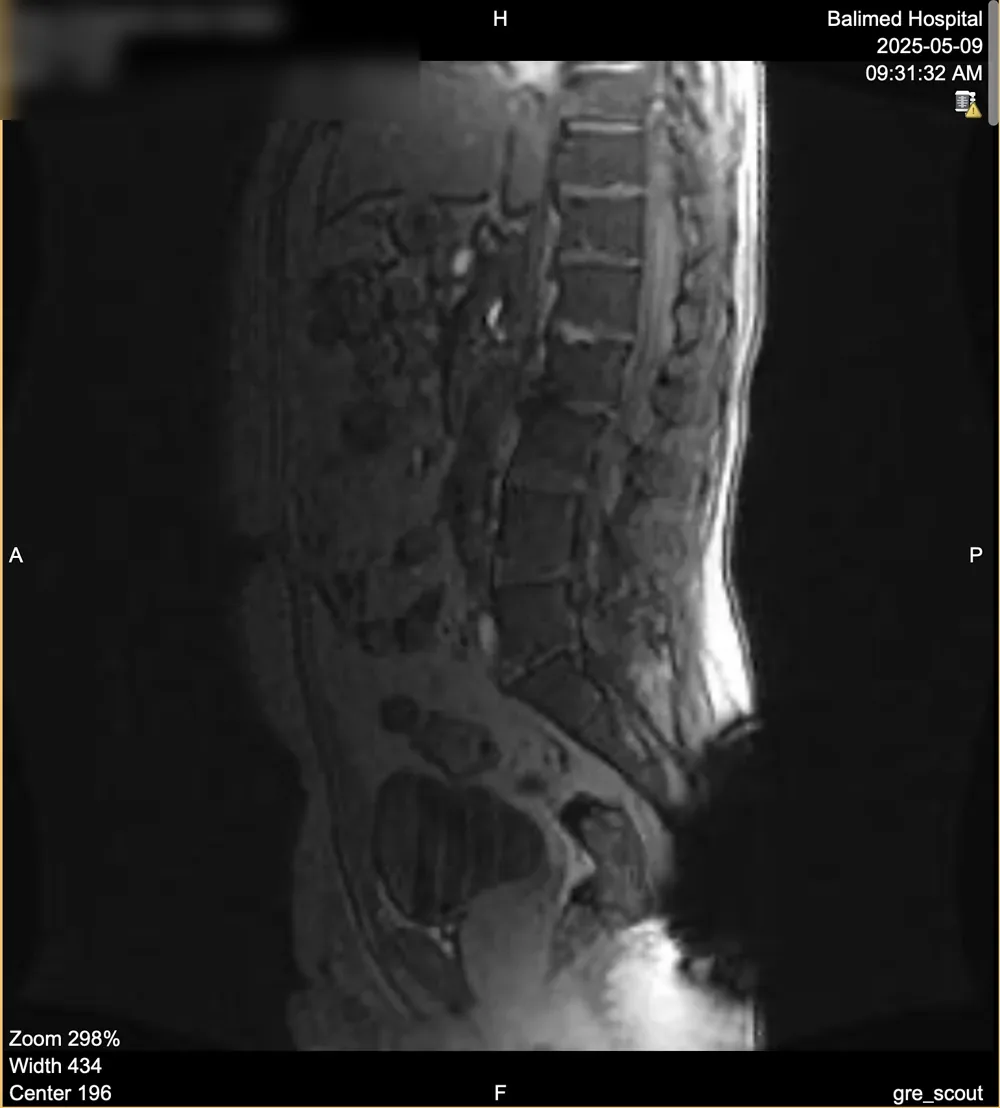
The scans showed several age-related changes that are common in active adults. I had degenerative discs in my lumbar spine, arthritis in the facet joints, and a mild spondylolisthesis at L5-S1, where one vertebra had slipped slightly forward over another.
Fortunately, there was no significant nerve compression and no surgeon recommended surgery.
Still, seeing those findings in black and white was unsettling.
Like many people who receive MRI results, my first reaction was fear.
Was my spine deteriorating?
Should I stop playing tennis?
Should I stop practicing yoga?
Was this simply what happens at 50-plus?
Over time, however, I learned something that changed my perspective completely.
The MRI findings were real, but they did not fully explain my experience.
Many people have disc degeneration and arthritis without pain. Others experience significant pain with relatively minor findings on imaging. The relationship between MRI results and symptoms is often far more complicated than most of us realize.
That realization became one of the most important lessons of my journey.
My MRI showed wear and tear.
It did not define what I was capable of doing.
The biggest lesson my MRI taught me
The most important thing my MRI taught me wasn’t about discs, arthritis, or spinal anatomy.
It was about fear.
Like many people, I initially viewed the MRI findings as a diagnosis of my future. I assumed that degenerative discs meant inevitable decline and that arthritis in my spine would gradually limit what I could do.
What I eventually learned is that MRI findings are often only one piece of the puzzle.
Many people walk around with bulging discs, degenerative discs, and arthritis without experiencing significant pain. Others experience severe pain despite relatively minor findings on imaging.
Pain is real, but it isn’t always a direct reflection of structural damage.
That realization changed how I approached movement.
Instead of asking, “What’s wrong with my back?” I began asking, “What helps my back function better?”
That shift moved me away from searching for a miracle cure and toward learning how to manage my condition through movement, recovery, strength, mobility, and lifestyle habits.
Ironically, I became less fragile when I stopped treating myself as fragile.
I still have the same MRI findings today.
Yet I continue to play tennis, practice yoga, walk, swim, travel, and live an active life.
My back requires attention, but it doesn’t control my life.

Can yoga help back pain?
For many people, yes.
In fact, yoga is frequently recommended as part of a conservative approach to managing chronic lower back pain.
When practiced appropriately, yoga may help:
- Improve mobility
- Reduce muscle tension
- Increase body awareness
- Improve balance and coordination
- Strengthen the muscles that support the spine
- Reduce stress and anxiety that can amplify pain
One of the reasons yoga can be so effective is that it addresses multiple factors at the same time.
Back pain is rarely just a structural problem.
Sleep, stress, movement habits, strength, flexibility, recovery, and even fear of movement can all influence how much pain we experience.
A thoughtful yoga practice can positively affect many of those variables.
The problem is that not all yoga is therapeutic.
And not all back pain responds the same way.
Why does my back hurt after yoga?
This is one of the most common questions people ask after developing pain during or after practice.
The answer depends on the cause.
Normal post-exercise soreness
If you’re new to yoga or returning after a break, some soreness is completely normal.
Your muscles are adapting to new movement patterns.
This type of soreness usually improves within 24 to 48 hours.
Overstretching
Many yoga practitioners are taught to chase deeper stretches.
The problem is that flexibility and health are not always the same thing.
Sometimes what feels like a productive stretch is actually irritation of sensitive tissues.
The lower back often pays the price.
Existing spinal conditions
Disc degeneration, facet arthritis, spondylolisthesis, spinal stenosis, and other conditions may become aggravated by certain movements.
A pose that feels wonderful for one person may create symptoms for someone else.
Poor movement patterns
Even experienced yoga students can unknowingly compensate during poses.
Instead of distributing movement throughout the hips, thoracic spine, and shoulders, they repeatedly load the lumbar spine.
Over time, those movement habits can become problematic.
Doing too much too soon
One of the biggest mistakes I see is assuming that more yoga is always better.
Sometimes the body needs recovery just as much as it needs movement.
Can yoga cause back pain?
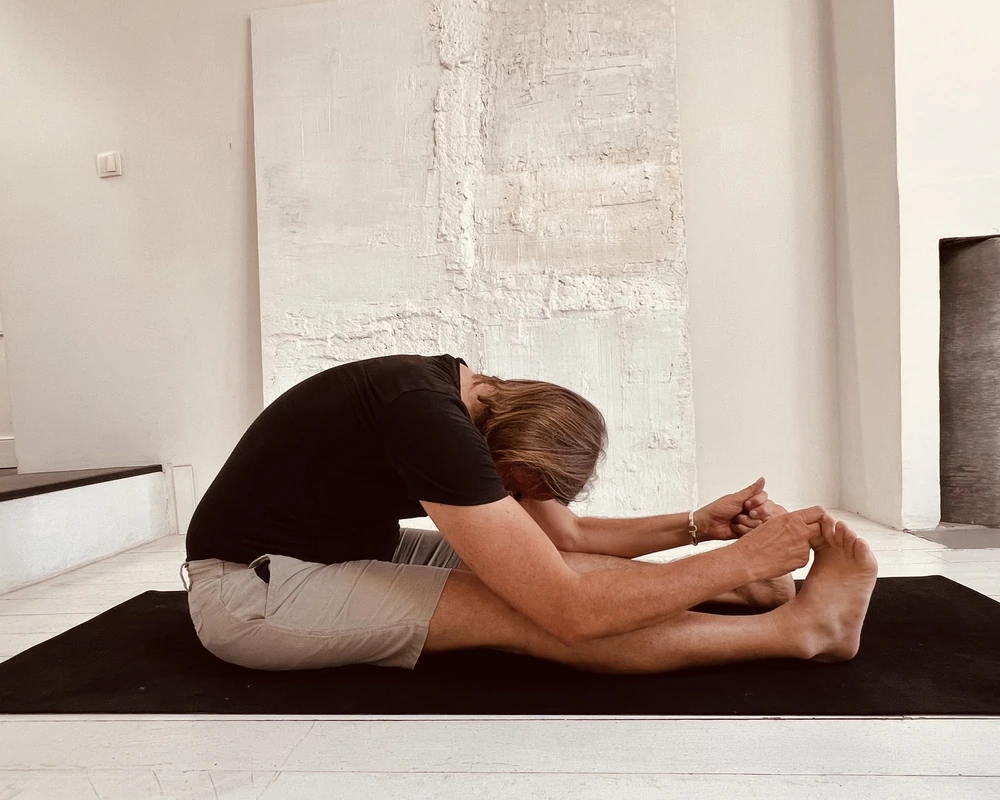
The honest answer is yes.
Yoga can absolutely contribute to back pain.
That doesn’t mean yoga is dangerous.
It simply means yoga is not automatically therapeutic because it is yoga.
Certain poses, movement patterns, and alignment cues may aggravate existing issues in some people.
This is particularly true when:
- Flexibility is prioritized over stability
- Pain signals are ignored
- Students force themselves into advanced postures
- Existing injuries are overlooked
- One-size-fits-all alignment is applied to every body
The same yoga pose that helps one person may worsen symptoms in another.
That’s why context matters.
Individual anatomy matters.
And listening to your body matters.
The yoga habits that may have contributed to my back pain
Looking back, I can identify several habits that probably didn’t help my situation.
Chasing deeper stretches
Like many practitioners, I believed deeper was better.
More range of motion.
More flexibility.
More intensity.
I now see that flexibility without stability can sometimes create its own problems.
Ignoring warning signs
The body often whispers before it screams.
In hindsight, there were plenty of warning signs that I brushed aside.
Occasional stiffness.
Recurring discomfort.
Pain after certain activities.
I convinced myself they were normal.
Practicing through pain
Yoga culture sometimes celebrates perseverance.
The problem is that perseverance can easily become denial.
Pain is information.
Ignoring it rarely works well in the long run.
Confusing discomfort with progress
Not every sensation during yoga is beneficial.
Learning the difference between productive challenge and harmful strain is one of the most valuable skills any practitioner can develop.
What I learned from studying posture and biomechanics
One of the most influential perspectives I encountered came from Esther Gokhale and the Gokhale Method.
Her work challenged several assumptions I had held for years about posture, movement, and spinal health.
In particular, it made me question whether some of the movement patterns commonly reinforced in modern life—and occasionally in yoga—were truly serving the body.
I became increasingly interested in how we stand, sit, walk, bend, and carry ourselves throughout the day.
After all, most of us spend far more time walking and sitting than practicing yoga.
If our everyday movement habits are problematic, one hour of yoga may not be enough to offset them.
That realization encouraged me to look beyond individual poses and focus on movement quality throughout the entire day.
It remains one of the most valuable lessons I learned from my back pain journey.
5 yoga poses that may aggravate back pain
Before we go any further, I want to be clear about something.
I’m not saying these poses are bad.
Many of them are excellent yoga poses when performed appropriately and by the right person.
The problem is that when back pain is already present, certain poses may place additional stress on sensitive structures.
Because these are not poses I currently practice with my own back history, the images in this section are demonstrated by our YOGI TIMES yoga model for educational purposes.
Deep seated forward folds
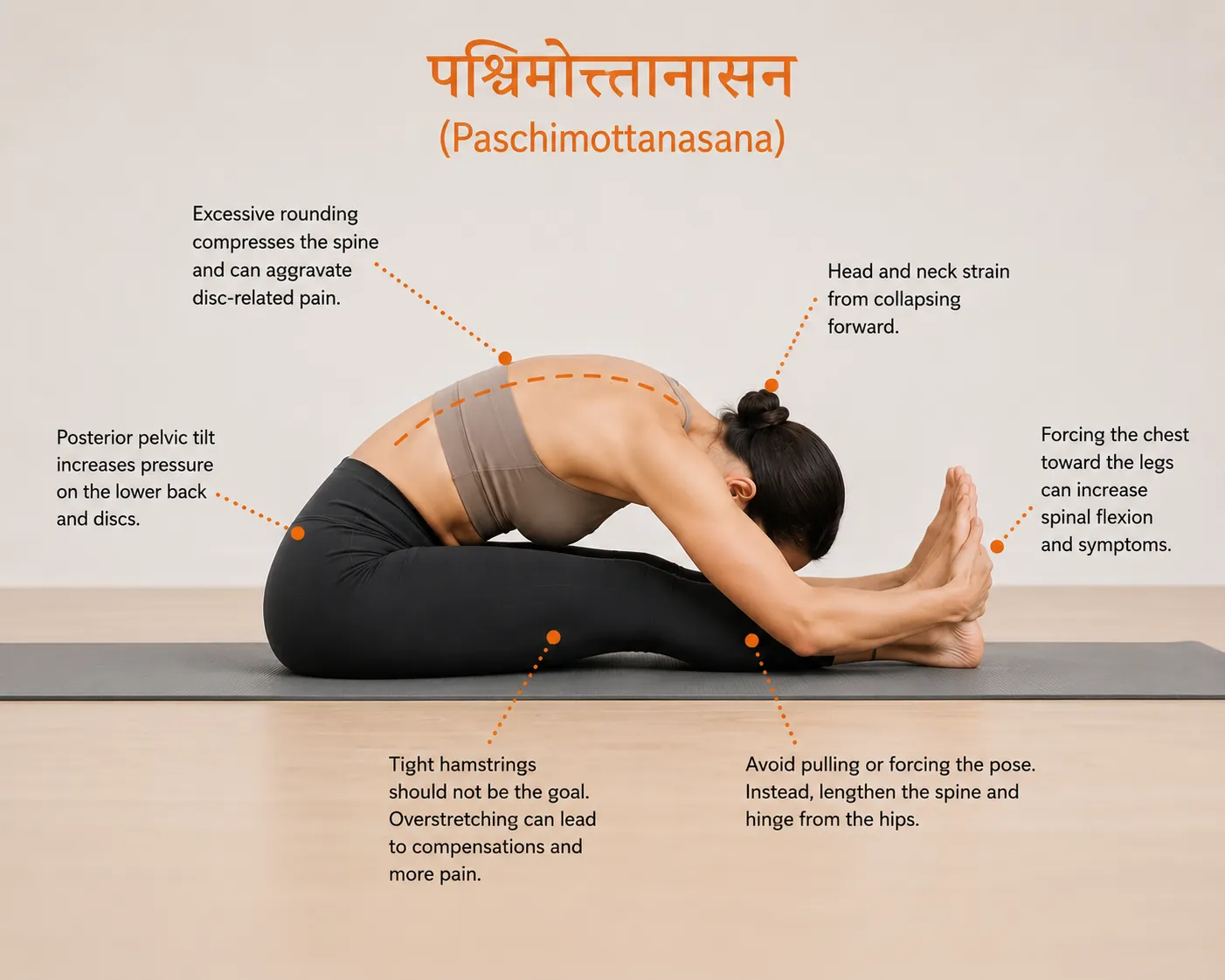
Poses such as Paschimottanasana can feel wonderful for tight hamstrings, but they often encourage people to round excessively through the lower back.
For individuals with disc-related issues, repeated spinal flexion may increase symptoms.
Instead of forcing your chest toward your legs, focus on lengthening through the spine and hinging from the hips.
Camel pose (Ustrasana)
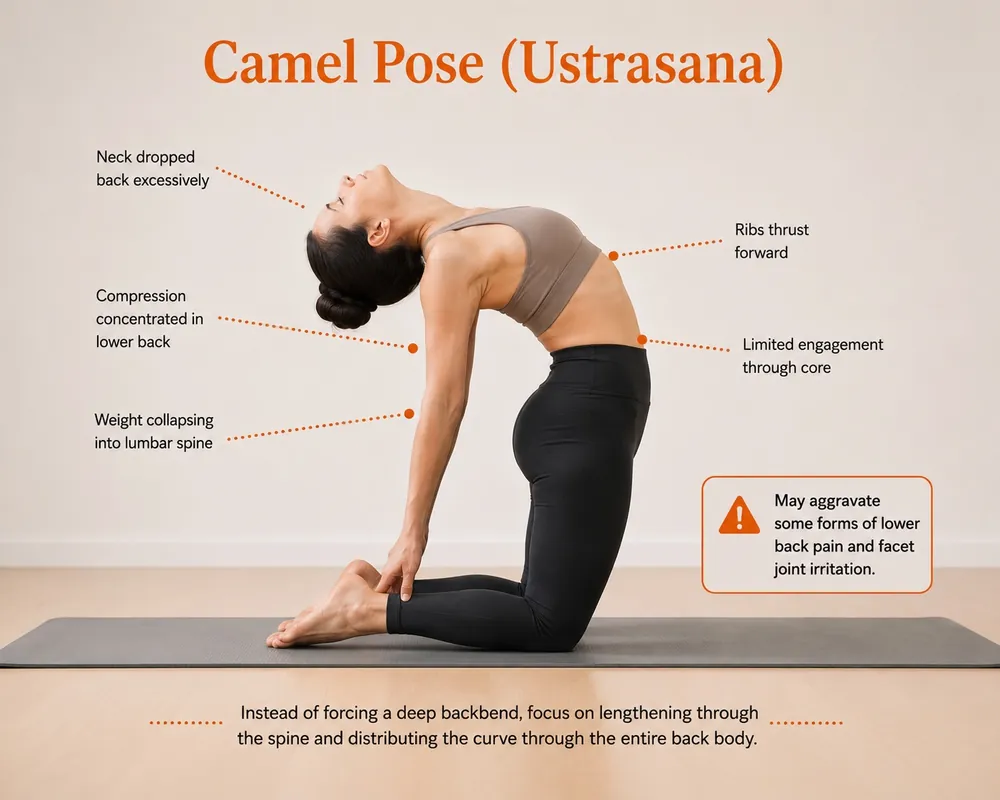
Deep backbends can be challenging for people with facet joint arthritis, spinal stenosis, or spondylolisthesis.
The issue isn’t necessarily the pose itself.
It’s the tendency to dump the movement into the lower back instead of distributing it throughout the entire spine.
Full wheel (Urdhva Dhanurasana)
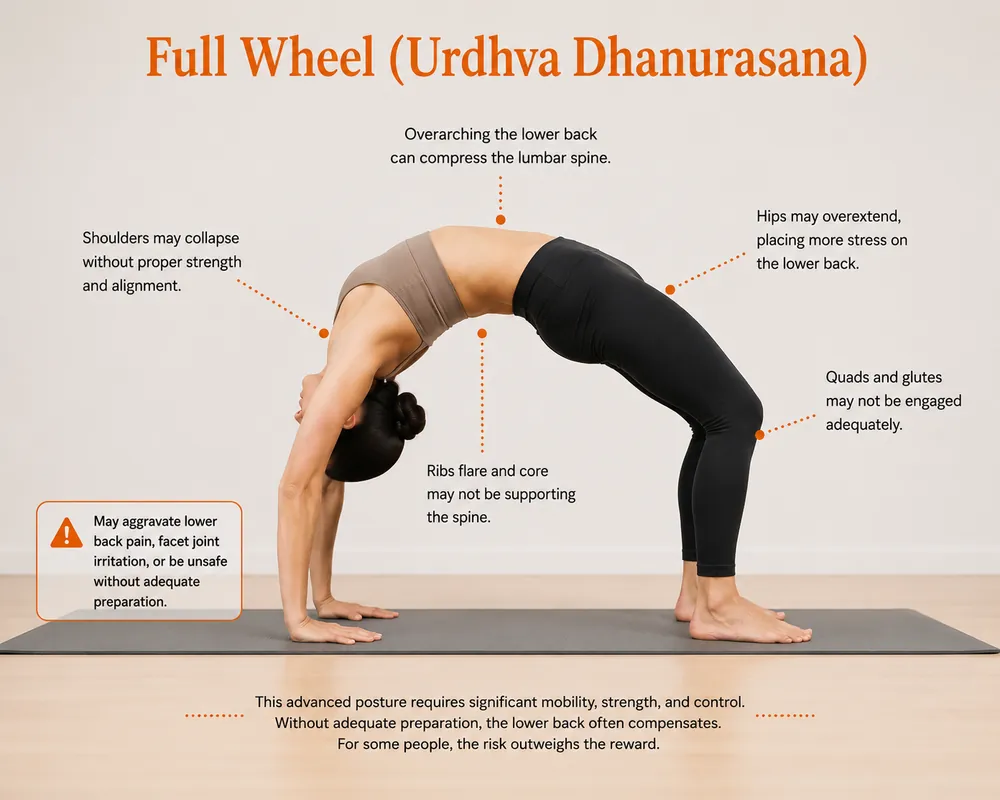
This advanced posture requires significant mobility, strength, and control.
Without adequate preparation, the lower back often compensates.
For some people, the risk outweighs the reward.
Aggressive seated twists
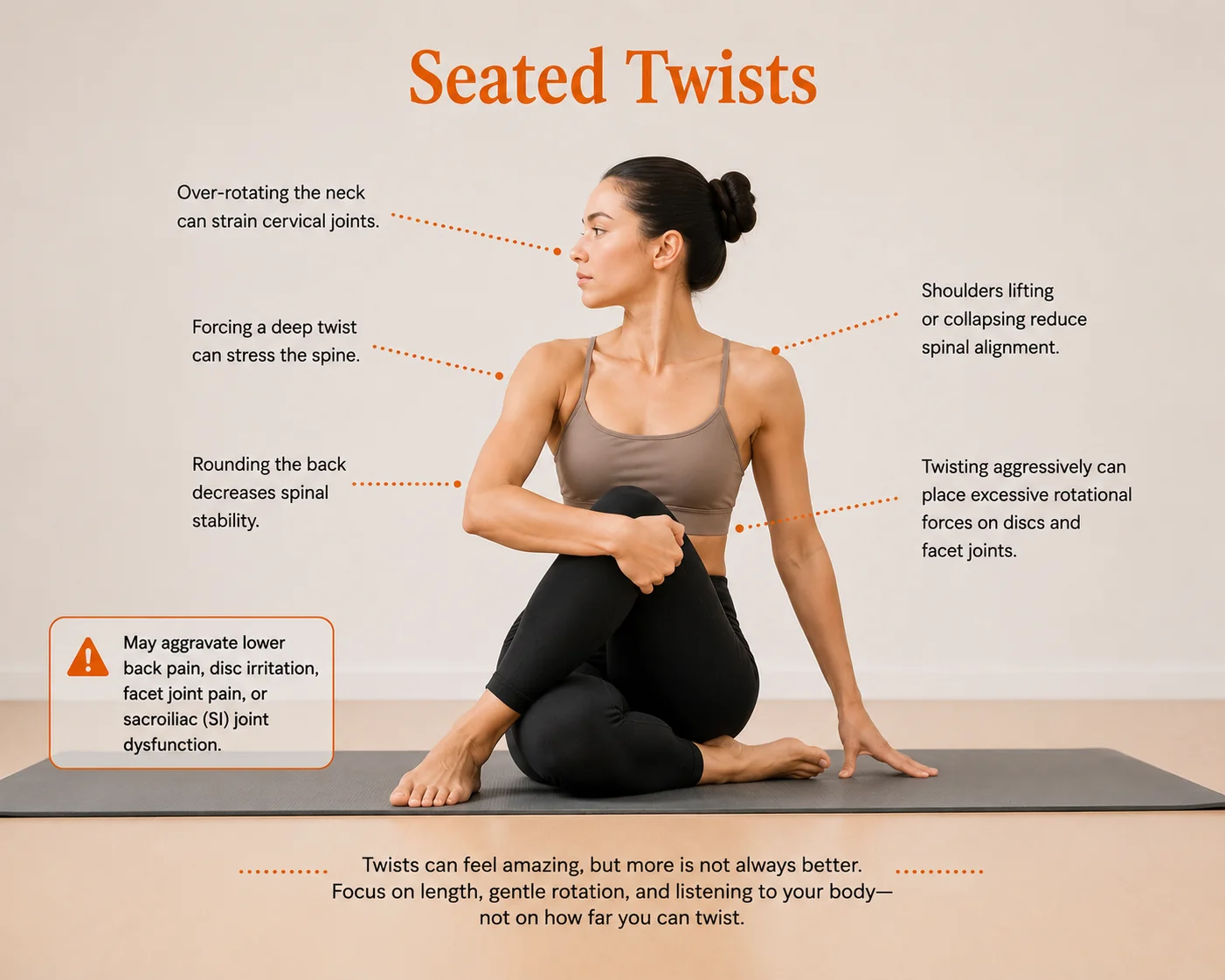
Twists can feel amazing.
They can also create excessive rotational forces when performed aggressively.
I no longer believe that cranking myself into the deepest twist possible is beneficial.
Poorly executed Upward Dog
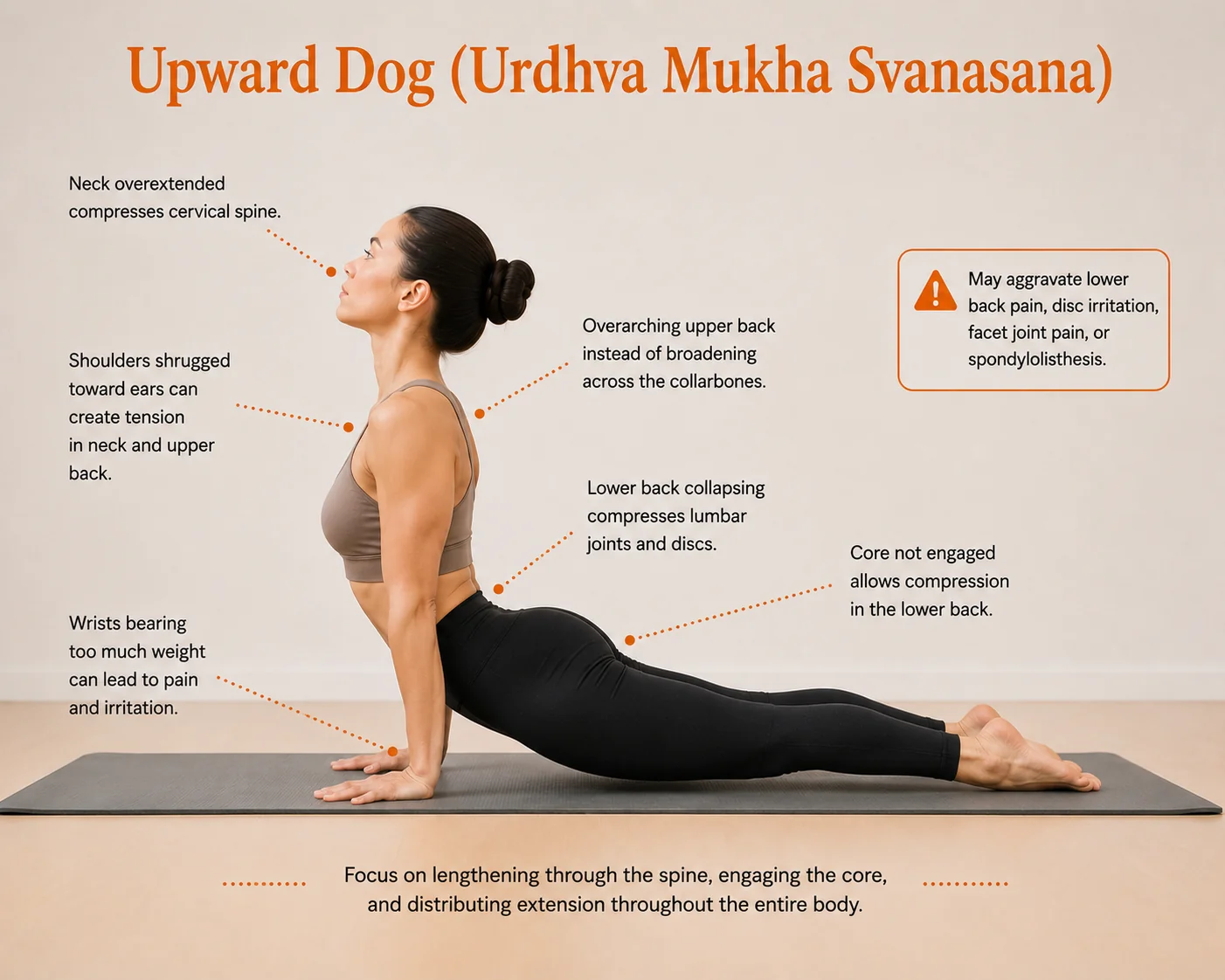
When the lower back collapses and the core disengages, Upward-Facing Dog can become a source of irritation rather than relief.
The goal should be spinal extension distributed throughout the entire body—not compression concentrated in one area.
Signs yoga may be making your back worse
How do you know whether yoga is helping or hurting?
Here are some signs that your practice may need modification.
Pain increases after every session
Some temporary soreness is normal.
Consistent worsening is not.
Symptoms radiate into the leg
Pain that travels into the buttock, thigh, calf, or foot may suggest nerve irritation.
Numbness or tingling develops
This deserves attention.
Especially if symptoms persist.
You feel worse the next day
Recovery matters.
If every practice leaves you significantly worse for days, something isn’t working.
Daily activities become harder
Yoga should improve function over time.
Not reduce it.
Is it normal to be sore after yoga?
Usually, yes.
Many people confuse soreness with injury.
The two are very different.
Normal soreness feels like:
- Muscle fatigue
- Mild stiffness
- Tenderness that improves within 24-48 hours
- General body awareness
Injury-related pain often feels like:
- Sharp pain
- Burning sensations
- Electrical symptoms
- Radiating pain
- Numbness
- Pain that progressively worsens
When in doubt, err on the side of caution.
What to do if yoga causes back pain
The worst thing I ever did was assume that more yoga would automatically solve the problem.
Sometimes the smartest move is to step back and reassess.
If yoga seems to be aggravating your back:
Reduce intensity
Temporarily decrease depth and duration.
Focus on stability
Many people with chronic back pain benefit more from strength than additional flexibility.
Modify poses
A modified pose is often more therapeutic than a perfect-looking pose.
Seek professional guidance
A qualified physical therapist, sports medicine physician, movement specialist, or experienced yoga therapist may help identify what’s driving your symptoms.
Keep moving
This is important.
Rest has its place.
But complete inactivity rarely helps chronic back pain.
What I do differently today
My yoga practice looks very different than it did twenty years ago.
Ironically, I think it’s healthier.
Today I focus less on achieving impressive postures and more on maintaining a body that allows me to keep doing the things I love.
That means:
Stability before flexibility
The older I get, the more I value strength.
Quality before quantity
One mindful practice is worth more than three rushed sessions.
Recovery matters
Sleep.
Walking.
Hydration.
Stress management.
These often influence my back more than any individual yoga pose.
Listening to symptoms
I no longer view pain as something to push through.
I view it as information.
Staying active
Perhaps the most important lesson of all.
My MRI didn’t convince me to stop moving.
It convinced me to move smarter.
Yoga poses that may help relieve lower back pain
Despite everything I’ve discussed in this article, I still believe yoga can be a powerful tool for managing back pain.
The key is choosing appropriate movements and respecting your body’s feedback.
Some of the poses that many practitioners find helpful include:
- Child’s Pose (Balasana)
- Cat-Cow Stretch (Marjaryasana-Bitilasana)
- Sphinx Pose
- Supine Knee-to-Chest Stretch
- Reclined Spinal Twist
- Bridge Pose
- Bird Dog
- Low Lunge
- Downward-Facing Dog
- Thread the Needle
- Happy Baby Pose
- Legs-Up-the-Wall Pose
For detailed instructions, modifications, and alignment tips, see our complete guide:
12 yoga poses that may help relieve back pain
When to seek medical advice
While most back pain improves with time and appropriate movement, some symptoms deserve prompt medical attention.
Seek professional evaluation if you experience:
- Significant leg weakness
- Progressive numbness
- Loss of bladder or bowel control
- Severe trauma
- Unexplained weight loss
- Fever alongside back pain
- Persistent symptoms that continue worsening
These situations fall outside the scope of self-management and require medical assessment.
Final thoughts
For years, I believed yoga was automatically helping my back.
Then my MRI forced me to reconsider what was really happening.
What I discovered wasn’t that yoga was bad.
It was that yoga, like any form of exercise, isn’t one-size-fits-all.
Some movements helped me.
Others didn’t.
Some beliefs I held about flexibility, posture, and pain turned out to be incomplete.
Today, I no longer think of my back as damaged.
I think of it as something that requires attention, adaptation, and intelligent management.
My MRI showed degenerative discs, facet arthritis, and spondylolisthesis.
Yet I still play tennis.
I still move.
I still practice yoga.
And perhaps that’s the most important lesson of all.
An MRI can tell you what your spine looks like.
It cannot tell you what your future will be.


Free Wellness E-Book
Find Your Zen!
Your Free Guide
To Wellness
Download Your Free Guide & Receive Weekly Inspirations From The Lifestyle Of a Modern Yogi!