Easy BFF 2-person yoga poses to try with your best friend (beginner-friendly + fun!)

Friends who do yoga together stay together. If you and your bestie want to take your practice to the next level, keep on reading!
Many people come to yoga in search of community – adding a social element makes the whole experience that much more enjoyable. I am really grateful to the practice for allowing me to meet some incredible people and cultivate close friendships.
In my experience, acro with your BFF is just a natural progression of a yoga friendship. It’s amost like a rite of passage! So grab your favorite person and get ready for some two person yoga poses…
How does 2 person yoga work?
Unless you’ve tried it before, two person yoga can seem daunting. Let’s break down how it works.
The goal of partner yoga or acro yoga is to work together with another person. The simple rule is that whatever pose or poses you’re performing, you have to interact with another person.
This can take many shapes, from counter-balancing to lifting each other off the ground. The best part is that you can practice partner yoga regardless of you skill level.
Want to guide others on their yoga journey? Start your certified yoga teaching journey online with one of these trusted YTT programs.
What is the difference between acro yoga and partner yoga?
You might have noticed that I am using multiple terms to describe the two person yoga practice. Some people use “acro yoga” and “partner yoga” interchangeably. For the purpose of this article, I will share my own definition to make things easier down the line.
Partner yoga is a broad term that decribes interactive practice with at least one other person. This may involve counter-balancing each other, mirroring asanas, leaning on one another, or supporting your partner in a more difficult posture.
Acro yoga is a mixture elements borrowed from yoga and acrobatics. This is typically a more advanced practice, with one participants partially or fully off the ground. Over time, acro yoga evolved as an independent branch of the practice, even developing its own names for two person yoga poses.
Whatever you call it, it is a delightful practice that can help you deepen connections with a partner, friend, or family member.
Benefits of two person practice
Whether you’re looking to strengthen your fruendship or enjoy an engaging workout, partner yoga offers a unique and gratifying experience. In addition to skills you gain through solo practice, 2 person yoga has its own challenges and rewards. Let’s highlight some of the benefits it brings:
- Develops trust and a strong bond between participating parties, whether you practice it with a friend, a family member, or a romantic partner.
- Improves communication skills and the ability to work as a team.
- Advances physical ability, including strength, balance, and prioperception.
- Provides opportunities to practice more difficult poses (e.g. inversions) with support.
- Brings out the adventurous, playful side in people.
- Encourages being out of your comfort zone while also allows you to practice setting boundaries.
- Creates an opportunity to spend time and make memories with your loved ones.
- Taps into your sense of empathy; partners really have to have each other’s best interest at heart.
How to prepare for 2 person yoga
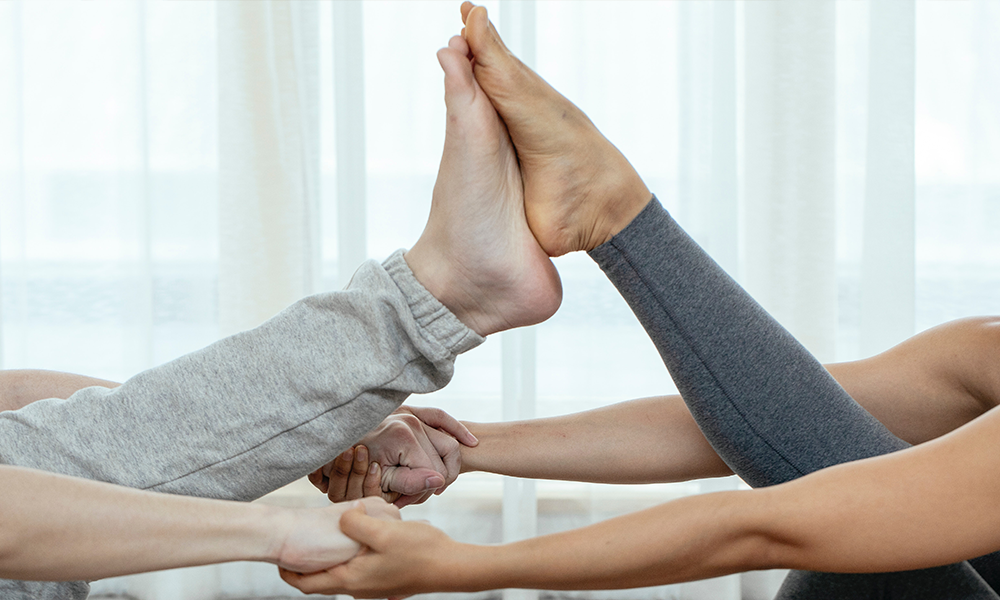
To make the practice safe and enjoyable, it is important to follow a few simple principles. If you do your due dilligence, you can avoid mistakes and reduce the risks.
- Warm up thoroughly before you do any partner yoga or acro yoga.
- Take into account the type of poses you will practice; center your warm-up around the relevant body parts.
- Play to your strengths, especially when the acro pose requires different things from the two participants.
- Make a safe practice space where you can move freely. Remove any sharp or fragile items, and ensure the safety of children or pets nearby.
- Communicate with your partner regarding expectations, boundaries, and physical contact. Consent is so important!
- Avoid any loose clothing, jewelry or hair that can obstruct vision or catch on something.
- Take breaks appropriately, hydrate, and decompress with opposing movements (e.g. Child’s pose after a backbend or inversion).
Beginner-friendly partner yoga poses
Are you ready to try some easy and fun yoga poses for two people? Grab your best friend, your spouse, sibling or child – let’s get started!
Grounding 2-person poses
Back-to-back Easy Seat (Sukhasana)
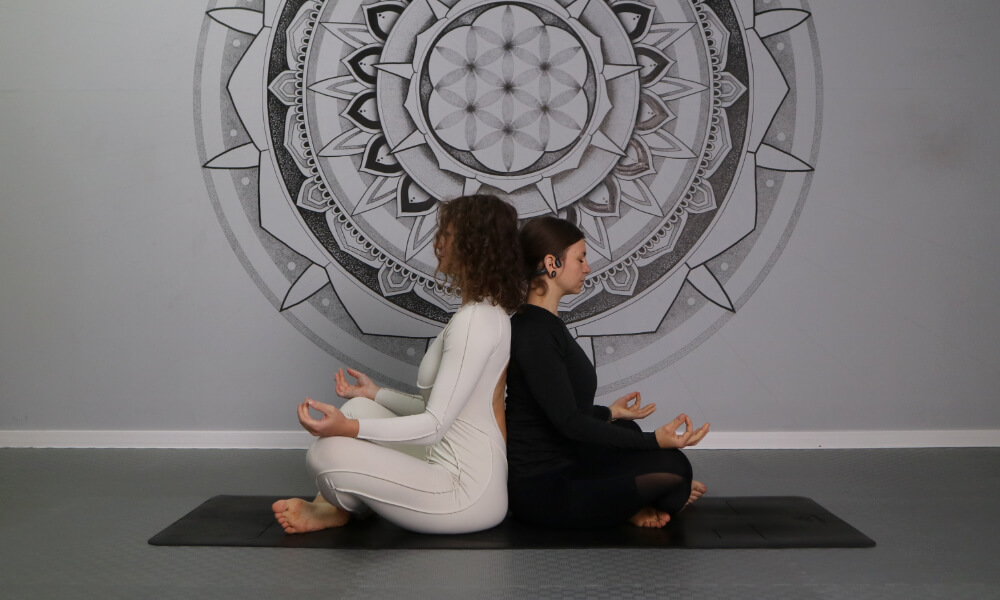
This 2-person pose is accessible for anyone who can sit cross-legged. This could serve as a meditation seat that won’t leave your back feeling tired.
How to:
- Facing away from each other, sit on the floor and cross your ankles or shins.
- Move closer to each other until you can lean on the other person’s back and support them at the same time.
Back-to-back twist
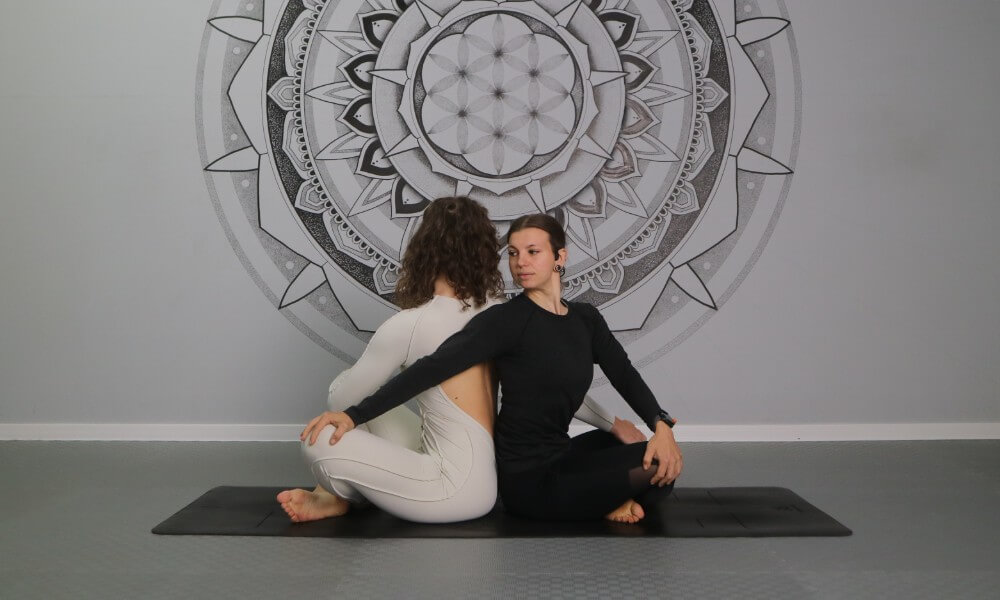
A step further from back-to-back easy seat, this twisted variation is great for warming up your spine and shoulders.
How to:
- Start in a back-to-back easy seat (as instructed above).
- Both partners reach their left hand to grab their own right knee.
- Both partners twist their chest and shoulders to the right and place their right hand on the other person’s left knee.
- After a few breaths in this position, repeat on the other side.
Child’s pose (Balasana) and Standing Forward bend (Uttanasana)
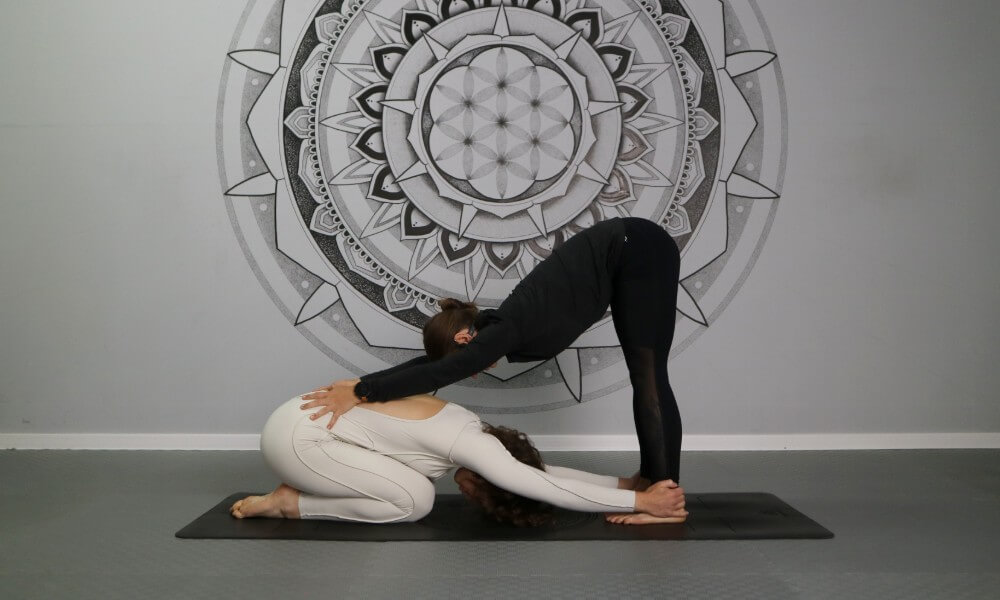
This 2-person yoga pose really emphasizes a lower back stretch in a downward motion. Additionally, it stretches and opens the shoulders.
How to:
- Facing each other, one person kneels while the other person stands.
- As the kneeling partner leans forward into Child’s Pose (pictured in white), they reach out and grab their partner’s ankles.
- The standing partner (pictured in black) can then fold at the hip and apply pressure to the other person’s lower back.
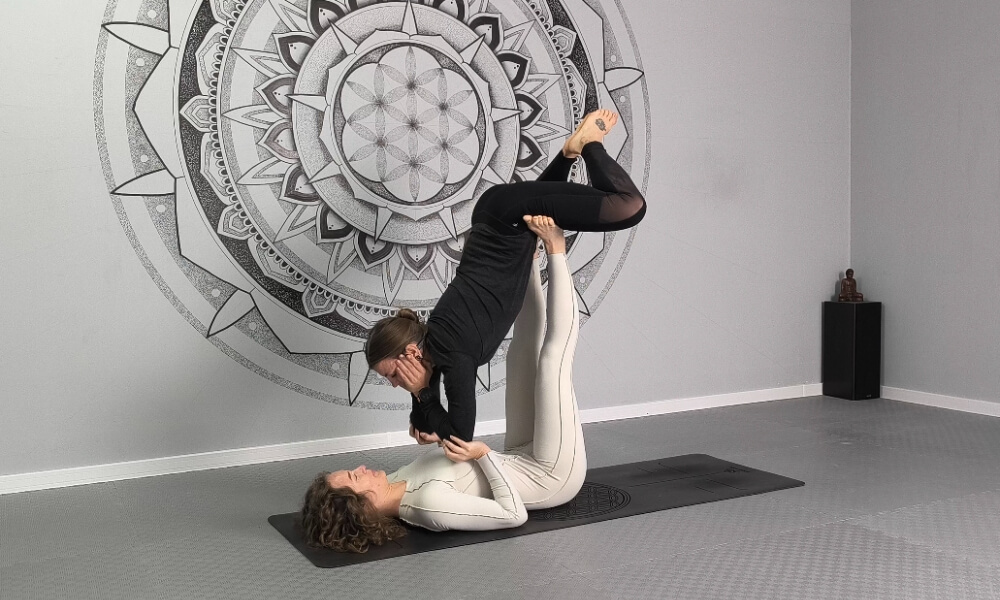
Yin-yang forward bend (Paschimottanasana and Halasana)
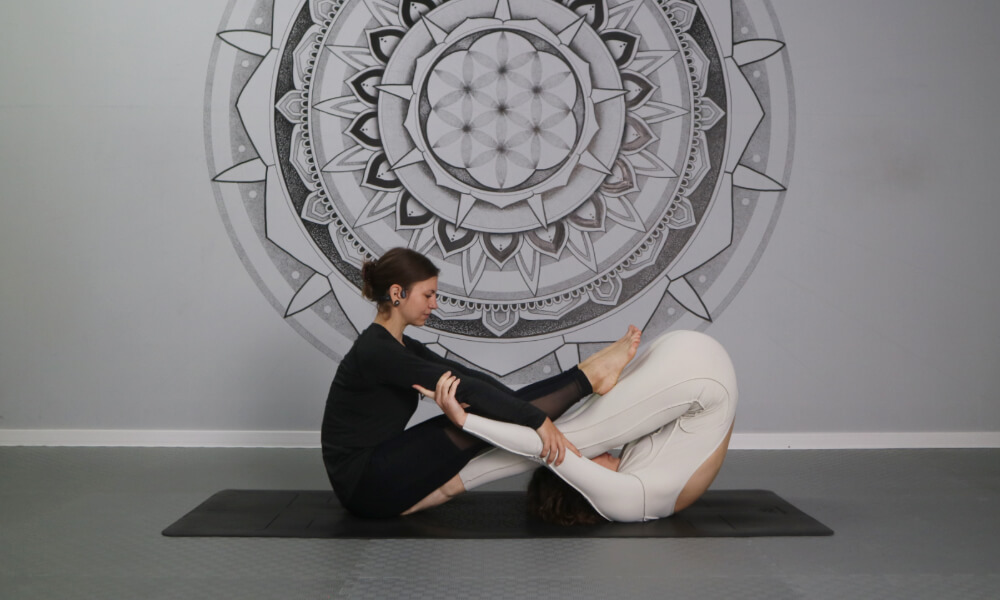
This variation is slightly more advanced. It combines two forward bends: Paschimottanasana and Plow Pose. It’s a fun way to play with inversion and symmetry, and to stretch your hamstrings.
How to:
- One partner lifts their pelvis and extends the legs behind their head for Plow Pose (pictured in white).
- Once the person in Plow is stable, the second person (pictured in black) can shimmy their seat next to the first partner’s feet and links hands or forearms depending on flexibility.
- Then, the person at the top can carefully extend their legs over the bottom person’s legs.
Standing yoga poses for two people
Double tree pose (Vrksasana)
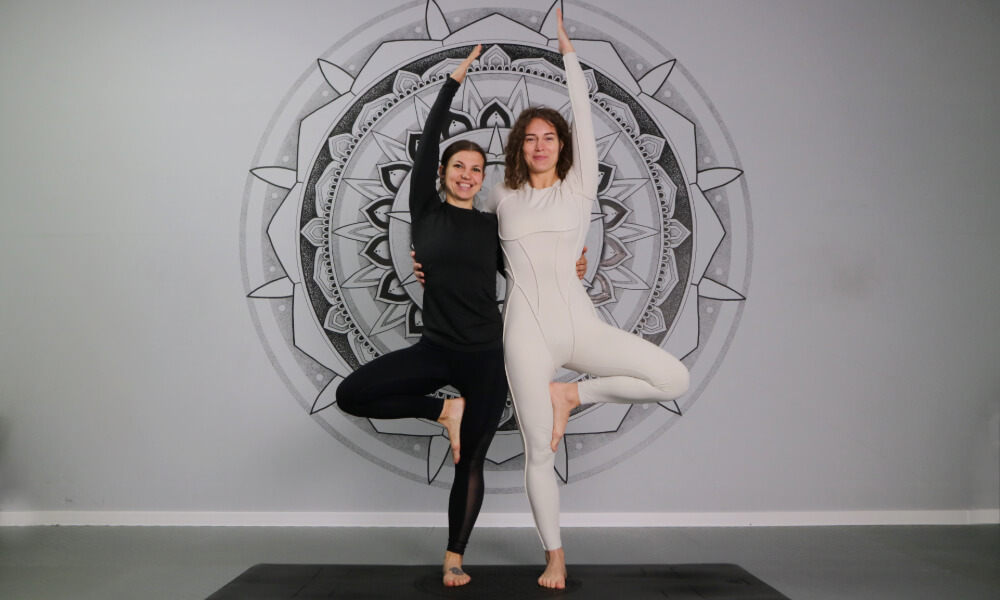
Unlike the solo Tree Pose, this variation challenges your collective balance as a team as you mirror and support one another.
How to:
- Stand next to each other side by side. Hug each other’s waist.
- Shift your weight to the leg closest to your partner. Slide the other foot up the standing leg and open the knee to the side.
- Reach your free arm overhead.
- Switch places to repeat on the other side.
Double Dancer pose (Natarajasana)
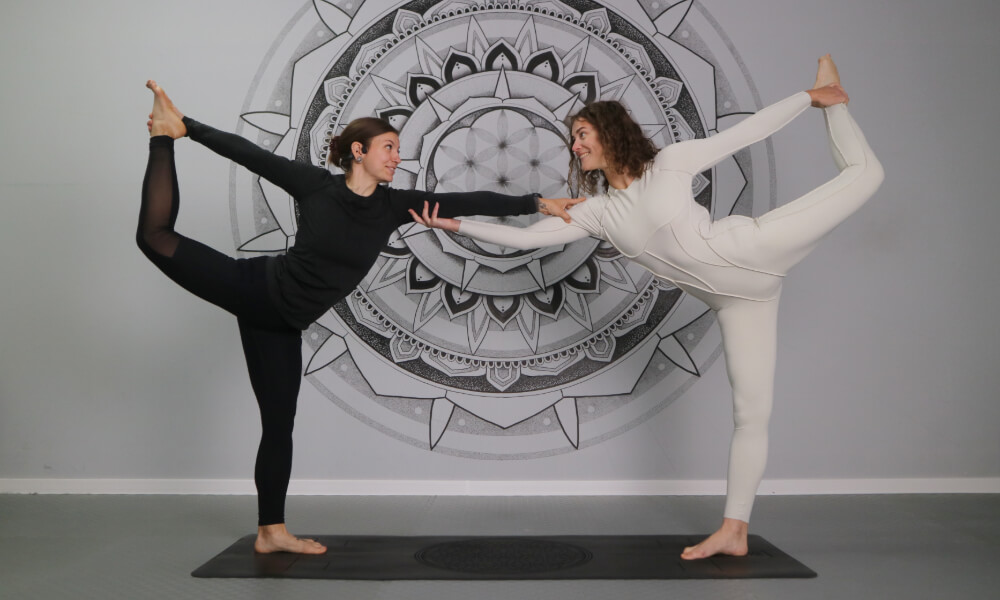
If you struggle with Dancer, it’s good to have someone to lean on – literally! This double Natarajasana provides all the same benefits with the added support and a boost of confidence.
How to:
- Facing each other, begin to enter Natarajasana mirroring your partner (e.g. if they stand on their right leg, you stand on your left).
- As you lean forward, reach out and link hands or forearms.
- After a while, repeat on the other side.
If partner yoga has reminded you how powerful practice can be when shared, you might love exploring a full immersion. Discover yoga teacher training in Bali or 200-hour yoga teacher training in Costa Rica to find a setting that supports both your growth and your sense of adventure.
Face-to-face double Chair pose (Utkatasana)
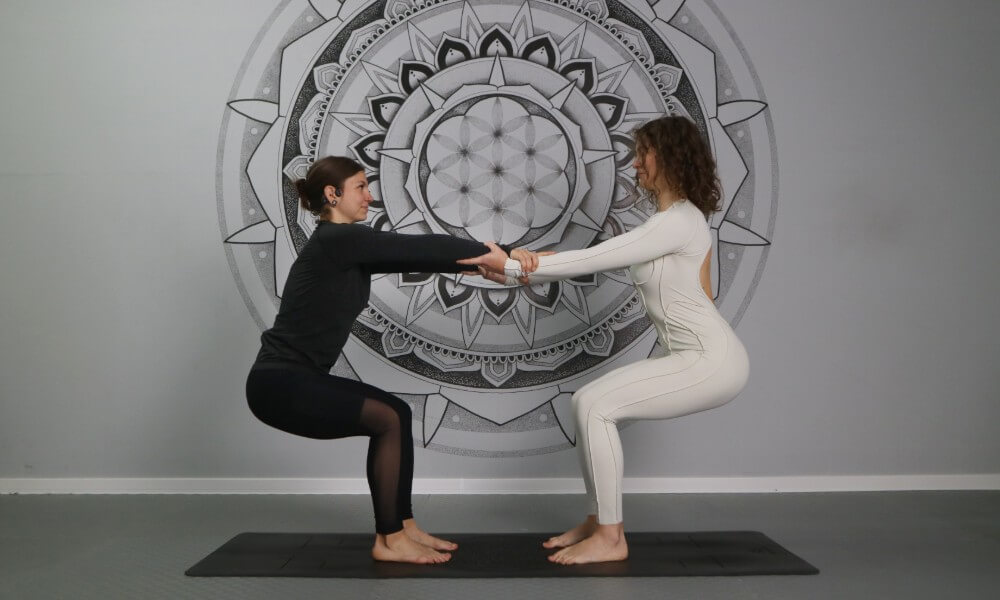
This daring variation of Chair Pose requires a perfect counter-balance with your partner. Both people have to trust each other to hold on and keep the equilibrium.
How to:
- Stand facing each other with your feet together. Link hands.
- Begin to simultaneously bend your knees and sit back into Chair Pose.
- When you’re ready to exit, bend your elbows and pull into the center at the same time as standing up.
Back-to-back double chair pose (Utkatasana)
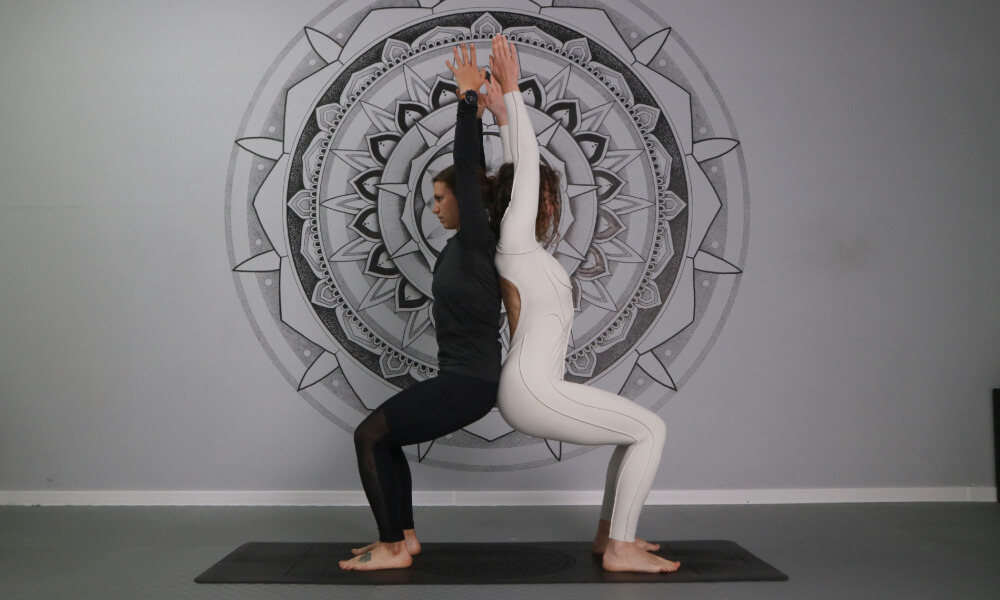
This partner variation of Chair Pose is more challenging. It requires both participants to blindly rely on each other’s balance and support. It’s also quite a quad workout!
How to:
- Stand back-to-back with each other.
- Communicating clearly, start walking your feet forward and bending the knees while pressing your back into your partner’s as they do the same.
- Once you find the sustainable knee angle, reach your arms up.
Intermediate partner yoga poses
Double Downward Dog (Adho Mukha Svanasana)
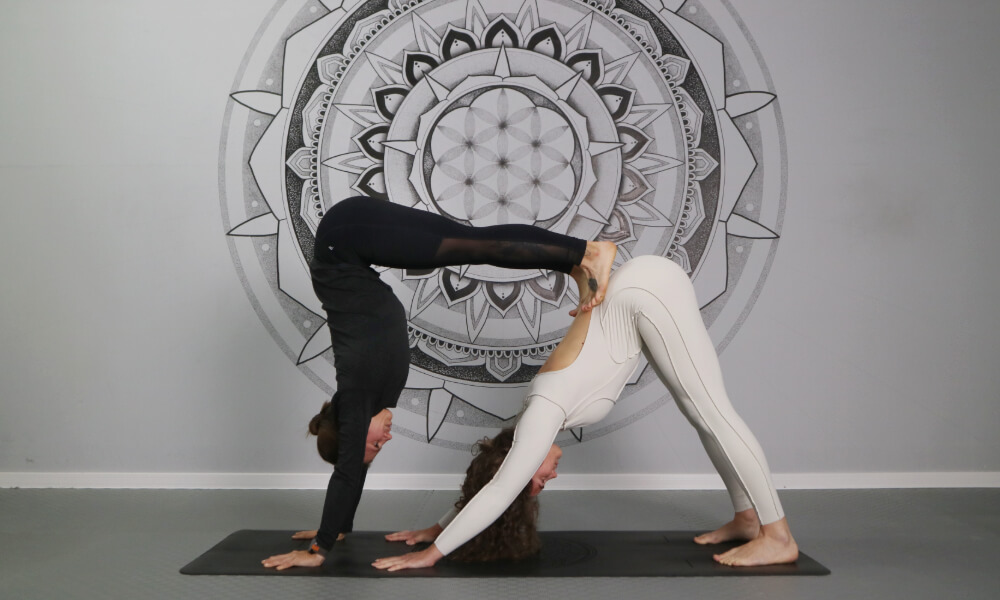
Take it up a notch with a stacked Downward Facing Dog variation. Although the shape is the same, both people have to work harder, since it involves holding extra weight in your palms.
How to:
- One partner starts in Donward Facing Dog (pictured in white).
- The second person (pictured in black) has to face in the same direction and place their hands in front of the first. The easiest way to position yourself as the person on top is to step your feet wide either side of the bottom person’s arms.
- The first partner carefully lifts their feet onto their partners lower back and straighten their arms and legs.
Double boat pose (Navasana)
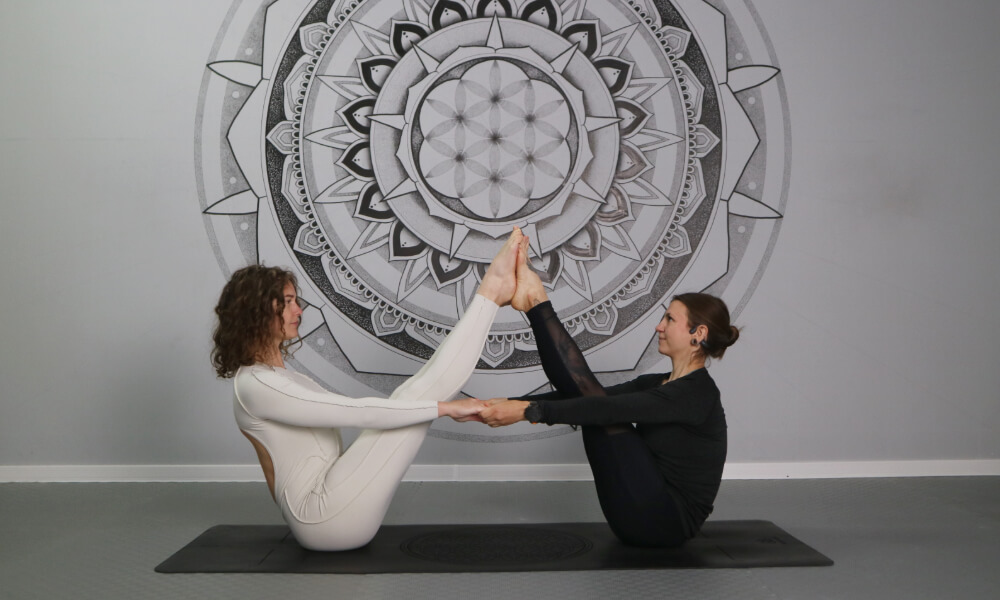
This double Boat Pose is excellent for balancing each other out and building a bond. It can be a little tricky to enter, but it looks beautiful!
How to:
- Sit facing each other with your legs bent in front.
- Hold hands and lean away from one another as you straighten your backs.
- Connect the soles of your feet and counter-balance each other as you straighten your legs into Boat Pose.
Advanced partner yoga poses
Inverse double Tree Pose (Adho Mukha Vrksasana)
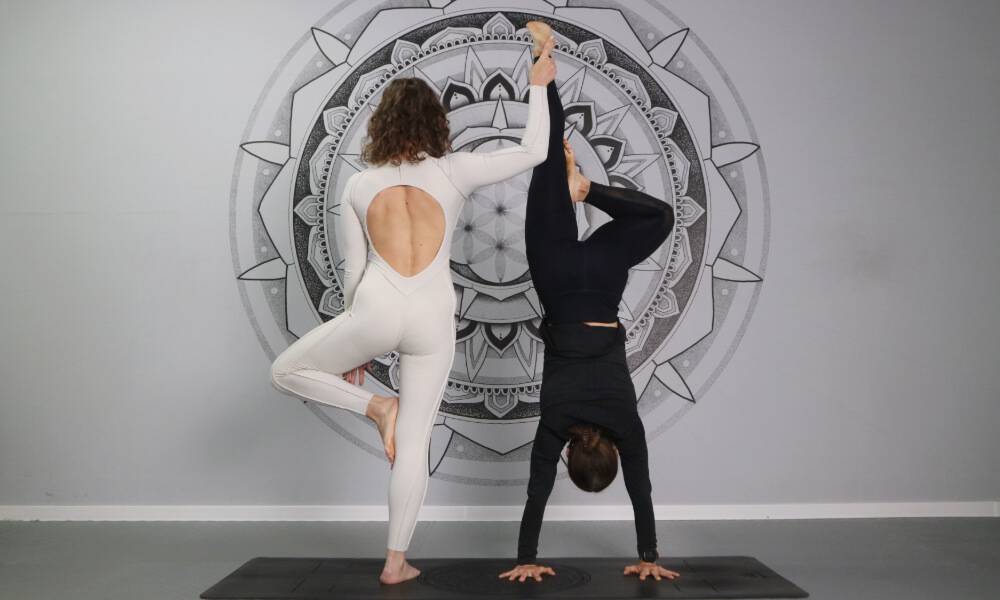
Did you know that the Sankskrit name for the handstand is “Downward Facing Tree Pose”? This yin-yang partner pose playfully pays homage to this fact.
How to:
- One partner lifts into a handstand (pictured in black), supported by the second person (pictured in white).
- The person in handstand can then assume the Tree Pose form by bending the knee of the farthest leg and opening the hip.
- Once the inversion is established, the standing partner can face the same way and bend the same leg (farthest from their partner) and plant it along the inner standing leg.
Staff pose (Dandasana) and Pike Handstand
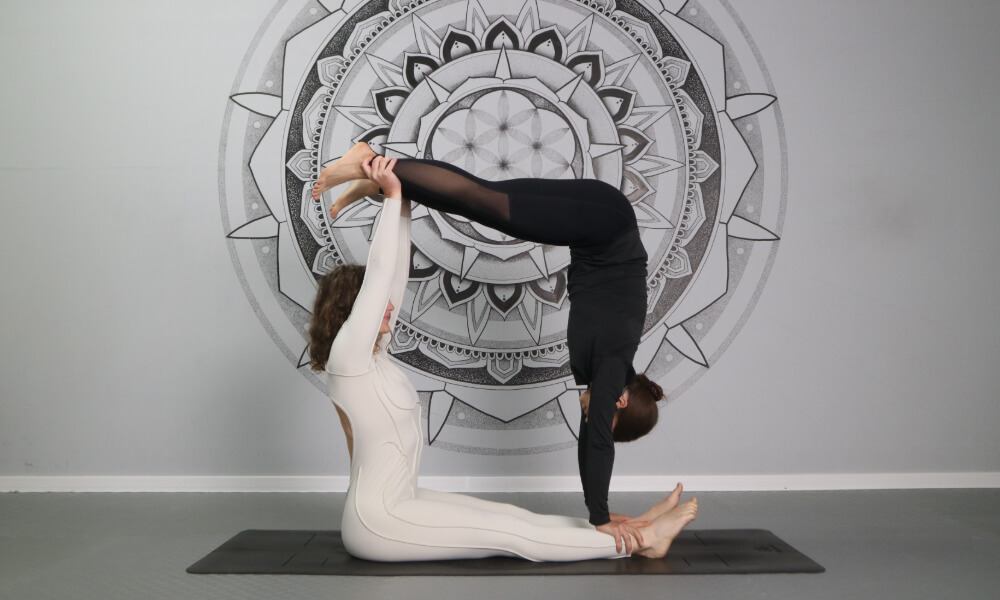
Another yin-yang combination, this pose inverts the shape of Staff Pose into a handstand. This pose requires strong core and back muscles from both parties, excellent communication, and a good sense of balance.
How to:
- One partner (pictured in white) sits down with legs extended in Dandasana.
- The second partner (pictured in black) places their hands on the first person’s ankles or the floor next to the feet (depending on body proportions and sensitivities).
- As the second person inverts, they can carefully place their ankles into the hands of their partner.
- Finally, both participants extend their arms and legs while flexing the hips at 90 degrees.
Camel pose (Ustrasana) and Handstand Scorpion (Vrschikasana)
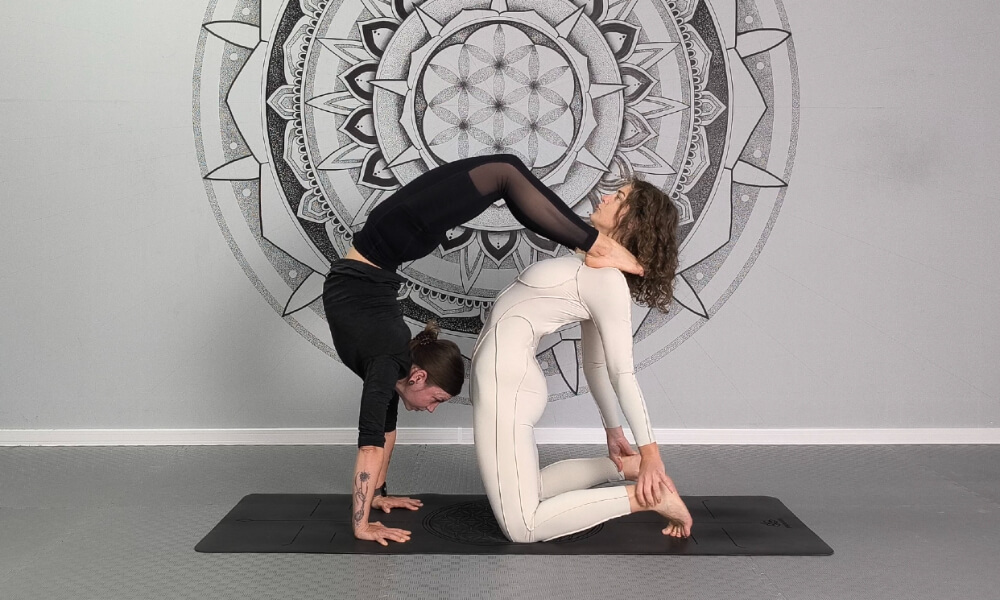
If you love backbends, this combination of Camel Pose and Scorpion is a must-try! As if these poses weren’t challenging enough by themselves, there is an added layer of coordination and teamwork.
How to:
- The first partner (pictured in white) kneels, ready to catch and direct the second person.
- Facing their partner, the second person (pictured in black) plants their hands on the ground and lifts into handstand.
- The first partner has to catch and direct their partner’s feet into their shoulders; this requires the person in handstand to arch into Scorpion.
- Finally, the kneeling partner has to carefully reach down to their heels to come into Camel Pose.
Double inverse Hanumanasana
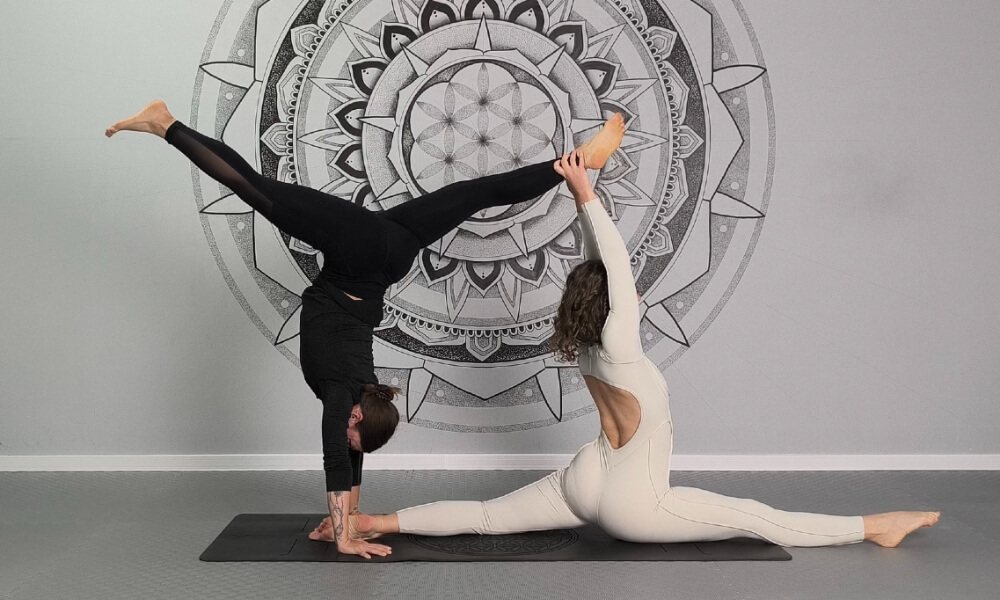
If you and your yogi friend can do splits, this is the next pose you should try! It combines a full expression of Hanumanasana with a split handstand.
How to:
- The first person (pictured in white) starts in deep low lunge (Anjaneyasana).
- Standing behind them, the second person (pictured in black) sets their hands either sides of the first person’s ankles.
- As the second person kicks into a split handstand, the first person catches their foot.
- Finally, the first person shifts their front foot forward into splits.
Roles in Acro yoga
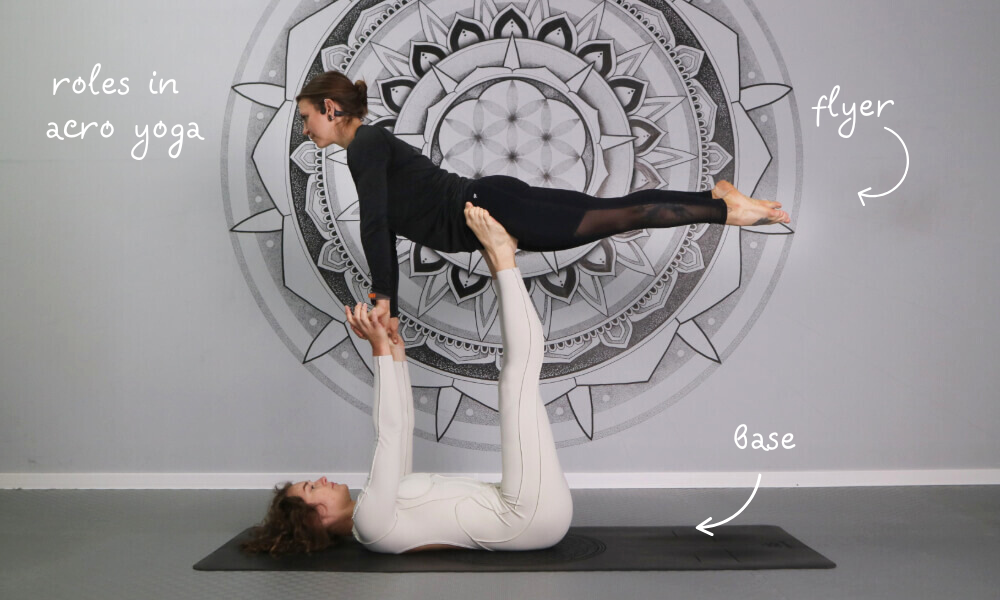
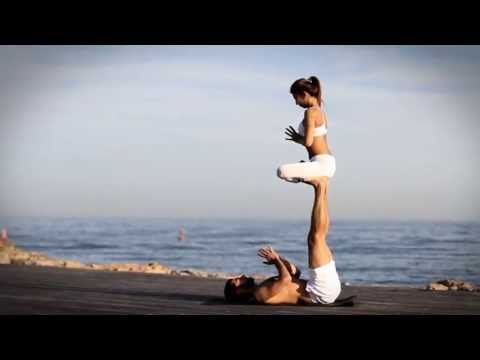
Acro yoga combines acrobatics and yoga, sometimes in surprising ways. It’s a more physical practice that typically involves at least one person completely untethered from solid ground.
There are two main roles in acro yoga: the “base” and the “flyer”. In simple terms, the base is the person on the ground, and the flyer is the person in the air.
There is some space for ambiguity, where people perform both roles. For example, in acro yoga poses with multiple participants, it’s common to be partially or fully in the air while also supporting another participant.
Additionally, some poses require a “spotter”: a person who can help to direct the base and flyer into the pose and intervene in case of a dangerous situation. If you’re new to acro yoga, it’s a good idea to have an extra person to help even with simple poses.
Fun and challenging Acro yoga poses
It’s time to explore some of the more adventurous two-person poses. As we venture into acro yoga, it’s especially important to be vigilant about your safety and work as a team.
Double Plank pose (Phalakasana)
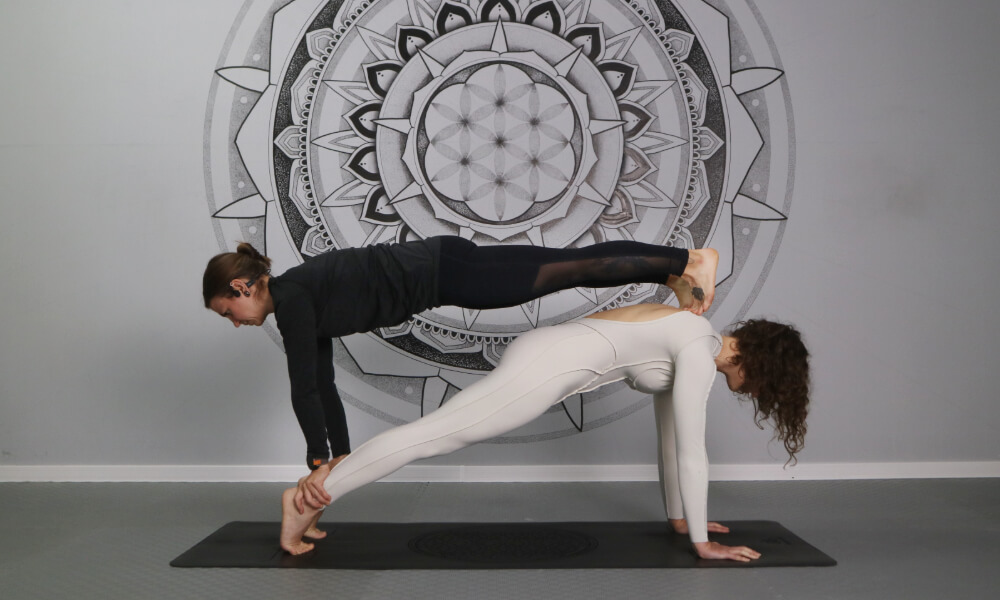
This stacked plank requires a lot of strength for the base (pictured in white) as they bear the entire weight of the other person. It’s not that easy for the top person either! Their plank is more horizontal and therefore require more arm and core strength.
How to:
- The base (pictured in white) starts in Plank Pose.
- Facing in the opposite direction, the second person (pictured in black) plants their hands on the base’s ankles. The most convenient way to do this is to step the feet wide either side of the bottom person’s legs.
- The flyer then steps their feet to the upper back of the base.
- Both participants level their plank.
Birdie
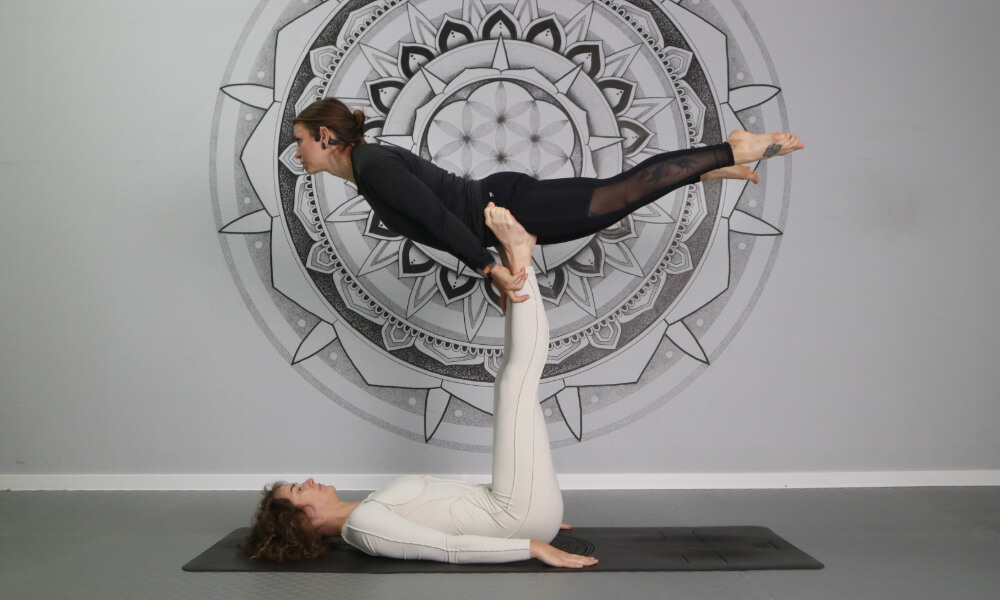
If you don’t have a lot of acro yoga experience, Birdie is a great pose to hone your skills, both as a base and as a flyer. Once you begin to improve, you can try the more challenging variations.
How to:
- The base (pictured in white) starts on their back, with legs lifted vertically and knees bent.
- Facing the base, the flyer (pictured in black) leans over to hold hands.
- The base places their feet around the flyer’s pelvis in a V-shape.
- As the flyer begins to transfer their weight forward, the base extends their legs and arms to push the flyer up. The arms of both people should form a straight vertical line.
- Optional: the flyer engages their posterior chain (similar to Locust Pose) and brings their hands to their heart of the base’s ankles.
Melting heart (Anahatasana)
This adorable version of the Puppy Pose (also known as the melting heart) is a great bonding opportunity. Once you’ve established the pose, it’s so nice – especially for the flyer!
How to:
- The base (pictured in white) starts on their back, with legs lifted vertically and knees bent.
- Facing the base, the flyer (pictured in black) leans over to hold hands.
- The base places their feet around the flyer’s pelvis in a V-shape.
- As the flyer begins to transfer their weight forward, the base balances the flyer on their feet in Birdie (see above).
- One by one, the flyer lowers their elbows into the base’s hands and cups their cheeks.
- Folding at the hip, the flyer can form their legs into Bound Angle shape: feet together, knees apart.
Whale
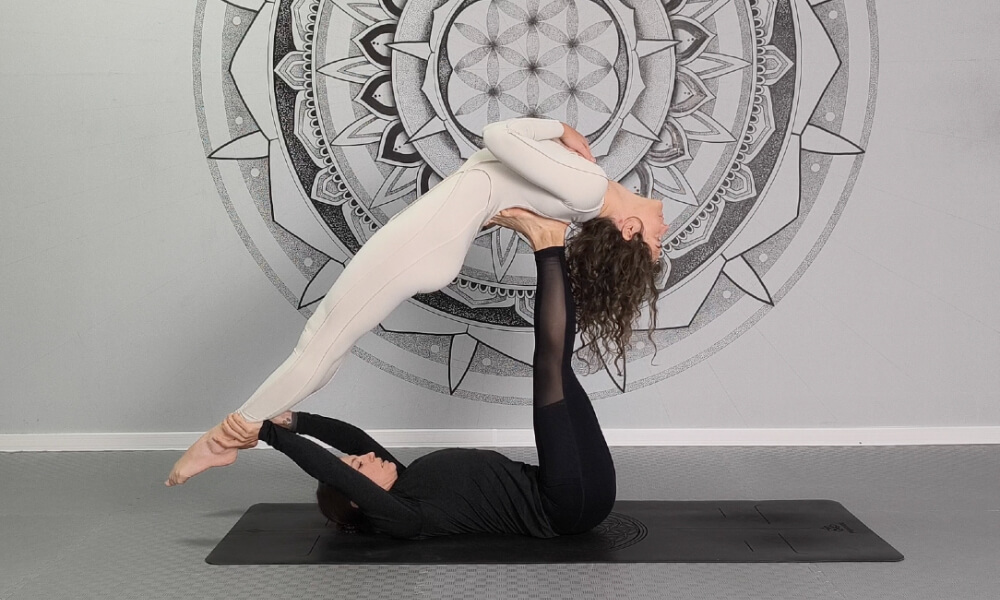
Whale shares some similarities with Birdie, at least in the sense that the base supports the flyer from a supine position. It’s also a pleasant upper back stretch, although it may feel somewhat daunting to lean back and trust your partner.
How to:
- The base (pictured in black) starts on their back, with legs lifted vertically and knees bent.
- Standing near the base’s head, the flyer faces the opposite way.
- The base grabs the flyer’s ankles and places their feet around the flyer’s shoulder blades: heels at the top, toes facing the waist.
- The next step is the most precarious. The flyer transfers their weight backwards, similar to a trust fall. The base extends their legs and aligns them on top of their own pelvis. At the same time, the base has to lift the flyer’s feet of the floor.
- The flyer’s legs and glutes are engaged to great a thoracic backbend with hip flexor extension.
Floating Bow pose (Dhanurasana)
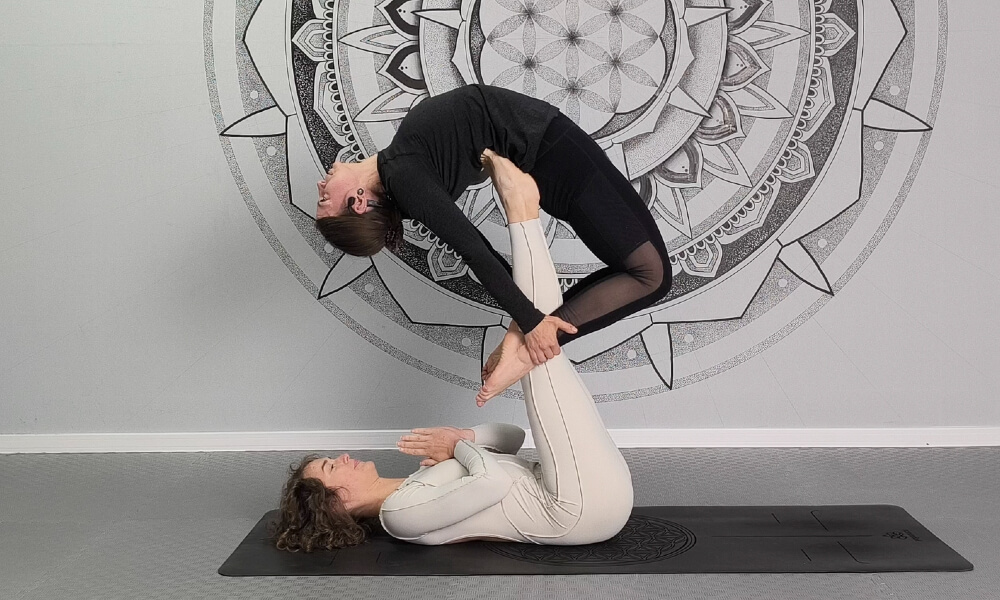
If you’re a fan of deep backbends, this upside-down Bow Pose is your next acro yoga challenge.
How to:
- The base (pictured in white) starts on their back, with legs lifted vertically and knees bent.
- Facing away, the second person (pictured in black) stands near the base’s legs.
- The base places their feet around the flyer’s lower back, avoiding the spine: heels on the pelvis, toes pointing at the shoulders.
- Carefully leaning back, the flyer transfers their weight and lifts their feet off the floor. The base must find a stable position and extend their legs vertically.
- Finally, the flyer reaches back for their feet to enter Bow Pose. This part is very challenging in regards to balance and flexibility.
Downward Facing Dog (Adho Mukha Svanasana) and chin stand
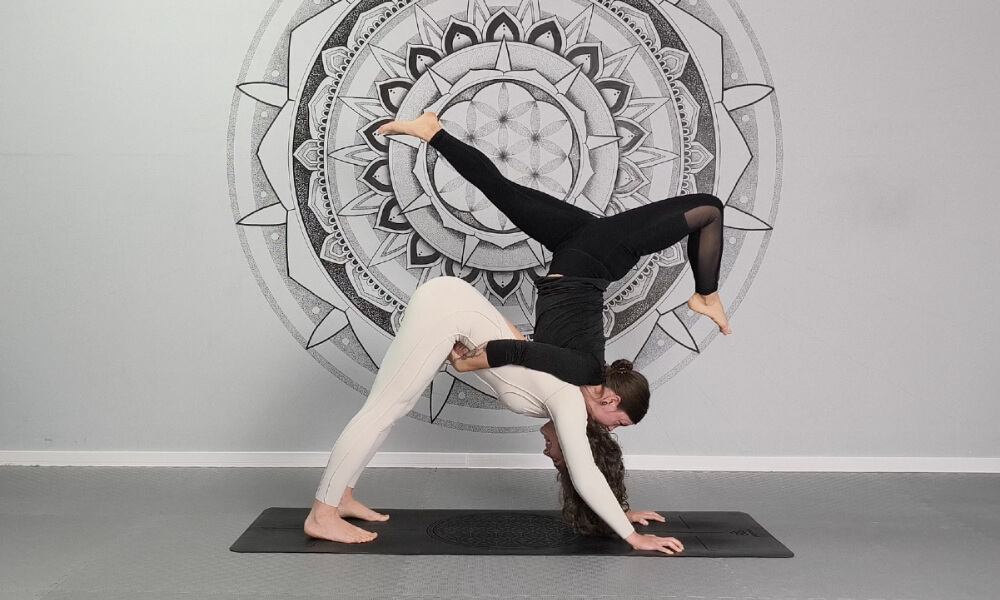
This acro yoga pose for two people definitely needs a third: a spotter who will help you get into the pose and stay safe. The end result is visually striking and very satisfying!
How to:
- The base (pictured in white) starts in Downward Facing Dog.
- It’s a little awkward to enter for the flyer (pictured in black) because they have to climb on top of their partner’s back.
- As the flyer wraps their arms around the base’s waist, they can start transferring weight into their chest and lifting the legs.
- The base has to push backwards to counter balance the shift in the center of gravity.
- From that point, the flyer can try different leg variations: straight up, split, backbend, etc.
Child’s pose (Balasana) and Crow pose (Bakasana)
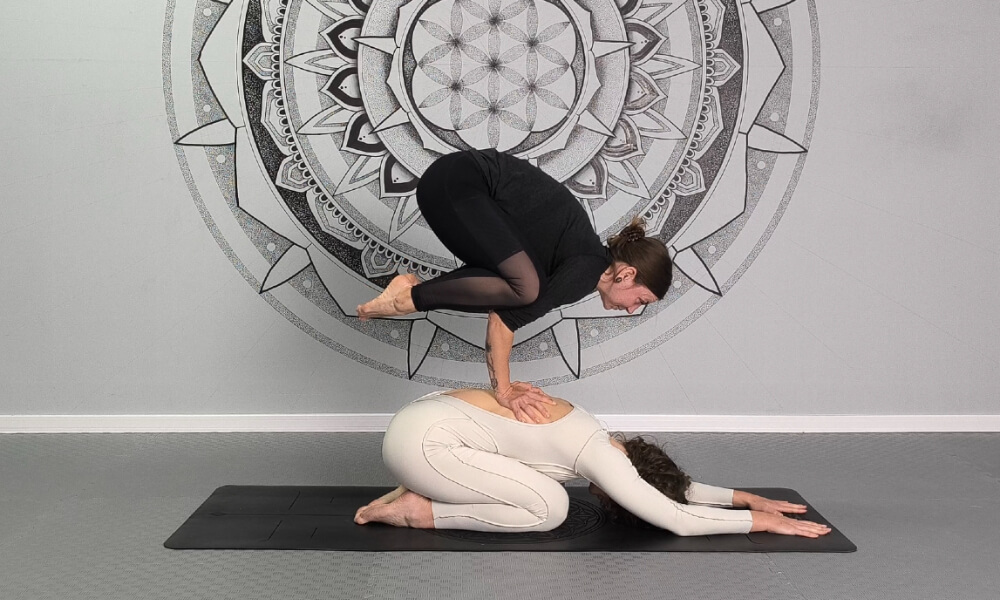
This combination of Bakasana and Balasana is fun juxtaposition of an arm balance and a resting pose. When you think about it, they look suprisingly similar in shape – but not in effort!
How to:
- The base (pictured in white) starts in Child’s Pose.
- The flyer (pictured in black) plants their hands on the base’s back, avoiding the spine.
- Stepping up to the base’s lower back, the flyer plants their knees to their upper arms and transfers their weight into the arm balance of Crow Pose.
Chair pose (Utkatasana) and flag
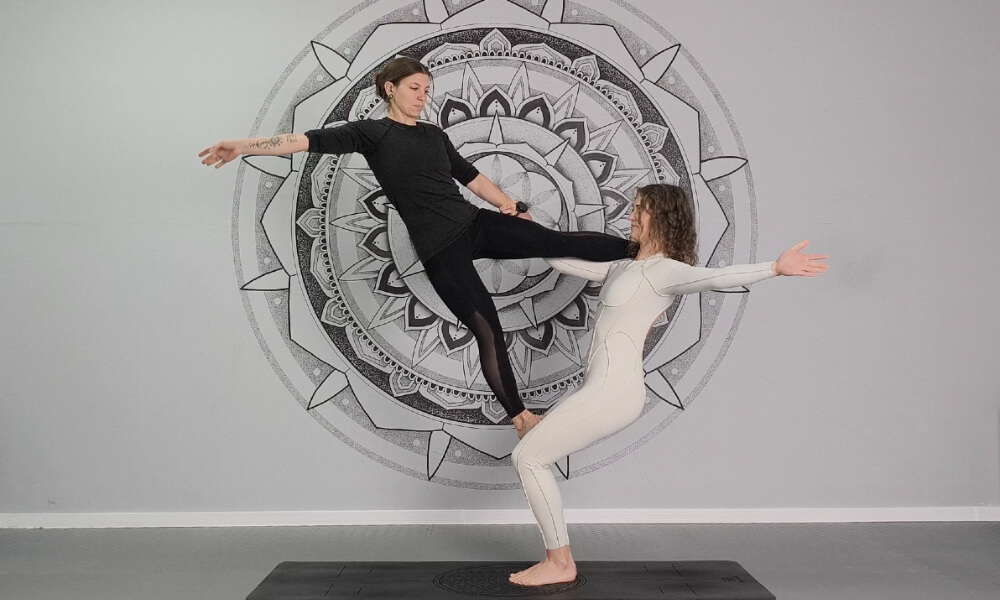
Finish with a bang! This fun counter-balance is easier than it looks, I promise. You just have to trust your partner and not be afraid of heights…
How to:
- The base (pictured in white) starts in Chair Pose.
- Holding hands with the base, the flyer (pictured in black) plants their right foot across the base’s knees.
- As both parties lean back, the flyer transfers their weight into their right foot, simultaneously standing up and lifting their left foot to hook sideways behind the base’s neck.
- Leaning further away from each other while maintaining balance, the base and flyer release one hand (right hand for the flyer, left for the base).
- Try this on both sides and switch roles.
Cool-down 2 person yoga poses:
Supported heart opening
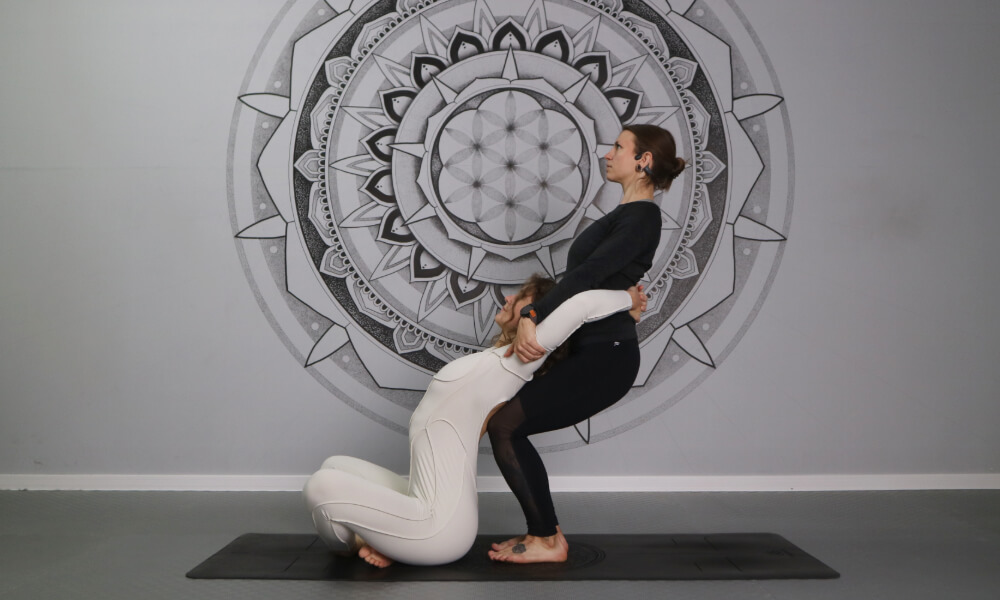
This is an amazing partner stretch for the chest and shoulders. It doesn’t even have to be a part of a larger two person yoga practice, I frequently use it at the end of my classes when I teach yoga.
How to:
- The first person (pictured in white) starts seated or kneeling.
- Standing behind them, the second person (pictured in black) aligns their knees with the first person’s shoulder blades.
- The seated partner lifts their arms and links them around the standing person’s waist.
- Then, the standing partner can gently support their partner’s shoulders as they sit back into Chair Pose and lean back with their torso.
- After a while, switch places.
Cobra (Bhujangasana) and Standing Backbend
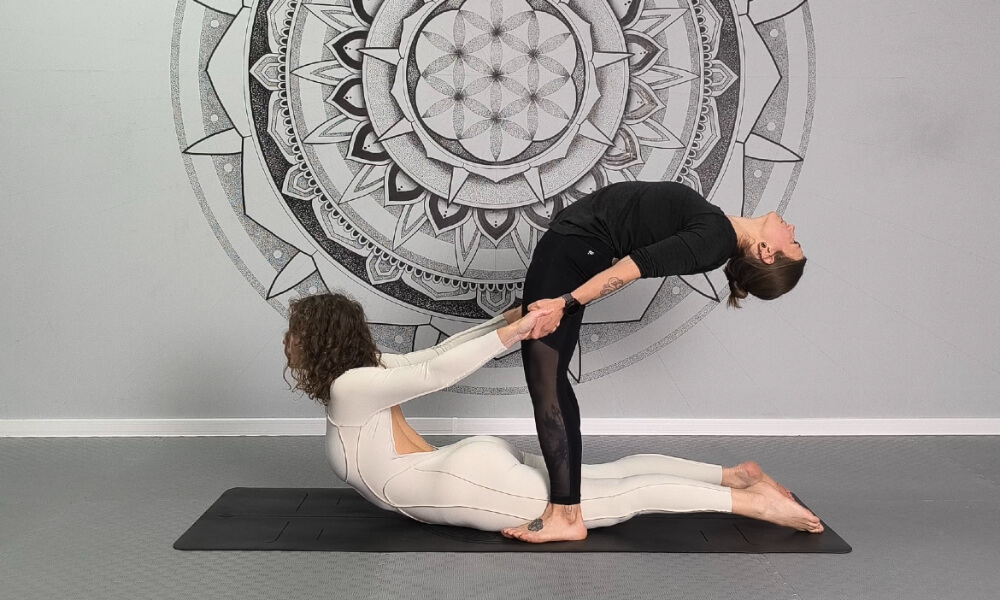
Somewhat similar to the heart-opening above, this double backbend combines a passive Cobra Pose with a standing backbend. The best thing about this partner pose is that you can both regulate how far you take your spinal extension.
How to:
- The first person (pictured in white) starts in prone position.
- Standing over the top, with their feet either side, the second person (pictured in black) holds hands with the first person.
- As the standing partner begins to pull back into a backbend, they gently lift the other person up by the arms.
- After a while, switch places.
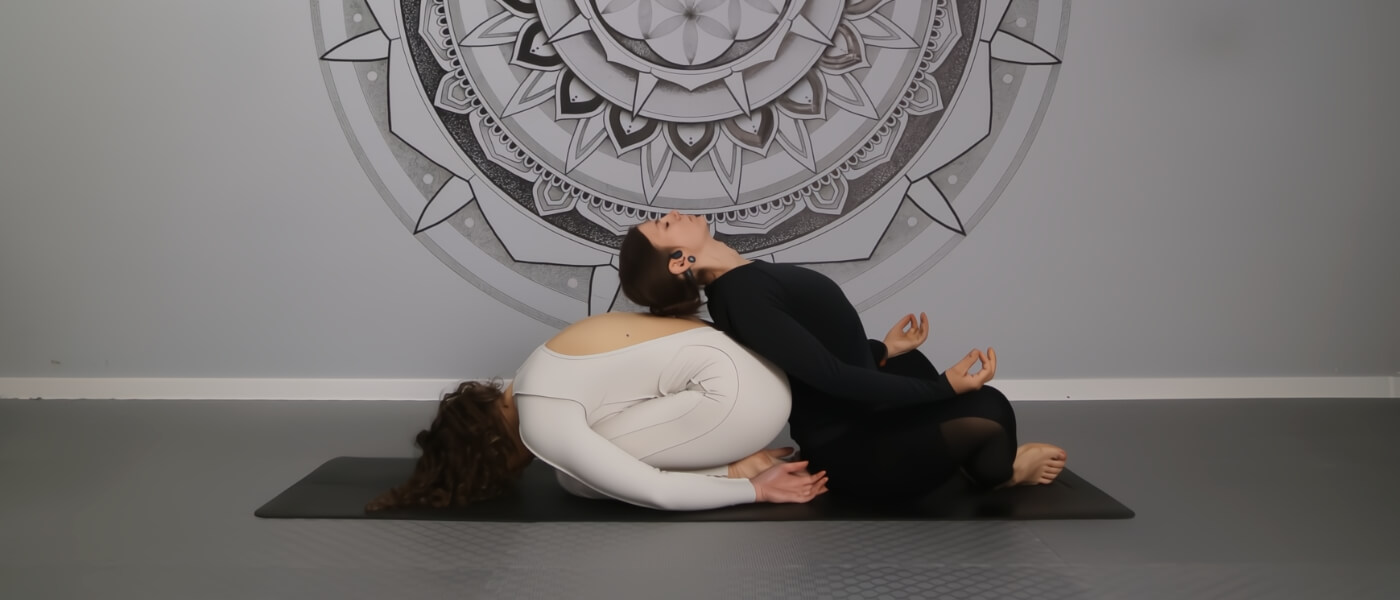
Child’s pose (Balasana) and reclined hero pose (Supta Virasana)
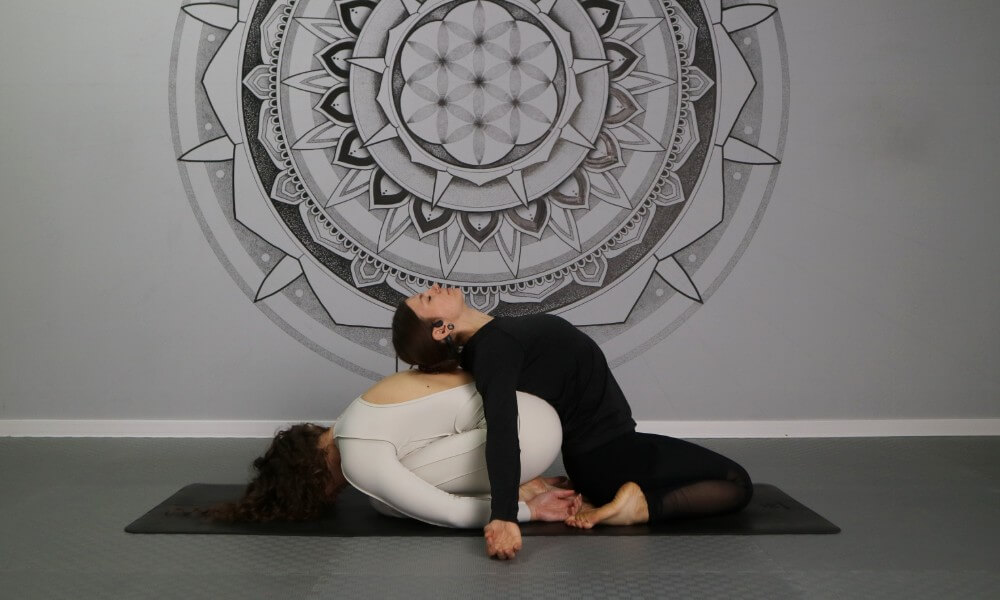
This 2-person pose uses the yin-yang principle to perform opposing spine movements. One person has a grounding rest in Child’s Pose, while their partner enjoys the opening of their chest and shoulders.
How to:
- Facing away from each other, kneel on the floor.
- As one person folds forward into Child’s Pose (pictured in white), the other person reclines and arches their back (pictured in black).
- After a while, switch places.
Child’s pose (Balasana) and Reclined Butterfly (Supta Baddha Konasana)
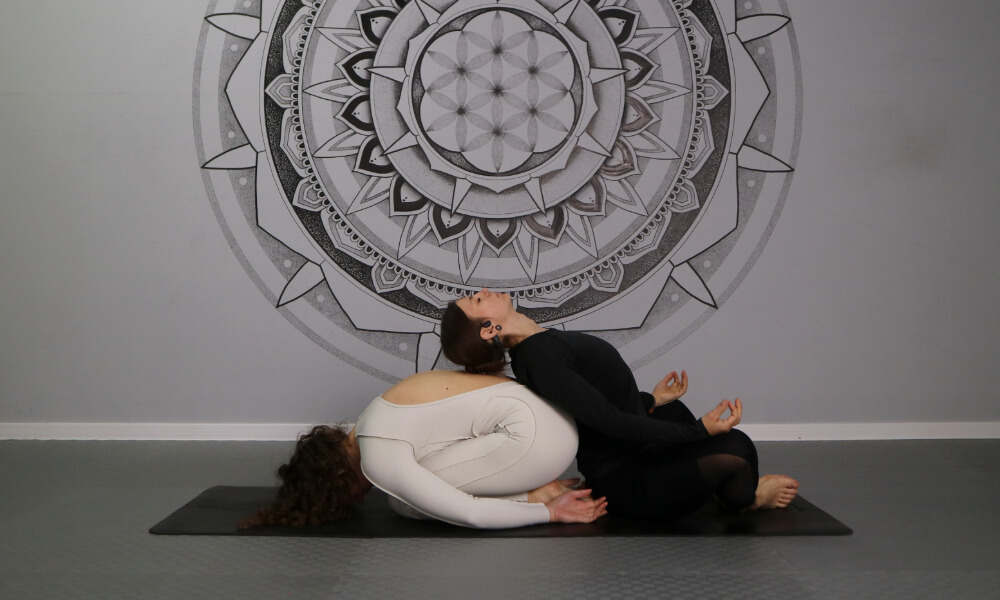
This combination also evokes a yin-yang principle. The person in Child’s Pose enjoys a gentle fold and a rounded spine. Meanwhile, their partner enjoys a supported heart- and hip-opener.
How to:
- Facing away from each other, assume your chosen position. One person kneels while the other person sits on the ground with their feet together and knees apart.
- As the kneeling partner folds forward into Child’s Pose (pictured in white), the other person can recline backwards and open their chest (pictured in black).
- After a while, switch places.
Ready to turn shared practice into a deeper path? Explore Bali yoga certification programs or Costa Rica 200-hour YTT options and keep growing your practice in a supportive, immersive community.
In Conclusion
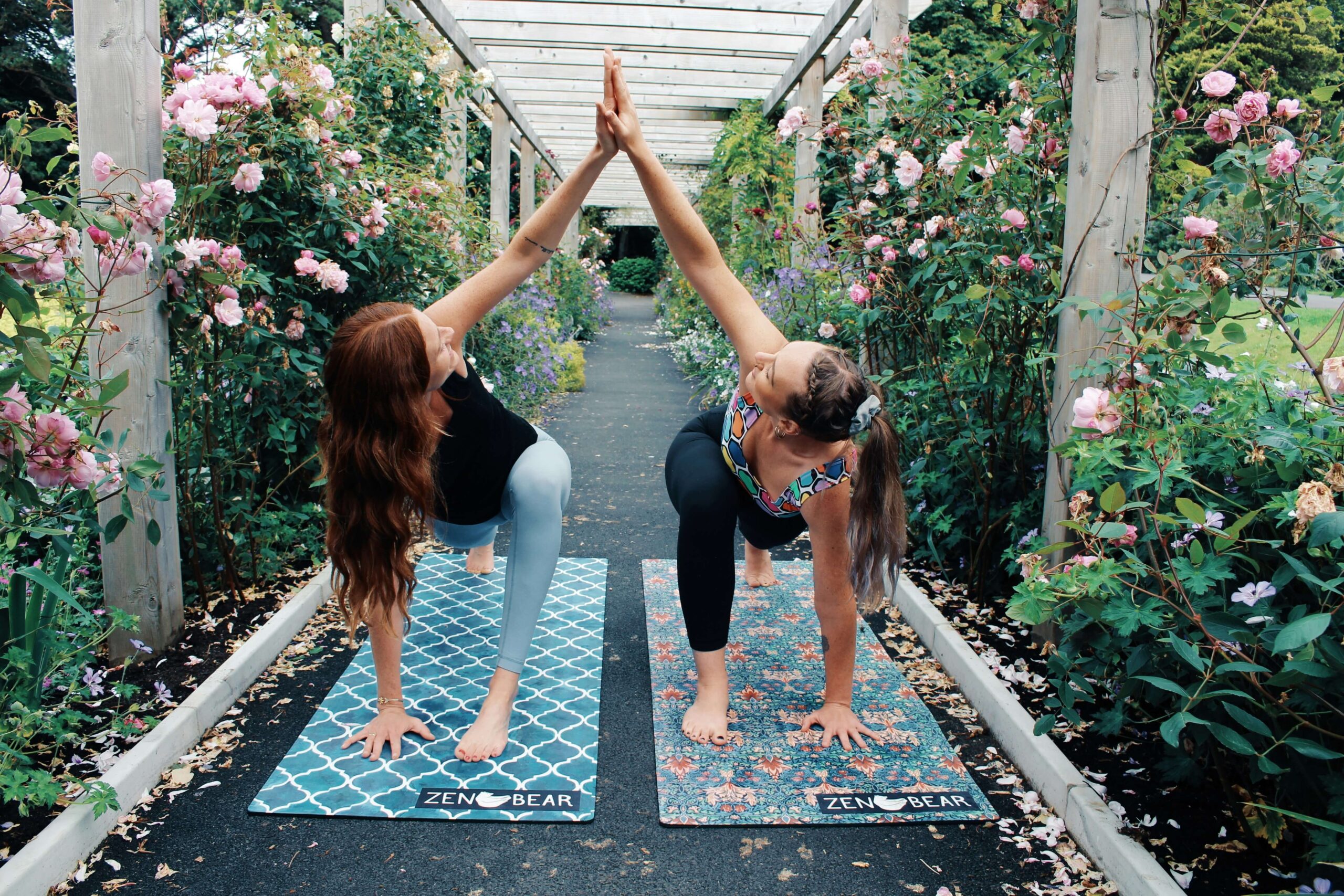
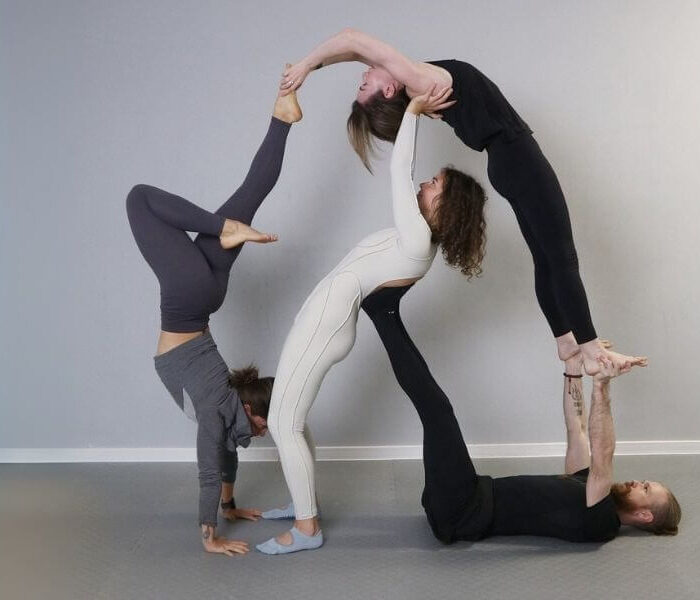
I have done a lot of partner yoga and acro yoga with my friends. From simple two-person poses to complex 4-person yoga pose combinations, it’s an amazing way to bond with people through challenge and laughter.
I would like to thank my friend Jana who helped me capture the photographs for this article, as well the studio owner Konstantin who let us use his space. It really goes to show the strength of yogic community and friendship. If you would like to support them, you can follow @konstantin_tkaciovand @janusjaaaon Instagram.
FAQs
It depends on your interpretation! This article has a mixture of acro yoga (advanced base and flyer poses) as well as partner poses (more accessible to yogis of different levels).
Depends on the pose and how you’re feeling. Restorative poses can be held for 1-3 minutes or even longer, while acro poses may only last a few seconds. Have fun with it!
-
- Warm up before starting
- Use mats on a non-slip surface
- Don’t attempt poses beyond your comfort level
- Use a spotter if possible
- Communicate if something feels painful or unstable
There are always modifications! Instead of lifting, try grounding poses where participants lean, hold hands, or support each other from the floor.
Yes, there are many safe and playful poses for families. Just make sure to choose age-appropriate variations and supervise closely.
Not at all! This article includes two person poses for all levels of ability and comfort.
Free Wellness E-Book
Find Your Zen!
Your Free Guide
To Wellness
Download Your Free Guide & Receive Weekly Inspirations From The Lifestyle Of a Modern Yogi!