Chaturanga Dandasana (Four-Limbed Staff Pose): forward first, then down

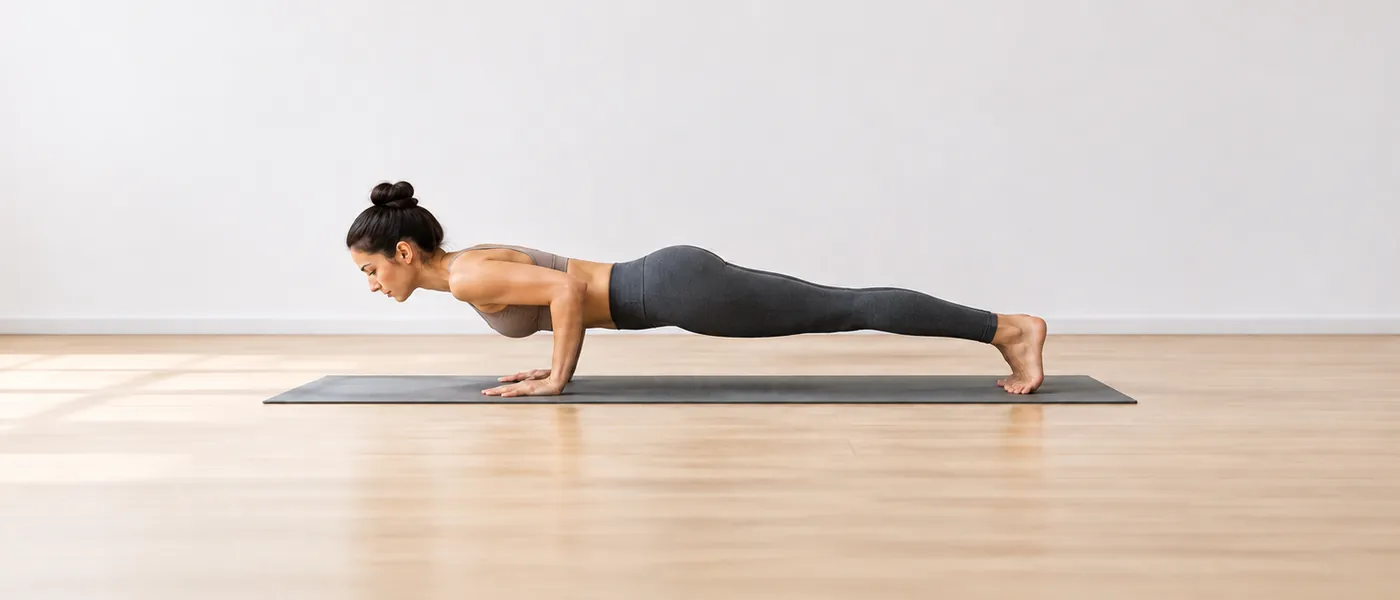
Most trouble with Chaturanga Dandasana is a direction problem, not a strength problem. Four-Limbed Staff Pose, the low plank of every Sun Salutation, has to travel forward before it travels down, and most people only do the second half.
From my mat
I began lowering my knees for Chaturanga when I noticed fatigue was making me rush through the transition.
Sophie Parienti, yoga teacher and YOGI TIMES founder
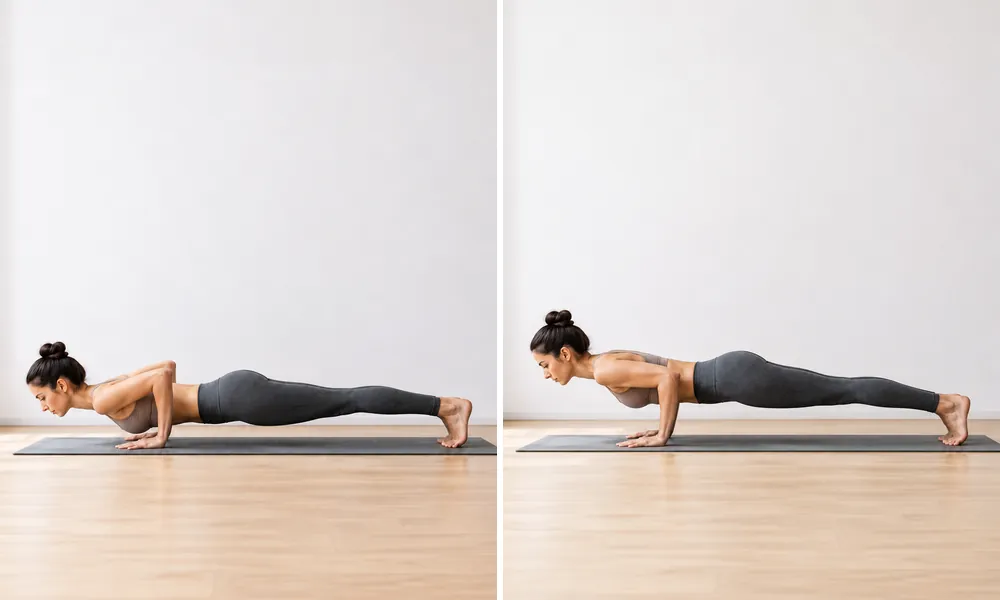
In short: start in Plank with your hands under your shoulders. Rock forward onto the tips of your toes until your shoulders are just past your wrists and your feet feel light. Then bend your elbows straight back, close to your ribs, and lower your straight body until your shoulders are level with your elbows. Hover there for a breath, without letting the chest drop further.
Skip the rocking forward and the elbows end up behind the wrists, the shoulders dip, and the front of the shoulder catches the whole body on the way down. Repeat that twenty times a class and it can be the ache you feel the morning after a vinyasa session.
Quick pose overview
- Also known as
- Chaturanga, low plank, Four-Limbed Staff Pose
- Sanskrit
- Chaturanga Dandasana: chatur (four), anga (limb), danda (staff)
- Pose type
- A core pose that works the arms as hard as the middle
- Level
- Intermediate; the knees-down and half versions are where most people start
- Where it sits
- Between Plank and Upward-Facing Dog in a Sun Salutation, usually on an exhale
- Main work
- The triceps, chest and fronts of the shoulders brake the lowering; the abdominals keep the body straight
- How low
- Shoulders level with the elbows, upper arms about parallel to the floor; higher is fine, lower is not
- Usually limited by
- Arm strength at the bottom, and a body that goes down without first going forward
- Props that help
- A cork block under the chest as a depth marker, a folded blanket under the knees, a wall
- Modify or skip if
- Recent shoulder, elbow or wrist injury; later pregnancy; a known separation of the abdominal muscles
Your teaching, this page, lasting visibility
What is Chaturanga Dandasana?
Chaturanga Dandasana is a straight body held low over the floor on the hands and toes, with the elbows bent and the upper arms about parallel to the ground. In a Sun Salutation it is the bridge from Plank Pose to Upward-Facing Dog, and in most flow classes it lasts half an exhale.
Chaturanga Dandasana looks like the bottom of a push-up, but two details separate them. The elbows travel straight back along the ribs instead of out to the sides, and the body moves forward as it lowers, so the hands end up beside the lower ribs rather than under the shoulders.
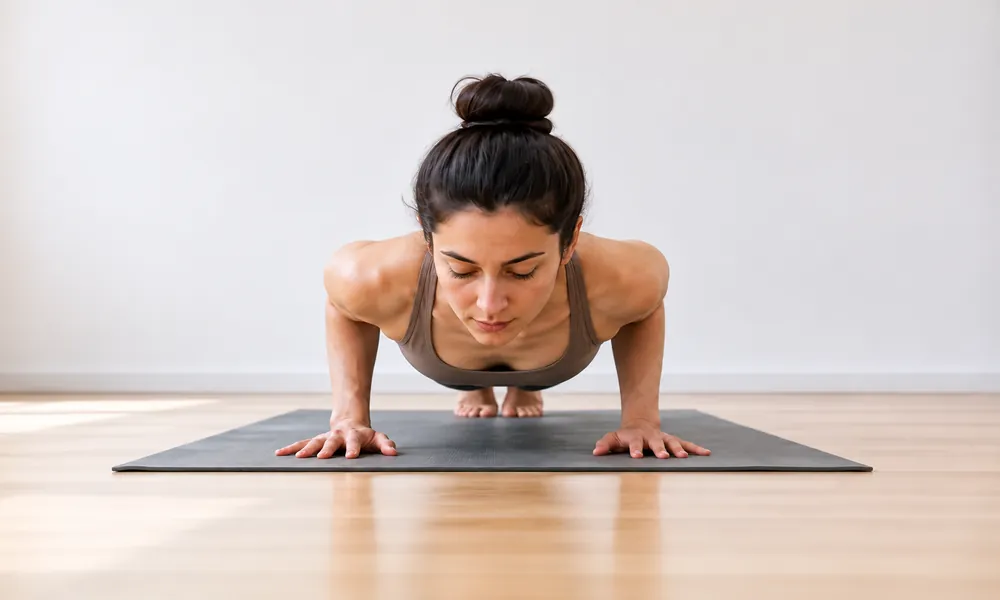
Forward first, then down
Chaturanga needs the forward part because of simple geometry. When the forearms stand upright over the wrists and the upper arms lie level, the shoulders sit about the length of an upper arm in front of the hands. In Plank they sat right over the hands. The only way to get from one to the other is to travel forward.
Lower straight down instead, and the elbows bend backward past the wrists while the shoulders stay over the hands. The pose still looks low, but the forearms slope back, the shoulders tip forward and down, and the front of each shoulder takes the load.
Chaturanga is also the pose YOGI TIMES has mentioned most without ever explaining. It turns up in at least a dozen of our published articles, and our guide to what power yoga is calls it the most commonly rushed pose in yoga. In the past year, Search Console logged exactly one impression for a Chaturanga search on our site.
Meaning of the Sanskrit name
Chaturanga Dandasana reads as four words: chatur (four), anga (limb or part), danda (a staff or stick) and asana (seat or pose). Four-Limbed Staff Pose is a literal translation: a staff held up by four limbs.
An older life for both words
Chaturanga Dandasana borrows a word with a long history. In Sanskrit dictionaries, caturanga means an army of four divisions (elephants, chariots, horse and foot soldiers), and it also names the old Indian board game played with those four kinds of pieces, which historians treat as an ancestor of chess.
Danda has a second life too. Dandavat means “like a stick”, and a dandavat pranam is the full prostration in which a person lies flat on the ground, straight as a staff. Chaturanga stops just before that point: the staff is lowered toward the ground and held a hand’s width above it.
Neither meaning tells you how to do the pose, and we don’t know who first gave the pose this name. The picture is still useful: a straight stick does not bend in the middle when you lower it.
Benefits of Chaturanga Dandasana
Chaturanga Dandasana builds pushing strength in the backs of the arms, the chest and the fronts of the shoulders, and it does most of that work on the way down. Its benefits come from doing it slowly and at a depth you control, which is rarely how it’s done in a fast class.
Physical
- Arm and chest strength. Lowering the body with control is a strength exercise for the triceps, chest and front shoulders.
- Shoulder-blade control. Keeping the shoulder blades flat on the ribs while the elbows bend trains the muscles that hold the shoulder steady under load.
- A trunk that holds while the arms move. The body has to stay straight while its height changes, which is harder than holding a still plank.
- A way into arm balances. The forward shift and bent elbows of Chaturanga are the same moves that carry weight into the hands in Crow Pose and similar balances.
Mental
Chaturanga Dandasana is often where a fast class asks you to choose between keeping up and doing it well. Choosing the slower, higher version while the room drops to the floor takes a kind of attention that carries into other poses.
What we won’t promise
Chaturanga is often sold as a route to toned arms or a flat stomach. We found no evidence that it changes body shape on its own, so we don’t claim it. Done carelessly and often, it is better known for sore shoulders than for any of those things.
Muscles worked in Chaturanga Dandasana
Chaturanga Dandasana is mainly a triceps pose. In a University of Miami study that recorded 14 muscles in 36 practitioners across the 11 Sun Salutation poses, the triceps were reported most active in Chaturanga (Ni and colleagues, 2014). The other muscles split into two jobs: the ones that brake the descent and the ones that keep the staff straight.
The brakes
- Triceps, at the backs of the upper arms, control how fast the elbows bend and hold them at the bottom.
- Pectoralis major, across the chest, and the front of the deltoids share the load as the shoulders move forward and down.
- Serratus anterior, along the side ribs, keeps the shoulder blades flat so the chest doesn’t sink between them.
The staff
- Abdominals (rectus, obliques, transversus) stop the hips sagging as the body gets closer to horizontal.
- Quadriceps keep the knees straight; the glutes work lightly to keep the hips level.
- Calves and toes do more than in Plank, because the feet roll forward onto the tips of the toes.
Chaturanga stretches almost nothing. The fronts of the shoulders and the chest open a little at the bottom, but that is load on a muscle at length, not a stretch to chase.
How to do Chaturanga Dandasana step by step
Chaturanga Dandasana is easiest to learn as a slow, separate pose, starting from Plank and finishing on your knees, before you try it inside a Sun Salutation.
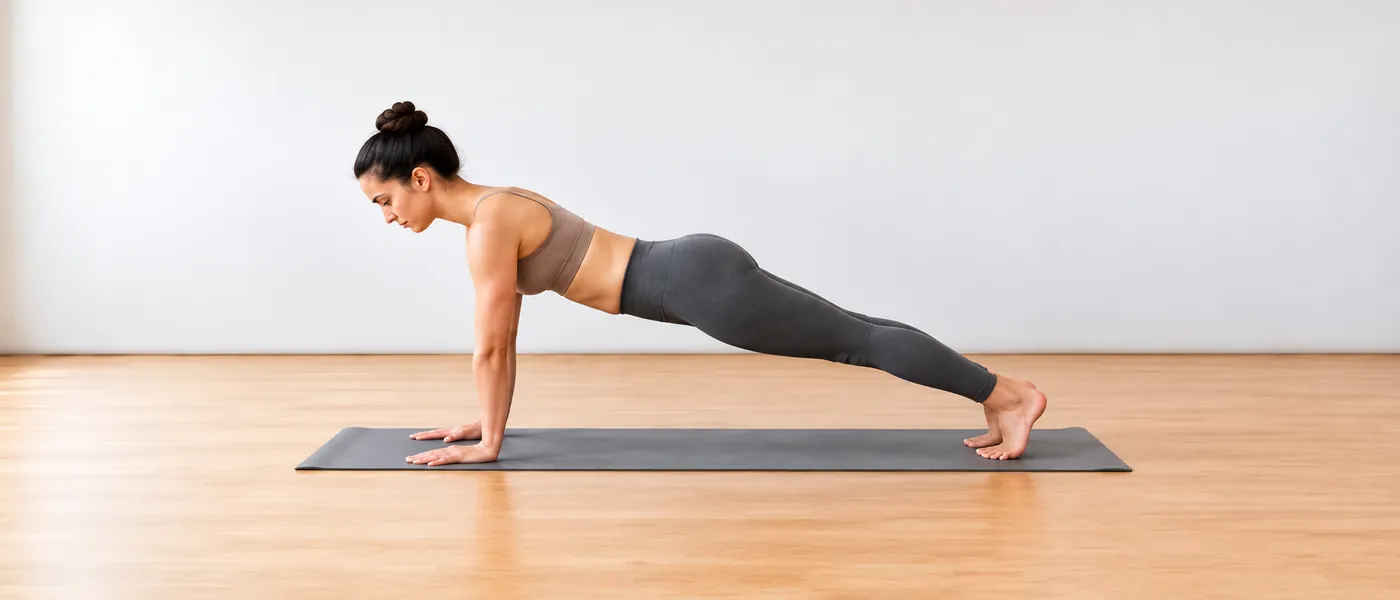
- Set up Plank Hands under the shoulders, fingers spread, index fingers pointing forward. Feet hip-width apart on the balls of the feet, body in one line from the back of the head to the heels.
- Firm the staff Draw the lower front ribs in a little and lengthen the tailbone toward the heels, so the middle won’t sag once the arms start to bend.
- Shift forward Rock forward onto the tips of your toes. Your shoulders move just past your wrists and your hands take more of your weight. Stop when the feet feel light.
- Bend the elbows back On an exhale, bend the elbows straight back, close to the sides of the ribs, as if you were sliding them into the back pockets of a jacket. Keep the whole body moving as one piece.
- Lower to shoulder height Keep lowering until your shoulders are level with your elbows and the upper arms are about parallel to the floor. If that’s too deep for today, stop higher; the line matters more than the depth.
- Hover Hold for one breath. The forearms stand upright over the wrists, the chest stays broad, and your eyes rest on the floor a little way in front of your hands.
- Breathe, don’t brace Keep a slow breath moving. If you find you’re holding it, the hold is over.
- Come out Lower the knees and then the body to the mat, or press back up to Plank, or, in a flow, roll over the toes into Upward-Facing Dog. Belly-flopping to the floor is the one exit to avoid.
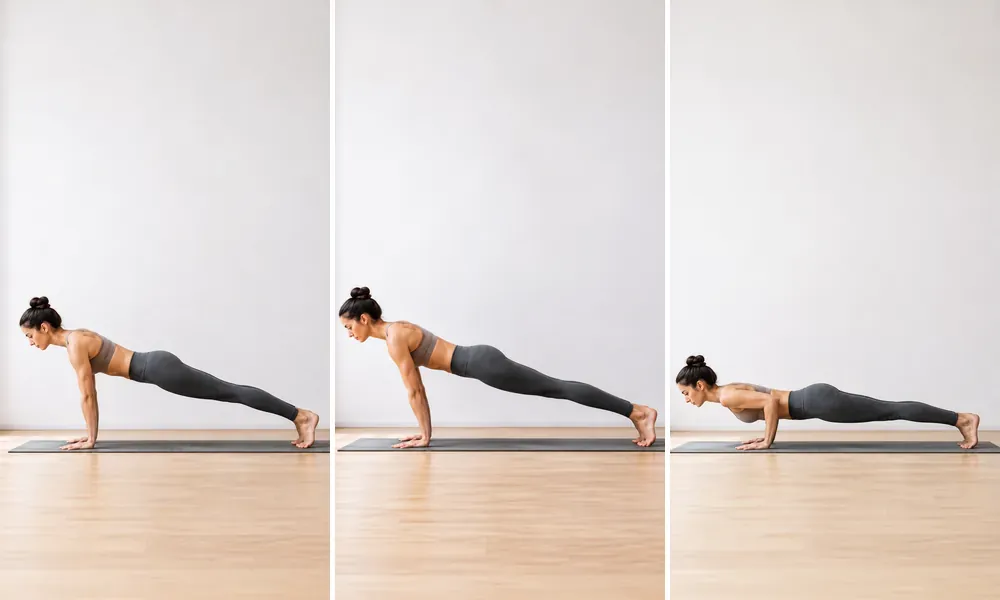
Practise the pose this slowly for a few rounds before you join it to a flow. Speed can come later; at speed, whatever you did slowly is what your body will repeat.
Alignment tips for Chaturanga Dandasana
Chaturanga Dandasana alignment depends on one thing you can’t see while you’re in it: whether your body moved forward before it moved down. You can feel it, though, at the end you’d least expect.
Your feet tell you when to bend
Chaturanga keeps the hands and toes planted, so when the shoulders travel forward past the wrists, the body’s weight travels with them, toward the hands. That weight has to come from somewhere, and it comes off the feet. The feet are the one place you can feel the shift happen.
In Plank, notice how heavy the balls of your feet feel. Rock forward onto the tips of your toes until your feet feel almost light and your hands feel heavier. Bend your elbows from there. If you start to bend while your feet still feel heavy, you haven’t shifted yet, and your elbows will slide back behind your wrists.
Teacher insight, YOGI TIMES editorialTry both versions once. Lower without changing your feet and the fronts of your shoulders take the strain. Lower after your feet go light and the work moves into the backs of your arms and your chest, where it belongs.
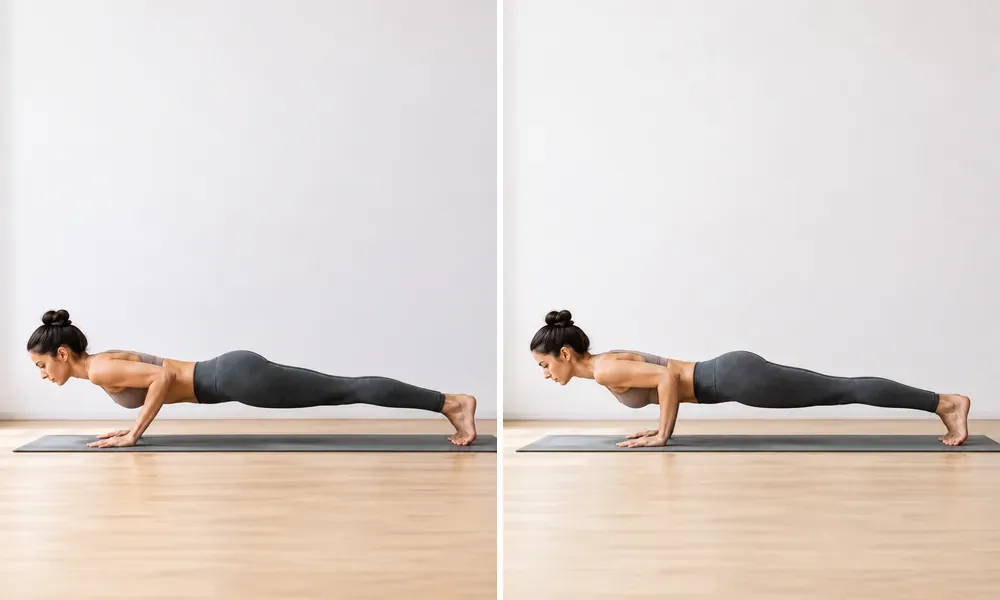
Elbows: back, close and over the wrists
Point the elbows straight back toward the hips and let the insides of the upper arms brush the side ribs. Seen from the side, the forearms should stand roughly upright over the wrists at the bottom. Elbows that splay sideways turn the pose into a wide push-up and twist the shoulder joint as it carries the load.
Depth: shoulders level with the elbows
Stop when the tops of the shoulders are level with the elbows. Going lower drops the shoulders below the elbows, the chest sinks and the fronts of the shoulders roll forward under load. Higher is always allowed. A half Chaturanga with a straight body teaches more than a deep one with a dip.
The staff: one line, eyes ahead
Keep the line of Plank all the way down: back of the head, upper back, hips and heels. Let the gaze rest on the floor a hand’s length ahead of the fingertips. Looking up crimps the neck, and looking back at your feet usually rounds the upper back.
Common mistakes in Chaturanga Dandasana
Chaturanga Dandasana mistakes mostly happen at speed, which is why they go unnoticed for months. Each of these four has a fix you can practise slowly and a sign you can feel without a mirror.
Correction: Go back to Plank, rock forward until the feet feel light, then bend. If the toes won’t roll forward on a sticky mat, start the plank with the feet a little further back. How to spot it: the elbows end up behind the wrists, the hands feel far forward, and the fronts of the shoulders ache.
Correction: Stop higher, with the shoulders level with the elbows or above them, and hold there for a breath. Use a block under the chest as a marker until the depth is automatic. How to spot it: the shoulders roll forward and down, the elbows point up toward the ceiling, and the chest is almost on the floor.
Correction: Lower the knees before the hips can drop, then the chest. In a flow, it is fine to take the knees down on every round. How to spot it: the hips reach the floor first and the lower back pinches as you come down.
Correction: Bring the hands under the shoulders, index fingers forward, and slide the elbows back along the ribs as you bend. How to spot it: the elbows point out to the sides and the pose feels like a wide push-up in the chest.
Beginner modifications for Chaturanga Dandasana
Chaturanga Dandasana has easier versions that keep the shape and lighten the load, so you can practise the real movement long before you can do the full pose. Pick one you can lower slowly with a straight body, three times in a row.
- Knees down, knees further back. On the knees there are no toes to roll over, so the forward shift has to come from where you put the knees. Start in a knees-down plank with the knees a hand’s length further back than feels natural, lean forward until the shoulders pass the wrists, then bend the elbows back. If the knees sit right under the hips, the hips fold and the elbows slide behind the wrists.
- Half Chaturanga. From full Plank, shift forward and bend the elbows only a third of the way down. Hold one breath, then press back up or lower the knees. The depth grows by itself as the backs of the arms get stronger.
- A block under the chest. Set a cork block on its long edge under your breastbone and lower until the chest just touches it. It takes the guessing out of depth. Our Three Minute Eggs block reviewer already keeps hers within reach in a flow, as wrist support between Chaturanga and Up-Dog.
- Wall Chaturanga. Stand facing a wall, palms on it at chest height, step back and lean in. Bend the elbows straight back along the ribs, then press away. It is the lightest way to rehearse the elbow path.
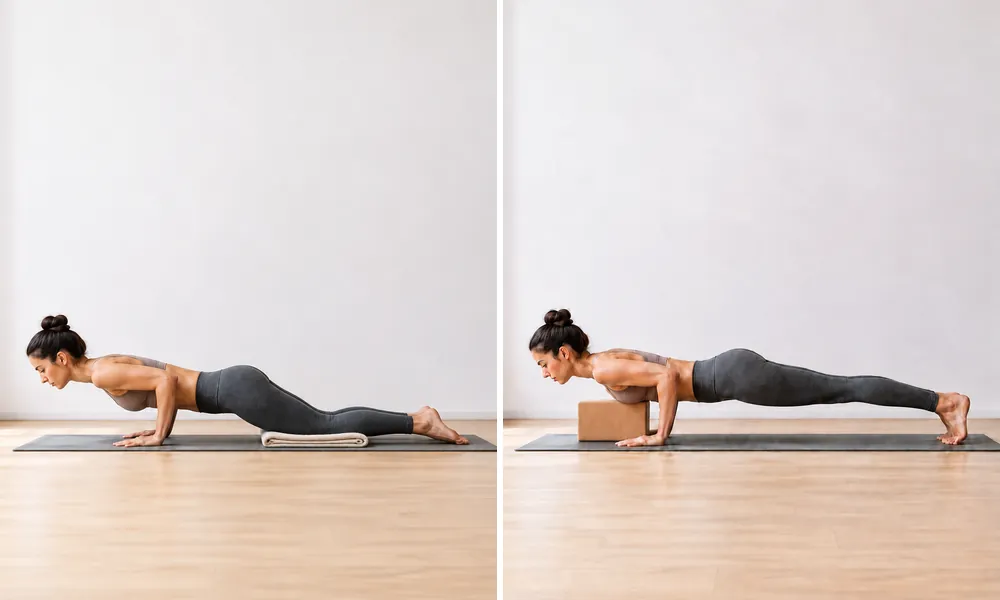
Knees-Chest-Chin Pose is sometimes taught as the easy Chaturanga. It is a different shape, hips high and chest to the floor, and a useful pose in its own right, but it doesn’t train the straight-body lowering. Use the knees-down version for that.
Advanced variations
Chaturanga Dandasana gets harder in two ways: slower and longer, or with less support. Slow and long comes first.
- Five-count lowering. Take five full counts from Plank to the hover. Any count where you speed up is the depth to practise holding.
- Chaturanga hold. Hover at shoulder height for three to five breaths with the body straight, then press back up to Plank.
- One-leg Chaturanga. Lift one leg a few inches before you lower. The body tries to twist toward the lifted side; keep the hips square.
- From an arm balance. Crow Pose can finish by shooting the legs back and landing in Chaturanga, which needs the forward shift to already be second nature.
In a Sun Salutation A, Chaturanga then becomes one of a dozen moves done on a single exhale, which is the real advanced version: the same slow pose, at speed, without losing the shift.
Contraindications and safety
Chaturanga Dandasana loads the front of the shoulder joint, the elbows and the wrists while the abdominals hold the body straight, and in a flow class it repeats dozens of times. Each caution below starts from that load. If one describes you, the knees-down, half or wall versions often make the pose workable; a doctor or physiotherapist can tell you which.
Shoulders take the biggest share when the elbows end behind the wrists or the shoulders sink below the elbows. With a recent shoulder injury, a rotator cuff problem or pain at the front of the shoulder, stay with the wall or knees-down version, keep the depth shallow, and skip Chaturanga in a fast flow until it’s comfortable.
Wrists and elbows carry weight at an angle. The wrists bend back under load, so recent wrist injuries and carpal tunnel symptoms call for the wall version or a half Chaturanga with a short hold. Elbow pain that worsens as you bend is a sign to stop higher or stay on the wall.
The lower back takes over when the hips sag. If your back pinches as you lower, take the knees down so the abdominals can hold the line; come out at once if pain turns sharp or travels down a leg.
Pregnancy, later on, and a known separation of the abdominal muscles both change the pose. Chaturanga lowers the belly toward the floor while the abdominal wall holds the body straight, the same load as Plank held lower and longer. Most teachers move to the wall or the knees; your midwife, doctor or physio has the final word.
Teacher cues for Chaturanga Dandasana
Chaturanga Dandasana cues work best when they come in the order the body needs them: forward, then elbows, then down. Short lines, said as the class moves:
- “Light feet, then bend.”
- “Rock forward onto your toes.”
- “Elbows back, brushing the ribs.”
- “Stop at elbow height. Higher is fine.”
- “Knees down whenever you like.”
- “Keep breathing on the way down.”
Demonstrate the knees-down version first and the full one second, so the room sees the knees as the normal option rather than a fallback. And slow one round right down, even in a fast class; students copy the speed they see.
If you’re training to teach, look for programmes that break Chaturanga into its parts instead of saying the word and moving on. We note which ones do in our review of the online yoga teacher trainings we compared.
Preparatory poses
Chaturanga Dandasana borrows its line from Plank and its strength from slow practice, so the best preparation is short and specific:
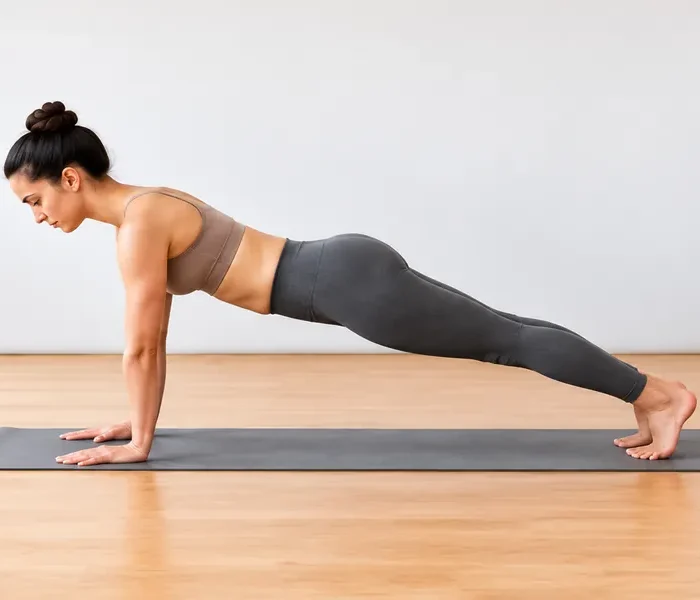
- Plank Pose (Phalakasana). Five steady breaths with the shoulders over the wrists. If Plank sags, Chaturanga will too.
- Plank with a forward rock. From Plank, rock forward onto the toe tips and back three or four times without bending the elbows, to learn the shift on its own.
- Forearm Plank. Builds the trunk endurance for the lowering, without loading the wrists.
- Downward-Facing Dog. Warms the shoulders and wrists and is the pose most flows return to straight after Chaturanga.
Counterposes
Chaturanga Dandasana leaves the chest, the fronts of the shoulders and the wrists working hard, so counterposes open the front of the body and take the weight off the hands:
- Upward-Facing Dog or Cobra. Lift the chest and open the front of the shoulders after the lowering.
- Child’s Pose. Rest the arms forward or alongside the body and let the shoulders soften.
- Wrist release. Kneel, turn the fingers to face your knees with the palms down, and lean back gently for a few breaths; then shake the hands out.
Sequences including Chaturanga Dandasana
Chaturanga Dandasana gets strong through a ladder of versions, settles into a Sun Salutation, and supports arm balances. Three short sequences:
Move up a rung when the test passes
- Wall Chaturanga, 5 slow lowerings
- Knees down, knees well back, 5 slow lowerings
- Half Chaturanga from full Plank, 5 slow lowerings
- Test: body straight and breath moving on all 5? Then the next rung
Repeat 3 to 5 rounds
- Half Forward Fold, inhale
- Step back to Plank, rock forward, exhale to Chaturanga (knees optional)
- Roll over the toes to Upward-Facing Dog, inhale
- Downward-Facing Dog, 3 breaths
Five minutes
- Plank with a forward rock, 4 rounds
- Chaturanga hold, 3 breaths
- Child’s Pose, 5 breaths
- Malasana (Garland Pose), 5 breaths
- Crow Pose attempts, 3 rounds
What this pose teaches
Chaturanga Dandasana rewards the part of a movement most people skip: the way there. The final shape lasts a breath; the lowering is where the strength is built, and where the shoulders take the strain if it’s rushed.
Research backs that up. In a lab study of Sun Salutation B, every muscle measured worked harder during the transitions between poses than during the holds (Potiaumpai and colleagues, 2017). Chaturanga is mostly transition, so how you move through it is the pose.
It’s also the pose a busy class is least able to correct. As our power yoga explainer puts it, a led class moves too fast for a teacher to fix ten people’s Chaturanga. That leaves the correcting to you, a few slow rounds at a time.
Is Chaturanga Dandasana your pose?
Related poses
Chaturanga Dandasana sits in a small family of floor poses that share its line or its arms:
- Plank Pose: the same straight body with straight arms, and the pose Chaturanga starts from.
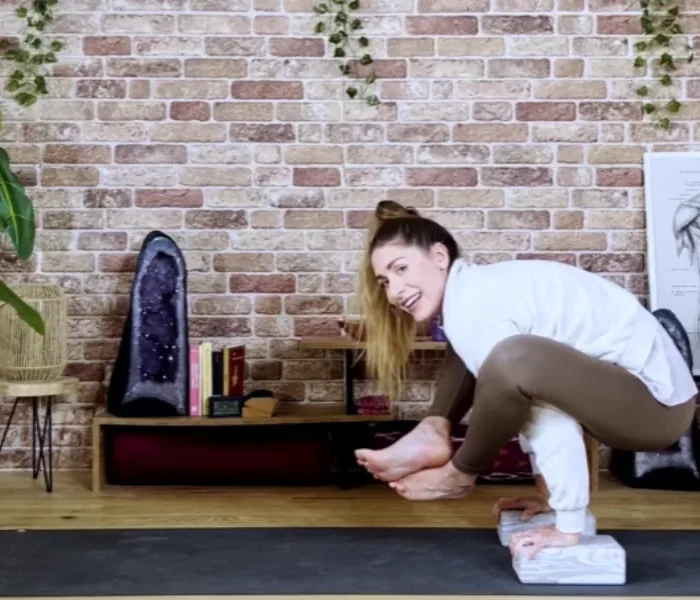
- Crow Pose (Kakasana): the bent elbows and forward weight shift, taken off the floor.
- Upward-Facing Dog: the backbend that usually follows Chaturanga in a flow.
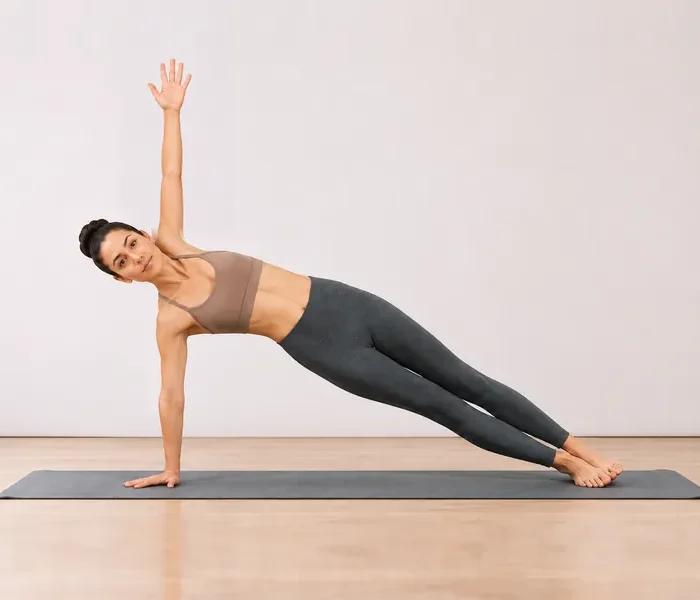
- Side Plank (Vasisthasana): the plank turned on its side, a different load for the same shoulders.
- All pose guides: the full YOGI TIMES pose library.
Chaturanga Dandasana: what people ask
Only until your shoulders are level with your elbows, with the upper arms about parallel to the floor. Below that, the shoulders roll forward and the front of the shoulder joint carries the weight. Many people are better off stopping a third or half of the way down for a few months; the straight body and the forward shift matter more than the depth.
Yes, on every round if you want to. Put the knees down while you are still in Plank, and place them a little further back than feels natural so you can still lean forward before you bend. The teacher won’t mind; a knees-down Chaturanga with the elbows over the wrists is better practice than a full one that drops.
Often because of how Chaturanga is lowered, many times in a row. When the body goes straight down without moving forward, or sinks below elbow height, the front of the shoulder takes the load. Shift forward until the feet feel light, stop at elbow height and use the knees. Pain that lasts or is sharp needs a physiotherapist’s look.
Not quite. A gym push-up usually keeps the hands under the shoulders, lets the elbows angle out and is repeated for numbers. Chaturanga moves the body forward, keeps the elbows back by the ribs, and is held for a breath before the body changes direction into a backbend. Rapid push-ups in place of Chaturanga practise the wrong pattern for a flow.
Yes. You can lower from Plank onto the knees and chest, or step back to Plank and go straight to Downward-Facing Dog. Skipping some rounds and doing the others slowly and well is a sound plan, especially in a class with twenty or more of them.
Straight back, toward the hips, with the insides of the upper arms close to the side ribs. Elbows that splay out make it a wide push-up, which loads the shoulder in a twisted position. If your elbows keep drifting out, check that your hands are under your shoulders and your index fingers point forward.
Final thoughts
What would your practice feel like if every Chaturanga started with light feet? Probably slower, a little higher and, after a while, a lot stronger in the backs of the arms. The pose is the same four limbs and the same straight staff; only the order changes. Forward, then down.
If you’re new to the pose, rehearse it on its own first, from a steady Plank, before it goes back into a fast flow.
References
- Catur, anga and danda, Wisdom Library, for the Monier-Williams and Apte entries (four; limb or part; staff or stick). Checked 12 October 2026.
- Caturanga, Wisdom Library, for the army of four divisions and the board game (Yates; Böhtlingk and Roth). Checked 12 October 2026.
- Dandavat, Wisdom Library, for “like a stick” and the full prostration (Apte). Checked 12 October 2026.
- Ni M, Mooney K, Balachandran A, Richards L, Harriell K, Signorile JF. Muscle utilization patterns vary by skill levels of the practitioners across specific yoga poses (asanas). Complementary Therapies in Medicine, 2014;22(4):662-9, for the triceps result across 11 Sun Salutation poses (36 practitioners).
- Potiaumpai M, Martins MC, Wong C, et al. Difference in muscle activation patterns during high-speed versus standard-speed yoga. Complementary Therapies in Medicine, 2017;30:24-29, for higher muscle activity in transitions than in holds.
- YOGI TIMES archive: What is power yoga and the Three Minute Eggs yoga blocks review.
- YOGI TIMES search data from Google Search Console, October 2025 to October 2026, pulled 12 October 2026.
- The foot test under Alignment follows from the pose’s mechanics: with the hands and toes planted, moving the shoulders forward moves weight from the feet to the hands. We found the forward shift widely taught, but not the feet used as its gauge, so the page labels it a YOGI TIMES editorial deduction.
Related Posts




Free course finder
Which online course fits you?
One question, and we send you all nine programs compared honestly, including who each one is not for.
One short email series, no spam. Unsubscribe anytime.
Free comparison
Nine online courses, compared honestly
Price, format, certificate, and the column most sites skip: who each course is not for. Read it before you pay.
One short email series, no spam. Unsubscribe anytime.

YOGI TIMES · Your privacy
A few cookies, only with your yes
We use cookies to understand what you read and to measure our own marketing. Nothing is set until you choose. Privacy policy