Eco-friendly yoga: how to make your practice lighter on the earth

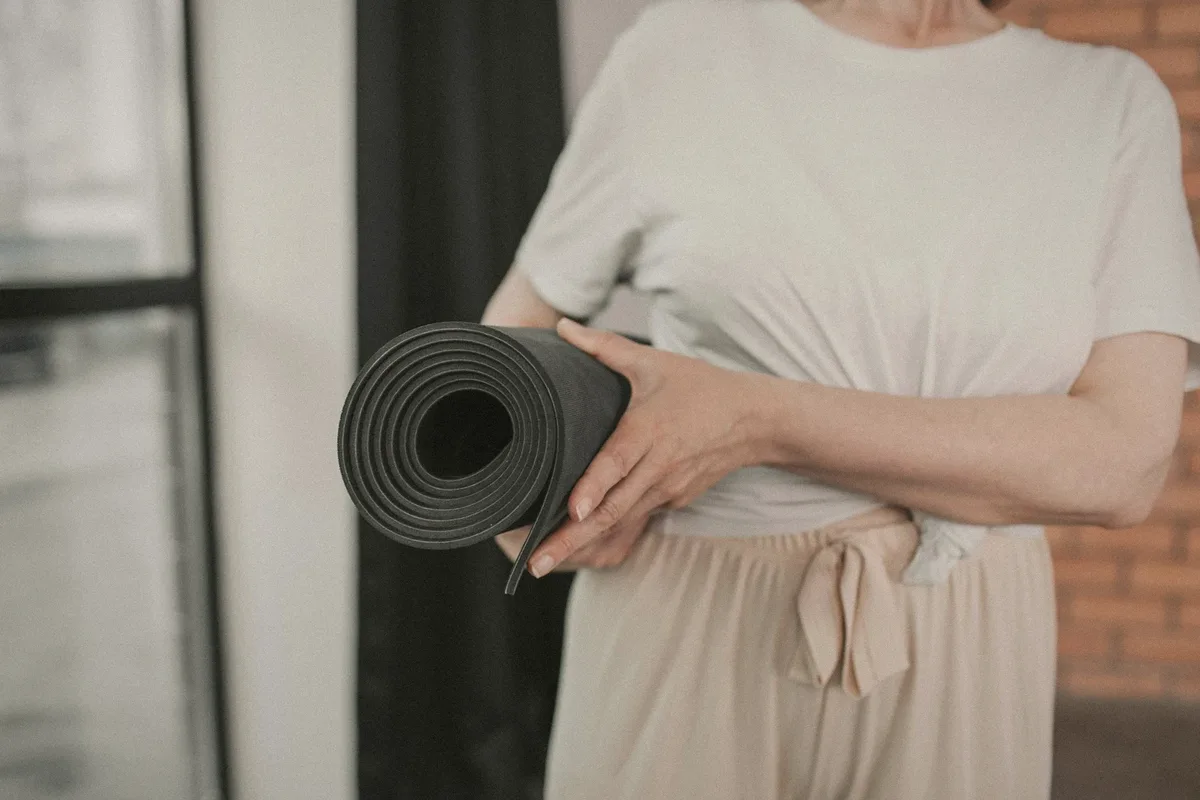
Count the plastic in your yoga corner and the total tends to surprise people: a PVC mat, a foam block or two, three pairs of polyester leggings, a water bottle, maybe a bolster with a synthetic cover. None of it is anything to be ashamed of. Most of it was what the shop sold when you started, and most of it still works.
The International Day of Climate Action, started by the climate group 350.org in 2009 with more than 5,000 events in 181 countries, falls every 24 October, and any day is a good day to look at the kit you practise with. We go through mats, clothes, props, incense, travel and studios below, and we leave the trade-offs in. If the news about it weighs on you, our guide to yoga for climate anxiety is for exactly that.
Quick answer
From our archive interview
We interviewed New York designer Jill Danyelle about fiftyRX3, her year-long project to make what she wore each day more sustainable. She set the bar at half, not all of it: “I decided not to choose one hundred percent because I did not want to throw away everything I had and start from scratch.”
Her test before buying anything new works just as well for yoga kit: “Do I already have something like this in the closet? Why am I buying this?” It is the same logic as keeping the mat you already own.
Eco-friendly yoga starts with the mat you already own
A yoga mat you already own, even a PVC one, has already been made, and its factory footprint is spent. Throwing it out early to buy a cork mat adds a second manufacturing footprint without cancelling the first. Use it until it tears, flakes or stops gripping. This is the least glamorous rule of sustainable yoga, and the one most eco-friendly brands leave out of their marketing.
Mat makers rarely publish a carbon figure per mat, so we cannot give you a reliable number for how long a new one takes to make up for itself. The logic still holds without the number: the more classes a mat lasts, the smaller its share of the footprint per class.
A PVC mat near its end usually tells you. The surface turns shiny and slick under damp palms, and small flakes stick to your forearms in plank. Until then, wipe it with a damp cloth and a drop of mild soap after sweaty classes and keep it out of direct sun, which wears any mat out faster.
PVC, natural rubber, cork and jute yoga mats compared
PVC, natural rubber, cork and jute are the four mat materials you will meet most often, and each trades grip, weight and end of life differently. None of them is free of compromise.
| Material | What it is | Good at | The trade-off |
|---|---|---|---|
| PVC | Plastic, made flexible with plasticisers, often phthalates | Cheap, light, durable | Fossil-based; four phthalates used to soften PVC are on the EU list of substances of very high concern |
| Natural rubber | Tapped from rubber trees, sometimes with a polyurethane top | Heavy, cushioned, very grippy | Heavy to carry, rubbery smell at first, not suitable for anyone with a latex allergy |
| Cork | Bark stripped from cork oaks, usually bonded to a rubber base | Warm, dry surface; the tree is not cut | Two bonded materials at end of life; costs more |
| Jute | Woven plant fibre, often heat-bonded to a PVC backing | Textured, breathable top | Rough under bare knees; check the backing, it is often plastic |
Cork has the easiest story to check. The Portuguese Cork Association explains that a cork oak is first stripped when it is about 25 years old, then every nine years for around two centuries, and the tree is never felled.
Natural rubber is renewable, but rubber plantations can replace forest. The EU names rubber among the seven commodities covered by its deforestation regulation, with obligations for large companies starting on 30 December 2026. Ask a brand where its rubber is grown and what certification backs that answer.
Price is why most of us own PVC, and it is fair to say so. Our guide to buying a yoga mat in Bali found a basic PVC mat at about Rp 100,000 to Rp 300,000, while an eco rubber, cork or natural-tree mat from a dedicated yoga label runs Rp 800,000 to Rp 1,500,000 or more.
What to do with a worn-out yoga mat
A worn-out yoga mat still has jobs left before the bin. Cut it into kneeling pads for the garden, a non-slip liner for a drawer or a grip pad under a rug, or ask a local animal shelter whether it takes old mats.
Treat “biodegradable” on a mat label as a claim to check with the maker. The word alone says nothing about how long it takes or in what conditions, and a cork top glued to a rubber base is two materials, not one.
Yoga clothes: microfibres, PFAS and how many pairs you need
Synthetic yoga clothes shed tiny plastic fibres every time they are washed. A 2017 IUCN study found that washing synthetic textiles and the wear of car tyres account for almost two-thirds of the primary microplastics reaching the oceans.
How to wash yoga clothes so they shed less
How you wash them changes how much they shed. Researchers at the University of Leeds and Procter & Gamble reported in 2020 that a 30-minute wash at 25°C released up to 52% fewer microfibres than an 85-minute wash at 40°C. Wash leggings cool, short, and only when they need it.
PFAS in yoga clothing
PFAS, the “forever chemicals” used for water and stain resistance, are the second worry. California and New York banned intentionally added PFAS in most new clothing from 1 January 2025, with gear for severe wet weather given until 2028.
Our Definite Articles PFAS-free leggings review walks through the brand’s Intertek lab reports, which found no PFAS or BPA in its leggings fabric. Those leggings are still synthetic, so they still shed in the wash. PFAS-free and plastic-free are different claims.
Natural fibres are the other route. The organic cotton yoga leggings by Sati Creation in our boutique are 90% GOTS-certified organic cotton and 10% lycra, sewn to order in Bali, so no unsold stock piles up. That 10% is still synthetic; it is what keeps the waistband up in a forward fold.
Fewer pieces worn longer matters more than any fibre. A reversible ramie kimono from Kokoon is two colours in one garment, which is the idea in miniature. We sell both pieces, so weigh our view with that in mind; a fourth pair of leggings rarely changes anyone’s practice.
Yoga props you can swap for things at home
Yoga props are the easiest place to skip new plastic, because most of them have a household stand-in. Two firm hardback books work as a block, a dressing-gown belt or a long scarf as a strap, and a rolled blanket or a firm sofa cushion as a bolster.
Our guide to stretching with blocks and bolsters shows what each prop does in a pose, which helps you judge what a stand-in has to do. When you do buy, cork and wood blocks feel heavier and steadier under the hand than foam, which dents over time. Cotton straps and bolsters filled with buckwheat hulls or cotton avoid a foam core.
The smallest swap of all happens before class: fill a reusable water bottle at home instead of buying a plastic one on the way. It is easy, it costs nothing, and over a year of classes it adds up to a lot of plastic water bottles.
Palo santo and incense: check which tree it came from
Palo santo is the common name of two different trees, and the difference matters. Bursera graveolens, the aromatic wood usually sold to yoga students, is listed as Least Concern by the IUCN. Bulnesia sarmientoi, a separate tree from the Gran Chaco also called palo santo, is on CITES Appendix II, which controls its international trade. The same question applies to palo santo essential oil, which is distilled from the wood: ask which tree, and where it came from.
Our ethical sourcing guide to palo santo, which draws on the Ecuadorian producer EcuadorianHands, sets out what to ask a seller: wood only from trees that died naturally and rested on the forest floor for three to four years, permits from Ecuador’s environment ministry, and a clear place of collection.
Freshly cut sticks are the red flag, because living wood has not developed the aroma yet; someone cut it for volume. The smoke itself smells sweet and resinous, a little like citrus and pine. Light a stick for a few breaths, then put it out, and one stick goes a long way.
Yoga retreats and teacher trainings: the flight is the big number

Travel is where a yoga life’s footprint grows fastest. Our World in Data, using UK government emission factors, puts a domestic flight at about 246 grams of CO2-equivalent per passenger-kilometre, against about 35 for national rail and about 4 for the Eurostar. Per kilometre, the flight emits about seven times as much as the train.
The train is therefore the first choice wherever one runs. Amara Valley, the off-grid retreat in Catalonia where we spent four days, sits about 1h40 by road from Barcelona, a city much of Western Europe can reach by rail. Our stay there was hosted.
What we saw on site is what an eco claim should look like on the ground: solar panels crowdfunded by its own community, compost toilets that do not smell, and plant-based, seasonal meals cooked without waste. Ask any retreat to show you its equivalents before you book.
No train reaches Bali or Costa Rica from most of the world, and we promote destination yoga teacher trainings in both, so read this with that in mind. If you fly long-haul, go less often and stay longer: one three-week training is a better use of a flight than several long weekends away.
If the certificate is the goal, the online yoga teacher trainings we have ranked cover the 200 hours without a flight. What a screen cannot give you is weeks away from your normal life with a group, which is the real reason many people still choose to travel.
Choosing a yoga studio with a lighter footprint
A yoga studio’s footprint shows in four things you can see from the mat. Does it lend mats or push new ones, how does it heat the room, does it refill water rather than sell bottles, and how far is it from your door?
Heating a hot yoga room takes energy every class, so if climate is your filter, mix heated classes with unheated ones. The studio you can walk or cycle to usually beats a slightly better one across town that you drive to. And practising at home some days removes the trip altogether.
If something at your studio bothers you, ask the owner. A question from a regular is easier to act on than a complaint, and small studios often change one thing at a time.
Who this guide is not for
Readers with a latex allergy, a tight budget or a humid climate should ignore parts of this advice. With a latex allergy, skip natural rubber and cork-on-rubber mats, look for a mat with a non-latex base, or simply keep your PVC one.
If money is tight, a cheap PVC mat used for years is a reasonable choice, and nobody in class should make you feel otherwise. If you practise in a hot, humid place, a fabric that dries quickly may serve you better than cotton that stays damp.
And if a training abroad is the trip of your life, plan it well and take it. The point of a climate day is fewer, longer journeys, not a practice built on guilt.
None of this changes the yoga practice itself. An eco-friendly yoga practice looks exactly the same on the mat; the planet only notices what you buy, how you wash your yoga clothing and how far you travel to unroll it.
FAQs
Usually not. A mat you already own has had its manufacturing footprint spent, and buying a new one adds a second. Use it until it tears, flakes or stops gripping, then choose natural rubber or cork over PVC unless you have a latex allergy.
Natural rubber or cork are the usual swaps for PVC, with a non-latex base if you are allergic to latex. Ask the brand where its rubber is grown and what certification it holds, because rubber is one of the commodities covered by the EU deforestation regulation.
It depends which tree. Bursera graveolens, the wood usually sold to yoga students, is listed as Least Concern by the IUCN. Bulnesia sarmientoi, a different tree also called palo santo, is on CITES Appendix II. Buy only wood from naturally fallen trees with a clear place of collection.
Wash them cool, short and only when they need it. In a University of Leeds and Procter & Gamble study, a 30-minute wash at 25°C released up to 52% fewer microfibres than an 85-minute wash at 40°C.
A lot more than the mat. Our World in Data puts a domestic flight at about 246 grams of CO2-equivalent per passenger-kilometre, against about 35 for national rail and about 4 for the Eurostar. Take the train where one runs, and choose an online training when the certificate is the goal.
References
- IUCN (2017). Invisible plastic particles from textiles and tyres a major source of ocean pollution. iucn.org
- University of Leeds and Procter & Gamble (2020). Quicker and cooler is best for clothes. sciencedaily.com
- Venable (2024). PFAS bans on apparel in California and New York, effective 1 January 2025. venable.com
- Our World in Data. Which form of transport has the smallest carbon footprint? ourworldindata.org
- Kew, Plants of the World Online. Bursera graveolens (IUCN status). powo.science.kew.org
- Bulnesia sarmientoi (CITES Appendix II listing since 2010). wikipedia.org
- EY Global Tax News (2026). EU deforestation regulation application postponed to 30 December 2026. taxnews.ey.com
- 350.org. 24 hours that shifted the world (International Day of Climate Action, 24 October 2009). 350.org
How we fact-checked this article: in November 2026 the YOGI TIMES editorial team opened each source above and checked the figures against it: the IUCN textile and tyre share, the Leeds wash result, the New York and California PFAS dates, the flight and rail emissions, and the EU deforestation date. Palo santo’s status was checked against Kew’s summary of the IUCN assessment and a summary of the CITES listing. The Amara Valley stay was hosted, as stated above. This article is general information, not purchasing or medical advice.


Online yoga teacher training
$100 off your 200‑hour online training
Learn to teach yoga, from home
Take Movement Wisdom’s 200-hour online yoga teacher training and save $100 with your YOGI TIMES code.
Use code YT100
Get $100 offThe code is applied when you use this button, or enter YT100 at checkout.
Free wellness e-book
Find your zen
Your free guide to wellness
Download your free 7-Day Wellness Journey Guide and receive weekly inspiration for the lifestyle of a modern yogi.
🔒 We respect your privacy. Unsubscribe anytime.


YOGI TIMES · Your privacy
A few cookies, only with your yes
We use cookies to understand what you read and to measure our own marketing. Nothing is set until you choose. Privacy policy