Pyramid pose (Parsvottanasana): a complete guide to alignment, benefits, and practice

There’s a moment in Pyramid Pose where everything asks you to slow down. Your legs are working, your breath becomes more intentional, and your attention shifts inward. It looks simple from the outside, but once you step into it, you quickly realize how much precision and awareness it requires.
Pyramid Pose, or Parsvottanasana, is one of those postures that quietly builds strength, flexibility, and focus all at once. It’s not about how deep you fold. It’s about how honestly you move into the shape.
Quick answer
Pyramid Pose (Parsvottanasana) is a standing forward fold that stretches the hamstrings and spine while building balance and focus. Bending the knees slightly and using a block under your hands makes it accessible for tighter hamstrings.
What is Pyramid pose (Parsvottanasana)?
Parsvottanasana comes from Sanskrit:
Parsva meaning side
Uttana meaning intense stretch
Asana meaning posture
It is a standing forward fold performed with a staggered stance. The pose emphasizes hamstring flexibility, hip alignment, and spinal length.
It sits somewhere between strength and surrender. Your legs stay active while your upper body softens forward.
Benefits of Pyramid pose
Improves hamstring flexibility
This pose offers a deep stretch through the hamstrings, especially in the front leg. With consistent practice, it helps release tightness built from sitting or repetitive movement patterns.
Strengthens legs and stabilizes the body
Both legs are engaged throughout the posture. The back leg grounds you while the front leg supports the forward fold. This creates stability and builds strength over time.
Enhances balance and focus
Because the stance is narrow and the hips must stay aligned, the pose challenges your balance. It encourages concentration and body awareness.
Supports spinal alignment
When practiced with proper form, Pyramid Pose promotes length in the spine. It teaches you how to hinge at the hips rather than collapsing through the back.
Calms the mind
Forward folds tend to have a grounding effect. This pose naturally draws your attention inward and can help quiet mental noise.
How to practice Pyramid Pose step by step
Start from a standing position.
Step one foot back about two to three feet. Keep both hips facing forward. This is one of the most important parts of the pose.
Place your hands on your hips and take a moment to stabilize. Your feet should be about hip-width apart for balance.
As you inhale, lengthen your spine. As you exhale, begin to fold forward from the hips, not the waist.
Bring your hands to the floor, blocks, or your shin depending on your flexibility. Keep your spine long rather than rounding.
Stay here for several breaths. Maintain a steady, even inhale and exhale.
To come out, press into your feet, engage your core, and rise slowly with a flat back.
Alignment tips for Pyramid pose
Keep the hips square
Your front hip will naturally want to move back. Gently draw it forward so both hips face the same direction.
Lengthen the spine
Think of reaching your chest forward rather than down. This helps avoid rounding your back.
Ground through both feet
Press firmly into the back heel and the ball of the front foot. This creates stability and support.
Engage the core
A light engagement in the core helps protect the lower back and improves balance.
Common mistakes to avoid
Forcing the fold
Depth is not the goal. If you push too far, you risk straining your hamstrings.
Rounding the back
This often happens when flexibility is limited. Use blocks to maintain length instead.
Losing balance
If you feel unstable, widen your stance slightly. Stability comes before depth.
Locking the knees
Keep a micro-bend in the front knee if needed. This protects the joint and keeps the muscles engaged.
Modifications and variations
Use blocks
Placing your hands on blocks brings the floor closer and helps maintain proper alignment.
Shorten your stance
A shorter distance between your feet makes the pose more accessible and stable.
Hands on hips
This variation helps you focus on hip alignment without worrying about reaching the floor.
Wall support
Practice with your back heel against a wall to understand grounding and alignment.
Advanced variations
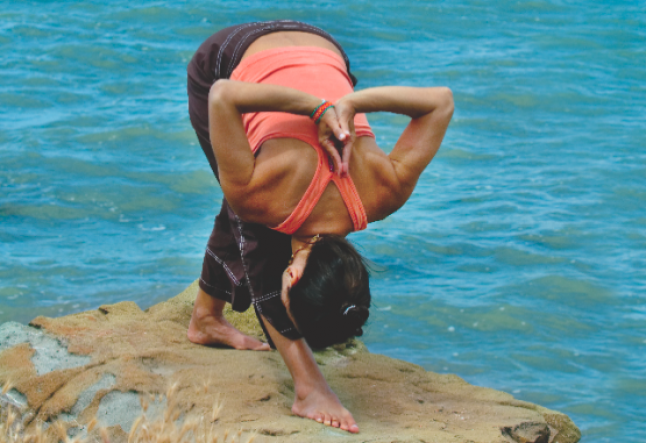
Reverse prayer
Bring your hands behind your back into a prayer position. This adds a shoulder opening component and increases the challenge.
Deeper fold
As flexibility improves, you can fold more deeply while maintaining spinal integrity.
Transition poses
From Pyramid Pose, you can move into Standing Split or Warrior III for a more dynamic sequence.
Contraindications and safety
If you have a hamstring injury, approach this pose gently and avoid deep stretching.
For lower back sensitivity, focus on keeping the spine long and avoid rounding.
If balance is challenging, use support such as a wall or blocks.
Move slowly and avoid forcing the body into position.
Breath and awareness
Your breath is what transforms this pose from a stretch into a practice.
Inhale to lengthen the spine.
Exhale to soften into the pose.
Let your attention rest on the sensation in your legs and the rhythm of your breath. This is where the real work happens.
Pyramid pose in a Yoga sequence
This pose fits naturally into standing sequences.
It pairs well after:
Downward Facing Dog
Low Lunge
Triangle Pose
It prepares you for:
Warrior III
Standing Forward Fold
Half Moon Pose
Related Yoga poses
Triangle Pose (Trikonasana)
Warrior I (Virabhadrasana I)
Warrior III (Virabhadrasana III)
Standing Forward Fold (Uttanasana)
Final thoughts
Pyramid Pose teaches patience. It reminds you that progress in yoga is not about pushing deeper but about moving with awareness.
Some days the pose feels open and steady. Other days it feels tight and demanding. Both are part of the practice.
What matters is how you show up to it.
The hamstring and hip-opening work here overlaps closely with Triangle Pose and the standing-leg strength built in Warrior III, two poses worth practicing alongside this one.
Have a specialty in standing forward folds? Claim Pyramid Pose through Pose for a Cause.
FAQs
Bend your front knee slightly and place a block under your hands to shorten the distance to the floor. Depth will come naturally with consistent practice; it is not the goal on day one.
Yes, keeping the hips square and the weight even between both feet builds real standing balance and stability, even though the pose is a forward fold rather than a one-legged posture.
Pyramid Pose folds over one leg at a time with the hips kept square, which challenges balance and works each side of the body independently, unlike a two-footed forward fold.

Free Wellness E-Book
Find Your Zen!
Your Free Guide
To Wellness
Download Your Free Guide & Receive Weekly Inspirations From The Lifestyle Of a Modern Yogi!